


You can advertise in Superpowers for Good. Click to learn more about our affordable options.

The landscape of Regulation Crowdfunding (Reg CF) continues to mature, proving that retail investors are not just looking for financial returns—they are actively seeking to fund the future they want to live in. Over the past two weeks, we have witnessed the successful closure of eight distinct impact-driven campaigns.
It is important to clarify that these companies did not necessarily raise all of their capital during the past two weeks; rather, they successfully completed and closed their crowdfunding campaigns during this period, culminating in a collective USD 1,759,506.00 raised. From atmospheric water generation to community solar and local bakeries, these offerings provide a fascinating cross-section of where retail capital is flowing in mid-2026.

Superpowers for Good Methodology
Before diving into the data, it is essential to understand how we curate these insights. Each week, Superpowers for Good shares a list of new impact-related offerings added to FINRA-registered crowdfunding portals and by broker-dealers. Using our classification methodology, we highlight offerings with social impact, women in leadership, and underrepresented founder leadership. The eight campaigns analyzed in this report represent the vanguard of community-aligned businesses that have successfully navigated the rigorous journey from launch to successful close.
Visualizing the Data: Where the Capital Flowed
Platform Analysis: Positioning, Strengths, and Audiences
The platform a founder chooses is often as indicative of their strategy as the security they offer. In this cohort, we see a distinct segmentation of platform utility.
StartEngine: The High-Growth Tech Engine
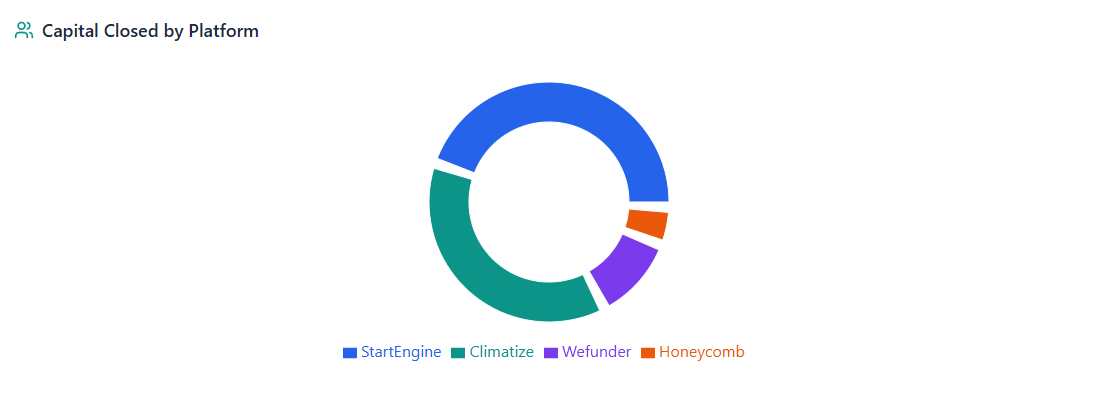
StartEngine captured the largest volume of capital (USD 821,161) across just two offerings: Kara Water and Testament. StartEngine continues to position itself as the premier destination for high-valuation, tech-enabled startups. The investor audience here is typically looking for venture-style returns and is willing to accept the high risks associated with early-stage equity.
Climatize: The Niche Juggernaut
Climatize is proving that niche, thesis-driven platforms are a force to be reckoned with. By focusing exclusively on climate and renewable energy, Climatize closed USD 680,000 across two debt offerings. Their strength lies in a highly engaged, mission-aligned investor base that understands the mechanics of energy infrastructure. For founders in the green energy sector, Climatize offers a concentrated pool of capital that generalist platforms struggle to match.
Wefunder: The Generalist Pioneer
Wefunder facilitated the USD 188,422 raise for Collab’s student housing project. Wefunder remains the most versatile platform, capable of hosting everything from SaaS startups to real estate revenue-share models. Their audience is broad, making it an excellent testing ground for novel financial instruments like real estate revenue sharing.
Honeycomb Credit: The Main Street Champion
Honeycomb Credit continues to dominate the local business and “Main Street” sector. While their total volume (USD 69,923) is smaller, they successfully closed three campaigns (The Noise Floor, Topanga Ridge Group, Voodoo Baking Company). Honeycomb’s superpower is activating local communities to fund the businesses they patronize daily, proving that community capital is a viable alternative to traditional bank loans for small businesses.
Security Type Analysis: Aligning Incentives
The choice of security—Equity, Debt, or Revenue Share—dictates the long-term relationship between founders and their crowd investors.
Debt (Promissory Notes)
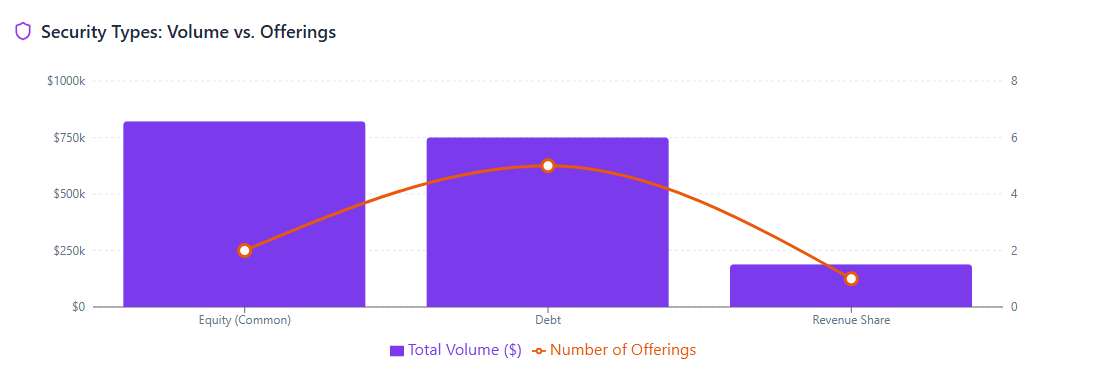
Debt was the most popular instrument by volume of offerings (5 out of 8). For infrastructure projects like the Texas Battery Storage and local businesses like Voodoo Baking Company, debt makes sense. It avoids founder dilution, provides investors with a predictable yield, and aligns perfectly with businesses that have clear paths to cash flow. However, it requires the business to service that debt immediately, which can be risky for pre-revenue startups.
Equity (Common Stock)
Used by Kara Water and Testament, common equity is the classic venture bet. Investors accept total illiquidity and high risk of failure for the chance at exponential returns. For founders, it preserves cash flow in the early years but dilutes their ownership. In 2026, we are seeing retail investors become more sophisticated regarding valuations; Kara Water’s USD 75.35 million valuation requires a massive future exit to generate meaningful returns for this cohort.
Revenue Share
Collab utilized a revenue-share model for its real estate offering. This is a beautiful middle ground. It provides investors with liquidity tied directly to the asset’s performance without burdening the company with fixed debt payments during lean months. For real estate and SaaS, revenue share is becoming the gold standard for Reg CF.
Minimum Investment Analysis: Accessibility vs. Friction
The minimum investment thresholds in this cohort reveal a fascinating dichotomy in crowdfunding strategy.
At the lowest end, Climatize offerings allowed investments as small as USD 10. This hyper-accessible threshold is brilliant for infrastructure projects where the goal is mass mobilization and political buy-in. When a community literally owns a piece of the local solar grid for the price of a cup of coffee, they become fierce advocates for the project.
Honeycomb and Wefunder hovered around the USD 100 mark. This is the “sweet spot” for retail crowdfunding—low enough to be an impulse decision for a supporter, but high enough to keep the cap table manageable and transaction fees reasonable.
StartEngine offerings set their minimums near USD 500. This creates friction, intentionally filtering out casual supporters to attract more serious retail investors. While it reduces the total number of investors, it often leads to a higher average investment size and a more manageable investor relations burden for high-growth startups.
Founder and Investor Psychology: Why These Succeeded
Crowdfunding is not just a financial transaction; it is a psychological alignment between a founder’s vision and an investor’s identity.
Founders who succeed in Reg CF, like Cody Soodeen of Kara Water, excel at storytelling. They don’t just sell a product (a water generator); they sell a solution to a global crisis (water scarcity). Retail investors are attracted to narratives where their capital feels catalytic.
Furthermore, credibility and traction are paramount. Kara Water’s USD 2.2 million in sales and Costco agreement provided the necessary “social proof” to justify their high valuation. Conversely, local businesses like The Noise Floor succeeded through deep community roots. Their investors aren’t looking for a 10x exit; they are looking for a vibrant local music scene. The psychological driver is civic pride, not just financial return.

Impact Investing Analysis: The 2026 Landscape
Impact investing in Reg CF has evolved far beyond simple ESG checkboxes. We are seeing highly specific, localized impact.
Climate Infrastructure: The success of Texas Battery Storage and the East St. Louis solar project proves that retail investors are eager to directly fund the energy transition. They no longer want to just buy green ETFs; they want to own the batteries stabilizing the grid.
Community and Mental Health: Topanga Ridge Group’s success highlights a growing trend of funding alternative mental health and wellness models. As traditional healthcare systems face strain, retail capital is flowing into community-based, holistic wellness centers.
Faith and AI: Testament represents a fascinating intersection of artificial intelligence and spiritual continuity. It shows that impact isn’t just environmental; it can be deeply personal and cultural, preserving family histories and faith traditions through modern tech.
Featured Offering Analysis: Deep Dives
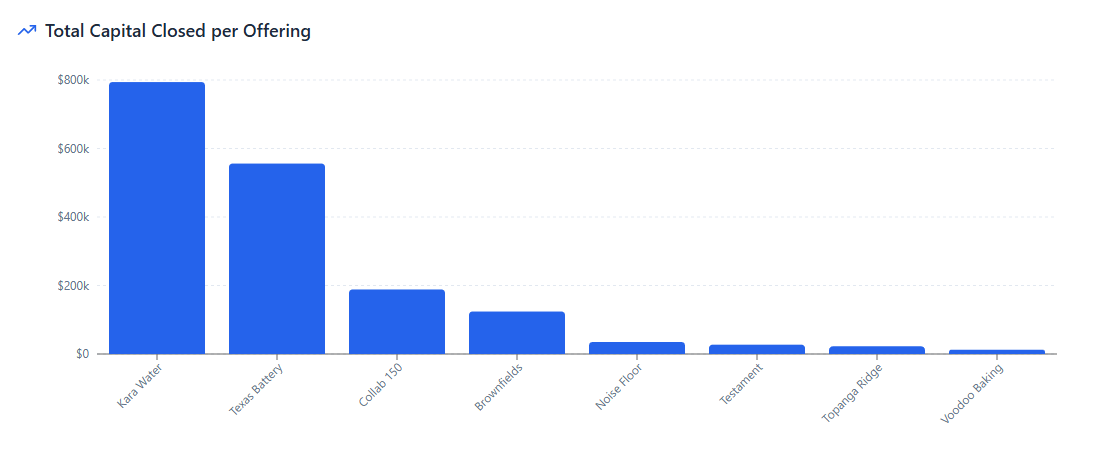
Kara Water (USD 793,955 Raised)
Kara Water is the blockbuster of this cohort. The combination of hardware innovation, a massive total addressable market (clean water), and tangible traction (Costco partnership) created a perfect storm for retail investors. The risk here is the valuation—at over USD 75 million, the company will need to achieve massive scale to provide a venture-scale return. However, the sheer volume raised shows that investors believe in the founder’s ability to execute.
Texas Battery Storage Portfolio (USD 556,000 Raised)
This offering is a masterclass in retail infrastructure funding. By breaking down a 9.9 MW project into crowdfunded debt, Green Bridge Corporation bypassed traditional, slow-moving institutional capital. Operating in ERCOT’s volatile market provides clear revenue potential through energy arbitrage. This is the future of grid resilience: decentralized, community-funded batteries.
Collab - 150 Panoramic Way (USD 188,422 Raised)
Collab is democratizing real estate. By allowing retail investors to buy into a UC Berkeley student housing property, they are breaking down the walls of traditional real estate syndication. The 100% occupancy rate and 4x rental growth provided the risk mitigation retail investors needed to participate.
Market Predictions and Trends
As we look at the remainder of 2026, several trends are clear:
The Rise of Retail Infrastructure: The success of Climatize proves that retail investors will fund heavy infrastructure if the platform makes it accessible. Expect to see more community-funded microgrids, EV charging networks, and water treatment facilities.
AI in Due Diligence: As seen with the sophisticated retail investor base, AI tools are increasingly being used by the crowd to analyze valuations, read through Form C filings, and assess market risks. Founders must be prepared for a more highly educated retail investor.
Debt as the Dominant Main Street Tool: Platforms like Honeycomb will continue to eat into traditional small business lending. For local businesses, the marketing value of a crowdfunding campaign combined with a fair interest rate is vastly superior to a faceless bank loan.
The USD 1.75 million closed across these eight campaigns in the last two weeks is more than just a financial metric; it is a barometer of retail sentiment. Investors are deploying capital with incredible intentionality—funding clean water, stabilizing power grids, supporting local music, and democratizing real estate. For founders, the message is clear: if you can combine a rigorous business model with a compelling, community-aligned narrative, the crowd is ready and willing to fund your vision.

SuperCrowd Investment Directory
Search our Database of 200+ Devin’s Impact Pick of the Week Offerings and Preliminary Diligence Reports on New Offerings

We’ve created a new perk for our Impact Members: a searchable directory of live offerings. To be clear, the database isn’t yet complete, but already includes almost 300 offerings, including a bunch that met the screening requirements to be chosen as one of “Devin’s Impact Pick of the Week” selections.
Each investment offering on the list is open to all investors with no wealth or expertise test. We’ve also prepared a due diligence review—either preliminary or detailed as one of my weekly impact picks. Check it out and let us know what you think.
Disclaimer:
This article is for informational and educational purposes only. It does not constitute financial advice, investment advice, or a recommendation to buy or sell any securities. Crowdfunding investments are speculative, illiquid, and carry a high degree of risk, including the total loss of principal. Past performance is not indicative of future results. Investors should conduct their own due diligence and consult with financial advisors before making investment decisions.
Support Our Sponsors
Our generous sponsors make our work possible, serving impact investors, social entrepreneurs, community builders and diverse founders. Today’s advertisers include PurposeBuilt100™, High Desert Gear, and Climatize. Learn more about advertising with us here.
Max-Impact Members
(We’re grateful for every one of these community champions who make this work possible.)
Brian Christie, Brainsy | Cameron Neil, Lend For Good | Carol Fineagan, Independent Consultant | Hiten Sonpal, RISE Robotics | John Berlet, CORE Tax Deeds, LLC. | Justin Starbird, The Aebli Group | Lory Moore, Lory Moore Law | Marcia Brinton, High Desert Gear | Mark Grimes, Networked Enterprise Development | Matthew Mead, Hempitecture | Michael Pratt, Qnetic | Mike Babbit | Coledger Solutions | Mike Green, Envirosult | Nick Degnan, Unlimit Ventures | Dr. Nicole Paulk, Siren Biotechnology | Paul Lovejoy, Stakeholder Enterprise | Pearl Wright, Global Changemaker | Scott Thorpe, Philanthropist | Sharon Samjitsingh, Health Care Originals
Upcoming SuperCrowd Event Calendar
If a location is not noted, the events below are virtual.
Join the SuperCrowd Impact League! You can be recognized for making impact investments via Reg CF. See how your activity compares to your peers. It’s free. Win valuable prizes. Start now!
SuperCrowd Impact Member Networking Session: Impact (and, of course, Max-Impact) Members of the SuperCrowd are invited to a private networking session on July 14th at 8:00 PM ET/5:00 PM PT. Mark your calendar. We’ll send private emails to Impact Members with registration details. Upgrade to Impact Membership today!
SuperCrowd26 featuring PurposeBuilt100™️: This August 25–27, founders, investors, and ecosystem leaders will gather for a three-day, broadcast-quality global experience focused on disciplined capital formation, regulated investment crowdfunding, and purpose-driven growth. We’re bringing together leading voices in impact investing, compliance, digital marketing, and circular economy innovation to deliver practical frameworks, real-world case studies, and actionable strategies. The event culminates in the PurposeBuilt100™️ Showcase, recognizing 100 of the fastest-growing purpose-driven companies in the U.S. Register now to secure your seat and get all the details. August 25–27, streaming worldwide.
Share the application for the PurposeBuilt100™: Purpose-driven founders deserve recognition. The PurposeBuilt100™ application window is now open—celebrating the fastest-growing companies building profit with purpose. If you know a founder creating real impact and real growth, please share this opportunity. Applications are free and confidential. Explore the program and apply today: PurposeBuilt100.com.
Community Event Calendar
Successful Funding with Karl Dakin, Tuesdays at 10:00 AM ET - Click on Events.
Register Now! October 20th and 21st will be the Crowdfunding Professional Association Regulated Investment Crowdfunding Summit for 2026. This is the event of the year for everyone in the crowdfunding ecosystem.
If you would like to submit an event for us to share with the 10,000+ changemakers, investors and entrepreneurs who are members of the SuperCrowd, click here.
We utilized AI to efficiently gather data and analyze key success factors, enabling us to deliver an overview of these successful crowdfunding campaigns.
We share educational information—not investment advice. Some links may generate compensation. See our full disclosure.