


You can advertise in Superpowers for Good. Click to learn more about our affordable options.

The landscape of Regulation Crowdfunding (Reg CF) has matured from an experimental alternative financing mechanism into a cornerstone of institutional-grade retail capital formation. In this comprehensive market analysis, we evaluate a diverse cohort of eight impact-driven campaigns that successfully closed their investment offerings last week, collectively representing $1,868,616.00 in historic community-sourced funding.
Important Analytical Note: It is critical for investors, founders, and market observers to note that the capital totals detailed within this article were not raised exclusively within the last week. Rather, these figures reflect the culmination of multi-month campaign cycles that officially completed and successfully closed their offerings during this past week’s window. This distinction is vital for understanding the true velocity and lifecycle of Reg CF campaigns, which rely on sustained community building and structured marketing funnels rather than instantaneous capital injections.
From high-throughput AI robotics and decentralized cross-border banking to regional artisanal incubators and Main Street consumer staples, this cohort illustrates the profound democratization of private equity. By unpacking the platform distributions, financial instruments, founder profiles, and investor psychology underpinning these closed offerings, we provide an actionable blueprint for stakeholders navigating the modern capital ecosystem.
Superpowers for Good Methodology
To contextualize this analysis, it is essential to outline the rigorous frameworks used to identify and categorize these offerings.
Each week, Superpowers for Good shares a list of new impact-related offerings added to FINRA-registered crowdfunding portals and by broker-dealers. Using our classification methodology, we highlight offerings with social impact, women in leadership, and underrepresented founder leadership.
The campaigns analyzed herein represent businesses that have successfully transitioned from this initial pipeline through the grueling operational gauntlet of a live campaign to a successful legal and financial close last week.
The Closed Cohort: A Data Overview
The following data represents the definitive financial outcomes for the set of campaigns closing their offerings during last week’s weekly window:

Platform Analysis: The Battlefield of Community Capital
The performance of these closed campaigns varies widely by the platform chosen to host the offering. Funding portals are no longer passive bulletin boards; they have evolved into distinct ecosystems characterized by unique investor demographics, varying levels of institutional curation, and highly specific brand alignments.
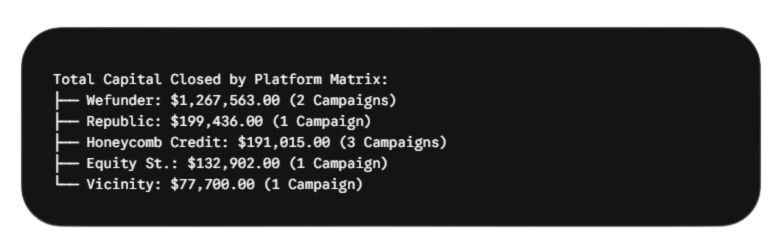
Wefunder: The Scale Aggregator for Hyper-Growth and Consumer Sub-Brands
Accounting for over 67% of the total capital closed in this cohort ($1,267,563.00 across just two offerings), Wefunder continues to demonstrate its dominance in the Reg CF market. Wefunder’s positioning leans heavily into democratizing venture-scale outcomes and high-affinity consumer brands.
The platform’s massive embedded investor base is uniquely responsive to clear product-market traction and cultural relevance. This environment proved ideal for Wild Rye (technical outdoor apparel) and p!ng (robotic coffee drive-thrus). Wefunder excels at hosting campaigns that require cross-over appeal: companies that can transform traditional consumers into financial evangelists. The platform’s UI emphasizes the human narrative behind the company, making it highly effective for founders who can articulate a compelling vision of the future.
Republic: The Institutional-Grade Portal for Global Tech and Web3 Innovation
Closing $199,436.00 with Anodos Labs, Republic occupies a distinct niche in the crowdfunding architecture. Republic has intentionally positioned itself as an institutional-retail hybrid marketplace.
Its investor base skews heavily toward tech-savvy, forward-looking individuals interested in deep tech, fintech, and cross-border software solutions. The platform’s infrastructure supports complex compliance frameworks, making it the preferred choice for companies like Anodos Labs that operate at the intersection of AI, privacy, and decentralized finance. Republic’s audience responds less to emotional local narratives and far more to institutional validation, such as accelerator pedigree (e.g., Tenity), ecosystem grants (e.g., Ripple), and enterprise partnerships.
Honeycomb Credit: The Main Street Debt Engine
With three distinct campaign closures last week (5 Generation Bakers, The Upper Crust, and Scandinavian Market), Honeycomb Credit closed a combined $191,015.00. Honeycomb’s market specialization is narrow, deep, and incredibly resilient: regional brick-and-mortar small businesses seeking non-bank debt.
Honeycomb’s positioning completely bypasses the venture-scale hype cycle. Instead, it focuses on physical community assets, tangible products, and immediate yield through structured debt payments. The investor audience here is fundamentally different from Wefunder or Republic. These are local patrons, neighborhood advocates, and income-focused investors who value the preservation of community infrastructure and visible local job creation over theoretical future liquidations.
Equity St. and Vicinity: The Rise of Bespoke Vertical Platforms
The final two platforms, Equity St. ($132,902.00 closed for Bernadette, The Musical) and Vicinity ($77,700.00 closed for Mathom House), highlight the growing fragmentation and specialization within Reg CF.
Equity St. focuses on entertainment, media, and alternative asset monetization. It provides a structured space for high-net-worth individuals and retail fans to invest directly in intellectual property and theatrical distributions.
Vicinity operates as a hyper-regional marketplace dedicated to localized wealth building. It targets specific geographical hubs (such as the Carolinas) to cultivate ecosystems where local capital stays within the local economy to fund creative real estate and maker incubators.
Security Type Analysis: The Financial Engineering of Impact
A founder’s choice of security type is one of the most reliable indicators of their long-term capitalization strategy, risk profile, and alignment with their investor base. The closed cohort features a sophisticated split across four distinct financial structures: SAFEs, Common Equity, Revenue Shares, and Debt.
Simple Agreements for Future Equity (SAFEs)
Utilized by: Wild Rye, p!ng
Founder Incentives: High. SAFEs defer complex valuation conversations to a future priced equity round, minimizing upfront legal costs and preventing immediate dilution. This allows founders to focus entirely on growth rather than cap-table engineering.
Investor Risks: Substantial. Investors do not hold actual equity until a qualifying pricing event occurs. If the company is acquired, goes public, or raises a priced round, the SAFE converts; if the company grows organically through cash flow without an exit event, the investor may remain illiquid indefinitely.
Long-Term Alignment: Aligned toward massive scale. This structure forces both founders and investors to pull in one direction: achieving a massive venture-scale liquidity milestone.
Common Equity
Utilized by: Anodos Labs
Founder Incentives: Moderate. Issuing common equity requires an immediate, definitive valuation calculation (Anodos Labs closed last week at a $21.8 million valuation). While it creates an immediate dilution hit, it avoids the compounding debt-like liabilities of unpriced SAFEs.
Investor Risks: High asset risk, low structural risk. Investors own a literal piece of the company from day one. They are subject to dilution from future rounds, but they possess fundamental shareholder rights, which offers greater transparency than a SAFE.
Long-Term Alignment: Highly balanced. Both parties share the exact same financial upside and downside on a pro-rata basis, cementing a traditional corporate alignment.
Revenue Share Agreements
Utilized by: Bernadette, The Musical; Mathom House
Founder Incentives: High for cash-flowing, non-venture-scale enterprises. Founders preserve 100% of their equity and long-term control. The repayment obligation scales dynamically based on top-line performance, protecting the company during seasonal downturns.
Investor Risks: Tied directly to operational execution and top-line health. If the business experiences low sales velocity, the investor’s payback period extends dramatically. However, it offers a clear path to liquidity without needing a corporate sale or IPO.
Long-Term Alignment: Excellent for steady-state lifestyle or creative businesses. Investors receive payouts as the business succeeds day-to-day, eliminating the conflict between a community-focused founder who wants to keep their business small and investors who want an exit.
Structured Debt
Utilized by: 5 Generation Bakers, The Upper Crust, Scandinavian Market
Founder Incentives: High for mature, predictable businesses. It allows founders to access capital to purchase equipment or inventory without giving away ownership or control. Payouts are predictable and fixed.
Investor Risks: Credit and default risk. Unlike revenue share models, debt requires fixed monthly or quarterly payments regardless of revenue performance. If the business fails, crowdfunding debt holders frequently rank behind senior institutional lenders.
Long-Term Alignment: Purely transactional. Investors act as a decentralized community bank. The relationship is clearly bounded by time and interest rates, allowing the business to retain its autonomy once the note is fully amortized.

Featured Offering Analysis: Case Studies in Crowdfunding Success
To understand exactly how these dynamics manifest in the real world, we dive deep into the standout campaigns from the cohort that closed last week. Each demonstrates a unique mastery of narrative engineering, operational execution, and community alignment.
Case Study 1: Wild Rye – The High-Affinity Consumer Brand Playbook

The Narrative & Market Opportunity
Founded by Cassie Abel, Wild Rye addresses a historical blind spot in the multi-billion-dollar outdoor apparel market: technical gear designed specifically for women. For decades, the industry relied on the “shrink it and pink it” strategy—taking men’s gear, scaling down the sizing, and changing the color palette. Wild Rye built its entire brand around specialized fit, high-performance fabrics, and a community-first approach to outdoor adventure.
Deconstructing the Crowdfunding Success
Wild Rye’s successful campaign close highlights the immense power of omni-channel validation. Prior to closing its offering on Wefunder, the brand secured distribution across 75 specialty retailers, spanning over 300 storefronts, alongside major media coverage in publications like Forbes and Outside.

By the time the campaign officially wrapped last week, retail investors weren’t just funding a theoretical concept. They were investing in an established operational footprint with proof of product-market fit. By utilizing a democratic $100 minimum investment, Wild Rye transformed its digital community and customer base into active shareholders. These brand-advocates-turned-investors now have a clear financial incentive to champion the company’s retail products.
Case Study 2: p!ng – Deep Tech Meets Main Street Friction

The Superpowers for Good Connection
We are incredibly proud to note that founders Jane Lo and Rob Whitten, along with this groundbreaking offering, were recently featured on the Superpowers for Good show. Hosting them allowed us to dig deep into their vision of community-scale automation and witness firsthand the dedication that drove this campaign to a successful close last week. For a comprehensive look at their background, operational journey, and technical insights, you can view their featured appearance below:
The Narrative & Market Opportunity
Founded by Jane Lo and Robert Whitten, p!ng sits at the intersection of high-throughput robotics, AI, and commercial food automation. The company is taking aim at the modern drive-thru experience. By replacing human-managed beverage lines with 24/7 automated robotic pods, p!ng aims to eliminate order errors, reduce staffing overhead, and deliver custom-brewed coffee at high speeds the moment a customer arrives.
Deconstructing the Crowdfunding Success
p!ng’s campaign resonated deeply because it addresses a highly visible everyday problem: the inefficiency of the morning drive-thru. While deep tech and robotics can sometimes feel abstract to retail investors, anchoring that technology to a daily ritual like buying coffee makes the business instantly relatable.
The campaign’s success was driven by a clear validation strategy: the promise of an elegant mobile app experience combined with 24/7 autonomous retail units. Investors were willing to back an aggressive $19 million valuation because the cost efficiencies and scaling potential of automated robotics offer a clear path to high margins and rapid market expansion.
Case Study 3: Anodos Labs – Building the Infrastructure for a Borderless Economy

The Narrative & Market Opportunity
Panagiotis Mekras and Peter Condilis launched Anodos Labs to build a privacy-focused, AI-powered banking experience tailored for digital nomads, international professionals, and cross-border businesses. Operating under the banner of “banking as a lifestyle,” Anodos aims to decouple traditional financial services from rigid geographical restrictions. The platform prioritizes user sovereignty, data privacy, and frictionless global asset movement.
Deconstructing the Crowdfunding Success
Anodos Labs approached its Reg CF campaign with an exceptional level of institutional validation. Rather than relying on conceptual promises, the founders highlighted a robust ecosystem of strategic backing:
Grants & Accelerators: Recipient of a Ripple grant and alumnus of the Tenity accelerator.
Infrastructure Partners: Formed core technical integrations with Palisade, Axelar, Fairmint, and Schuman Financial.
This layer of institutional validation helped convince retail investors to support a premium $21.8 million valuation before the offering successfully closed last week. By issuing Common Equity instead of a SAFE, Anodos provided immediate ownership alignment, which appealed directly to Republic’s sophisticated, tech-forward investor base.
Case Study 4: Bernadette, The Musical – Democratizing Entertainment IP

The Narrative & Market Opportunity
Founded by Pierre Ferragu, Bernadette, The Musical is a commercial theatrical property based on the life of Bernadette Soubirous. After building a successful track record and large audiences across Europe, the production team launched a campaign to fund its upcoming U.S. premiere in the fall of 2025. The production features a high-profile creative team, including producer Kelsey Grammer and director Serge Denoncourt.
Deconstructing the Crowdfunding Success
Historically, investing in commercial theater was an exclusive club restricted to ultra-wealthy Broadway insiders. Bernadette broke this barrier by utilizing a Revenue Share model on Equity St., allowing retail fans to acquire a direct profit-share interest in the operating entity.
The campaign succeeded by combining the emotional pull of a classic story with institutional entertainment pedigree. For investors, the risk of a new, unproven theatrical production was mitigated by the show’s documented track record in Europe. This combination of creative validation and structured revenue participation created a highly compelling offering for alternative asset investors looking at last week’s closes.
Case Study 5: Mathom House – The Regional Creative Incubator

The Narrative & Market Opportunity
Based in Greenville, South Carolina, and founded by Will Donovan, Mathom House serves as a community hub and business incubator for ceramicists, potters, and independent makers. The space blends shared workspaces, educational facilities, a retail storefront, and an integrated cafe. By pulling together creative resources under one roof, Mathom House provides regional makers with the infrastructure needed to turn their art into sustainable businesses.
Deconstructing the Crowdfunding Success
Mathom House stands out for its unique approach to investor composition. While most campaigns in the weekly cohort prioritized low investment barriers, Mathom House implemented a higher $1,000 minimum investment.
This decision filtered for a smaller, highly committed group of local stakeholders. By offering a Revenue Share structure, the company aligned its returns directly with the physical growth of the studio, cafe, and retail shop. The campaign succeeded because it tapped into a powerful regional desire for community wealth-building, showing that local investors are increasingly eager to fund the physical and cultural spaces that define their hometowns.

Founder and Investor Psychology: The Anatomy of the Crowd
Successful crowdfunding is rarely just a function of clean spreadsheets and efficient financial models; it is an exercise in human psychology, community mobilization, and trust architecture.
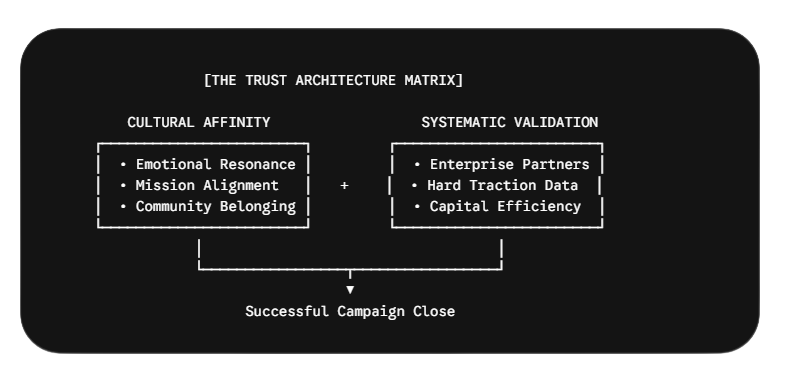
The Founder Alpha: Why Certain Campaigns Cross the Line
Founders who successfully close their Reg CF campaigns share several key characteristics:
Radical Transparency and Credibility: In the retail landscape, investors lack the resource access of institutional venture capitalists to run comprehensive operational audits. Instead, they look for signals of founder integrity and domain expertise. Founders who engage openly in public Q&A forums, share detailed monthly progress reports, and address business risks head-on build a distinct trust premium.
The Power of Ecosystem Traction: The crowd rarely likes to be the first check in the door. The most successful founders leverage early traction—such as institutional grants, accelerator pedigrees, or retail distribution wins—to generate initial momentum. This creates a powerful fear of missing out (FOMO) among retail investors as the campaign approaches its final close.
Narrative Design and Shared Identity: Great equity crowdfunding campaigns frame the investment as an invitation to help build a shared future. For example, Wild Rye didn’t just sell outdoor clothing; they invited women to invest in a movement for inclusivity in the outdoors. This shift transforms a purely financial transaction into a powerful badge of shared identity.
The Retail Investor Mindset: Navigating the Double Bottom Line
Understanding why everyday investors allocate capital to these campaigns requires looking past simple portfolio diversification:
Relatable Utility: Retail investors lean heavily toward businesses whose everyday utility is easily understood. A robotic drive-thru or a local bakery franchise provides an intuitive business model that makes investors feel confident in their ability to evaluate the opportunity.
Direct Local Impact: There is a growing desire among retail investors to bypass Wall Street intermediaries and deploy their capital directly into communities. Investing in a local main-street asset provides a tangible return on impact that cannot be matched by public market equities.
Social and Cultural Capital: Owning shares in an innovative startup, a feature film, or an eco-friendly brand offers a form of cultural currency. Retail investors value the ability to share these investments within their social circles, transforming their portfolios into an expression of their personal values.
Minimum Investment Analysis: Accessibility vs. Cap Table Dynamics
A subtle but critical point of optimization in any crowdfunding campaign is setting the minimum investment threshold. The cohort that closed last week exhibits a clear divide, with most companies selecting a low entry barrier ($100 to $250) and a single outlier choosing a higher threshold ($1,000).
The $100 Threshold: Maximum Democratization and Scale
Setting the entry bar at $100 aims to eliminate as much friction as possible. By making the investment accessible to almost anyone, founders can rapidly scale their total number of investors. This strategy is highly effective for consumer-facing brands that want to transform everyday customers into active brand advocates.
The core challenge of this approach is managing a large cap table. Fortunately, modern funding portals solve this issue by utilizing Custodial or SPV (Special Purpose Vehicle) structures, which roll thousands of retail allocations into a single legal entity on the cap table. This preserves the company’s clean corporate structure for future institutional venture rounds.
The $1,000 Threshold: Higher Intent and Community Quality
As demonstrated by Mathom House, a $1,000 minimum signals a very different capital formation strategy. This approach intentionally prioritizes investor depth over raw numbers. It filters out casual observers, ensuring that every investor on the roster has meaningful skin in the game.
This dynamic is highly valuable for hyper-local or regional incubator concepts where investors are expected to act as active local advisors, connectors, and strategic partners. While this higher entry barrier slows down initial fundraising momentum, it builds a focused, high-intent investor base that can offer real operational value well after the campaign closes.
Impact Investing Analysis: The Next Frontier of Reg CF
The evolution of Regulation Crowdfunding has fundamentally shifted the nature of impact investing. Historically, impact capital was the exclusive domain of institutional foundations and ultra-high-net-worth family offices. Today, Reg CF acts as a powerful decentralized engine for societal and structural change.
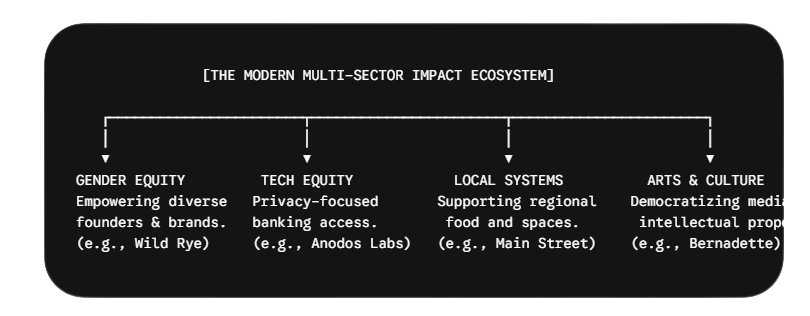
The Expanding Scope of Modern Impact
The current cohort of campaigns that successfully finalized their offerings shows how the definition of “impact” has expanded far beyond simple carbon-offset initiatives:
Gender and Leadership Equity: Companies like Wild Rye show that impact means intentionally designing products for underrepresented demographics while building sustainable, women-led corporate leadership models.
Ethical Tech Infrastructure: Anodos Labs illustrates how impact is moving into our digital architecture. By building financial systems that protect personal privacy and user sovereignty, the company addresses key digital rights concerns in our modern tech landscape.
Local System Resilience: The debt rounds secured by 5 Generation Bakers, The Upper Crust, and Scandinavian Market represent vital investments in local economic infrastructure. Funding these independent regional businesses helps maintain diverse job markets and keeps capital circulating within local communities.
Cultural Infrastructure: Creative spaces like Mathom House and projects like Bernadette highlight the importance of cultural impact. By providing community spaces for independent makers and democratizing access to media investments, these initiatives help sustain vibrant local and creative economies.
The Road Ahead for Impact Crowdfunding
Looking forward, several key structural shifts are poised to shape the future of impact-driven Reg CF:
Rise of B-Corp Alignments: We anticipate a significant increase in companies securing formal B-Corporation certification before launching their crowdfunding campaigns. This framework gives retail investors clear, standardized metrics to evaluate a company’s true social and environmental impact.
Blended Capital Stacks: Future projects will increasingly combine traditional municipal grants and institutional impact funds with democratic Reg CF tranches. This approach allows community capital to act as the vital matching layer that unlocks larger institutional funding.
Direct Carbon Asset Tokenization: The intersection of climate-tech and community finance will likely yield highly structured offerings where retail investors can directly fund local green infrastructure in exchange for yield tied directly to generated carbon credits.
Market Predictions and Trends: Look Ahead into 2026
As we analyze the broader Reg CF data, several definitive trends emerge that are shaping the future of early-stage private capital markets throughout 2026.
The Emergence of the AI-Enhanced Due Diligence Layer
With thousands of active Reg CF campaigns running concurrently across dozens of distinct funding portals, retail investors face a major information scaling challenge. To address this, 2026 is seeing a rapid rollout of automated, AI-driven due diligence tools.
These platforms pull data directly from SEC Form C filings, founder histories, competitive market matrices, and early campaign traction to generate independent, objective risk-reward scores. This technological shift will help level the playing field, giving everyday retail investors access to the same deep analytical capabilities historically reserved for elite venture capital firms.
The Institutionalization of Retail Portfolios
The days of retail investors viewing crowdfunding as a series of isolated, one-off emotional bets are drawing to a close. Investors are increasingly taking a highly structured, portfolio-wide approach to the asset class.
By spreading allocations systematically across various security types—such as balancing high-growth equity SAFEs with steady, yield-generating Main Street debt notes—retail participants are building highly resilient, diversified private market portfolios designed to weather broader macroeconomic shifts.
The Continued Surge of Community-Driven Micro-Syndicates
We are tracking a strong surge in the formation of localized, digital investment syndicates. These are self-organized groups of retail investors who pool their collective research and network capital to back specific verticals—such as climate-tech, women-led brands, or regional real estate. By rallying behind a knowledgeable lead investor, these syndicates can quickly drive large blocks of highly coordinated capital into campaigns, making them a powerful force for founders to engage with during their fundraising journey.
Strategic Actionable Playbooks
The Strategic Blueprint for Founders
For founders preparing to design and launch their own community capital campaigns, the data from this closed cohort offers several clear, actionable lessons:
Build the Foundation Before Launching: Do not treat a crowdfunding platform as a magical source of instant capital. Secure your foundational validation—whether through early wholesale accounts, technical integrations, or institutional grants—before going live. Use your existing momentum to build immediate confidence with the crowd.
Protect Your Long-Term Cap Table Structure: If your ultimate goal is venture-scale expansion, ensure you utilize a platform that supports Custodial or SPV models. This rolls your retail investors into a single line item, keeping your corporate structure clean, organized, and attractive for future institutional funding rounds.
Turn Your Customers into Shareholders: Leverage low minimum investment thresholds ($100 - $250) to transform your digital community into active owners. Give your audience an authentic stake in your success, converting casual buyers into long-term brand ambassadors who will actively champion your products.
The Strategic Playbook for Investors
For impact-focused investors looking to build a resilient, high-yield private market portfolio, this cohort provides an excellent structural guide:
Diversify Across the Capital Stack: Avoid putting all your capital into high-risk, long-horizon SAFEs. Balance your portfolio by allocating capital to immediate, yield-generating instruments like structured debt or revenue-share models to build consistent cash flow.
Look for Outside Institutional Validation: When evaluating high-valuation technology or software companies, look closely at their ecosystem backing. Prioritize teams that have successfully vetted their models through elite accelerators, enterprise partnerships, or reputable grant programs.
Evaluate the Liquidity Path Upfront: Before committing capital, ask a simple structural question: How does this investment actually return cash to my portfolio? Make sure you fully understand the mechanics of the chosen security—whether it requires a venture-scale acquisition to convert or relies on daily gross revenue distributions to pay out.
Final Thoughts: The Maturation of the Crowd
The successful closing of these eight diverse offerings last week demonstrates that Regulation Crowdfunding has firmly outgrown its early reputation as a desperate financing option for unbacked startups. Today, it stands as a sophisticated, efficient, and highly democratic capital marketplace where visionary founders can access non-dilutive debt, flexible revenue shares, and scale-ready equity.
By blending authentic human storytelling with institutional validation and robust financial structures, these companies have turned their user bases into powerful financial engines. As we move further into 2026, the continued growth of community capital formation will keep redrawing the boundaries of early-stage private markets, ensuring that the next generation of impactful innovation is funded directly by the people who believe in it most.
SuperCrowd Investment Directory
Search our Database of 200+ Devin’s Impact Pick of the Week Offerings and Preliminary Diligence Reports on New Offerings

We’ve created a new perk for our Impact Members: a searchable directory of live offerings. To be clear, the database isn’t yet complete, but already includes almost 300 offerings, including a bunch that met the screening requirements to be chosen as one of “Devin’s Impact Pick of the Week” selections.
Each investment offering on the list is open to all investors with no wealth or expertise test. We’ve also prepared a due diligence review—either preliminary or detailed as one of my weekly impact picks. Check it out and let us know what you think.
Disclaimer:
This article is for informational and educational purposes only. It does not constitute financial advice, investment advice, or a recommendation to buy or sell any securities. Crowdfunding investments are speculative, illiquid, and carry a high degree of risk, including the total loss of principal. Past performance is not indicative of future results. Investors should conduct their own due diligence and consult with financial advisors before making investment decisions.
Support Our Sponsors
Our generous sponsors make our work possible, serving impact investors, social entrepreneurs, community builders and diverse founders. Today’s advertisers include SuperCrowd26 featuring PurposeBuilt100™️, Crowdfunding Made Simple, SuperCrowd26 Live Pitch. Learn more about advertising with us here.
Max-Impact Members
(We’re grateful for every one of these community champions who make this work possible.)
Brian Christie, Brainsy | Cameron Neil, Lend For Good | Carol Fineagan, Independent Consultant | Eric Coury, Arthia AI | Hiten Sonpal, RISE Robotics | John Berlet, CORE Tax Deeds, LLC. | Justin Starbird, The Aebli Group | Lory Moore, Lory Moore Law | Marcia Brinton, High Desert Gear | Mark Grimes, Networked Enterprise Development | Matthew Mead, Hempitecture | Michael Pratt, Qnetic | Mike Babbit | Coledger Solutions | Mike Green, Envirosult | Nick Degnan, Unlimit Ventures | Dr. Nicole Paulk, Siren Biotechnology | Paul Lovejoy, Stakeholder Enterprise | Pearl Wright, Global Changemaker | Scott Thorpe, Philanthropist | Sharon Samjitsingh, Health Care Originals
Upcoming SuperCrowd Event Calendar
If a location is not noted, the events below are virtual.
Join the SuperCrowd Impact League! You can be recognized for making impact investments via Reg CF. See how your activity compares to your peers. It’s free. Win valuable prizes. Start now!
SuperCrowd Impact Member Networking Session: Impact (and, of course, Max-Impact) Members of the SuperCrowd are invited to a private networking session on August 11th at 8:00 PM ET/5:00 PM PT. Mark your calendar. We’ll send private emails to Impact Members with registration details. Upgrade to Impact Membership today!
SuperCrowd26 featuring PurposeBuilt100™️: This August 25–27, founders, investors, and ecosystem leaders will gather for a three-day, broadcast-quality global experience focused on disciplined capital formation, regulated investment crowdfunding, and purpose-driven growth. We’re bringing together leading voices in impact investing, compliance, digital marketing, and circular economy innovation to deliver practical frameworks, real-world case studies, and actionable strategies. The event culminates in the PurposeBuilt100™️ Showcase, recognizing 100 of the fastest-growing purpose-driven companies in the U.S. Register now to secure your seat and get all the details. August 25–27, streaming worldwide.
SuperCrowd26 Live Pitch: Apply to pitch at SuperCrowd26 if you now have and anticipate having a live Reg CF offering on August 26, 2026. This is a completely free opportunity to expose your offering to a large audience.
Community Event Calendar
Successful Funding with Karl Dakin, Tuesdays at 10:00 AM ET - Click on Events.
Register Now! October 20th and 21st will be the Crowdfunding Professional Association Regulated Investment Crowdfunding Summit for 2026. This is the event of the year for everyone in the crowdfunding ecosystem.
If you would like to submit an event for us to share with the 10,000+ changemakers, investors and entrepreneurs who are members of the SuperCrowd, click here.
We utilized AI to efficiently gather data and analyze key success factors, enabling us to deliver an overview of these successful crowdfunding campaigns.
We share educational information—not investment advice. Some links may generate compensation. See our full disclosure.