


You can advertise in Superpowers for Good. Click to learn more about our affordable options.
An important clarification before we begin. Every figure in this analysis represents the total amount a campaign closed with, not the amount it raised during the past week. These twelve offerings completed and closed their Regulation Crowdfunding campaigns in the last seven days. Several of them had been open for six months, a year, or longer. Avadain’s campaign did not attract $5 million in a week; it attracted $5 million over the life of an offering that reached its legal ceiling and shut. What happened last week was the closing bell, not the fundraising. We will repeat this distinction where it matters, because the difference between “closed at” and “raised this week” is the single most common misreading of weekly crowdfunding data — and it produces wildly inflated impressions of market velocity.
With that established: twelve impact-related campaigns closed across six FINRA-registered funding portals and broker-dealers, representing $11,802,215 in committed capital. It was, by the standards of any given week in Regulation Crowdfunding, a large number. It was also a deeply misleading one.
How These Offerings Were Selected
Each week, Superpowers for Good shares a list of new impact-related offerings added to FINRA-registered crowdfunding portals and by broker-dealers. Using our classification methodology, we highlight offerings with social impact, women in leadership, and underrepresented founder leadership. This week’s list is a variation on that theme: rather than newly opened offerings, we are examining the twelve impact-classified campaigns that successfully funded and closed during the period.
The distinction matters analytically. New offerings tell you what founders and platforms believe the market wants. Closed offerings tell you what the market actually did. One is a forecast; the other is a result. Results are rarer and more useful, and they are also more honest — a campaign that closes has been tested against real money from real people over real time.
A note on what “successfully funded” means here. Under Regulation Crowdfunding, an issuer sets a minimum target and a maximum target. If the minimum is not met by the deadline, all commitments are cancelled and investor money is returned. Every campaign in this cohort cleared its minimum. That is the bar for “successful.” It is a meaningful bar — plenty of campaigns fail it — but it is a floor, not a ceiling, and as we will see, the distance between a campaign’s floor and its ceiling is one of the most revealing metrics in this entire dataset.
The Shape of the Week
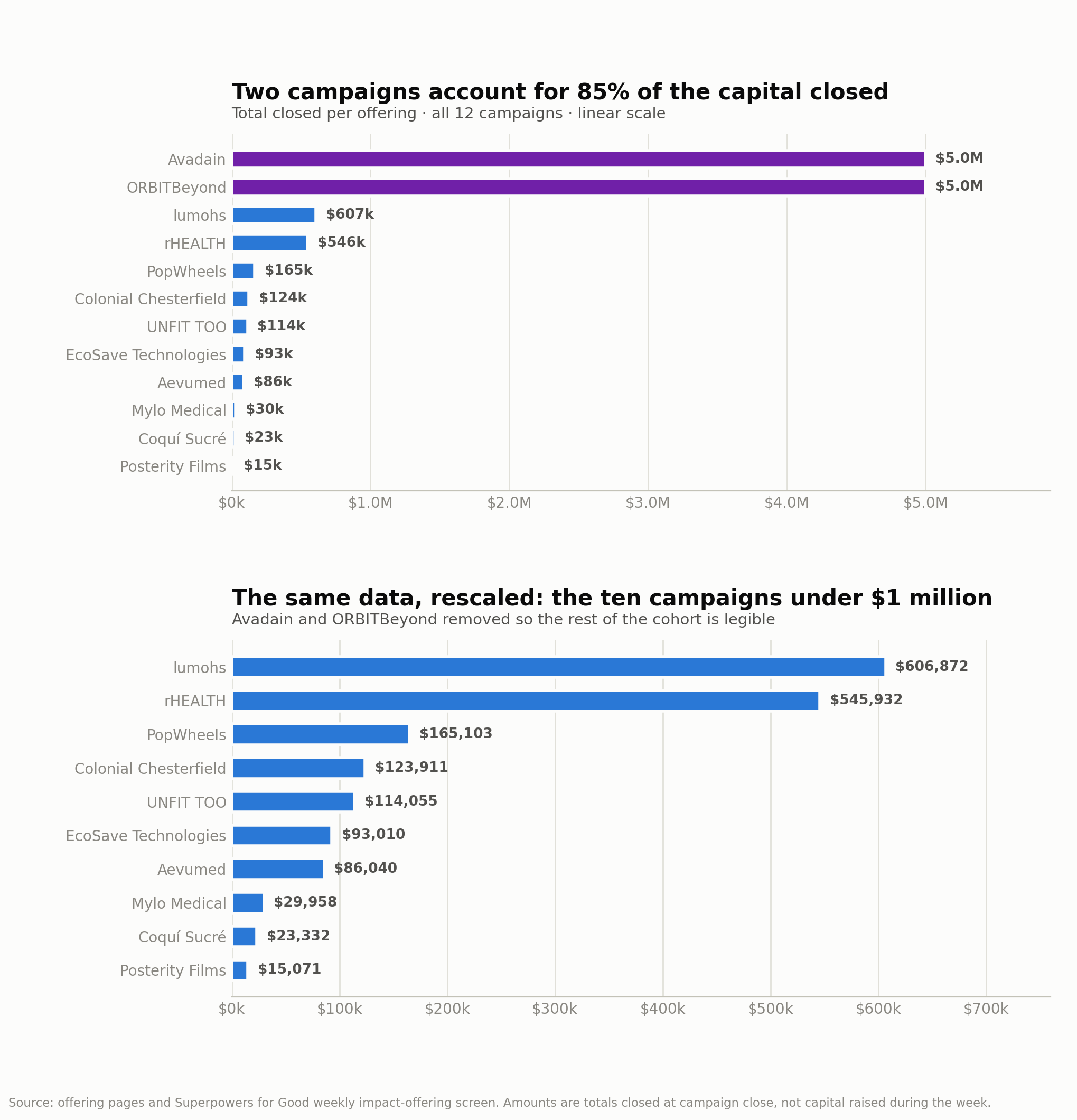
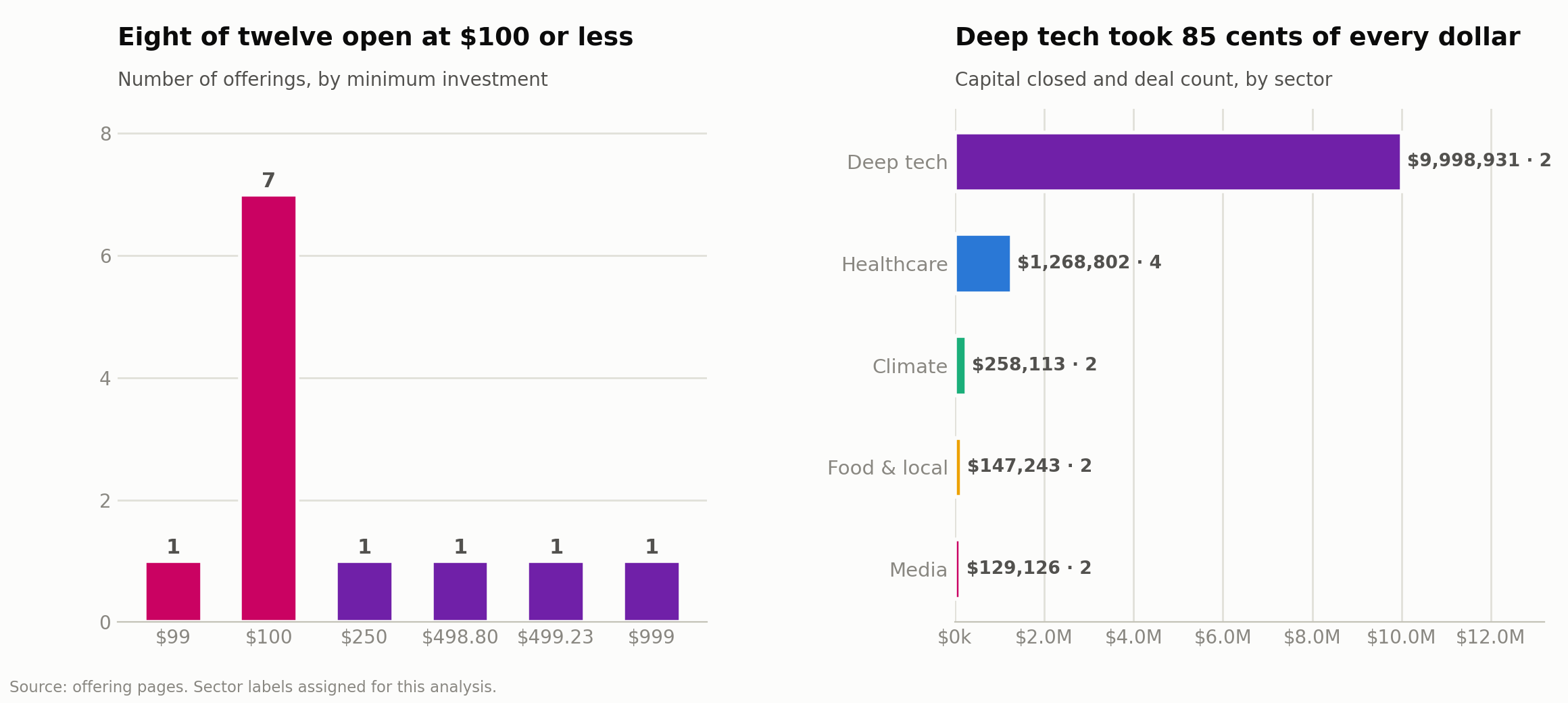
Look at the top panel and the story appears to be about two companies. Avadain closed at $4,999,990 — ten dollars short of the $5,000,000 statutory maximum a Reg CF issuer may accept in any twelve-month period. ORBITBeyond closed at $4,998,941, $1,059 short of the same ceiling. Between them: $9,998,931, or 84.7% of everything closed this week.
These are not demand-limited outcomes. They are law-limited outcomes. Both companies stopped because the federal cap told them to stop, not because investor interest ran out. That is a fundamentally different kind of result from a campaign that closed because it ran out of runway or interest, and it should be read differently. When a campaign finishes at the cap, the number tells you nothing about how much more the crowd would have given. The ceiling censors the data.
The distributional statistics make the concentration concrete. The mean campaign closed at $983,518. The median closed at $118,983. The mean is more than eight times the median — a textbook power-law signature, and a reminder that in crowdfunding, as in venture capital, the average is a fiction that describes almost nobody.
Strip out the two cap-maxed deals and the picture changes character entirely. The remaining ten campaigns closed a combined $1,803,284 — a healthy but unremarkable week, with a top performer at $606,872 and a bottom performer at $15,071. This is what a normal week in impact Reg CF actually looks like: a few six-figure raises, a cluster of five-figure community deals, and a long tail that would be invisible on any chart scaled to accommodate a $5 million outlier.
Founders reading weekly roundups should internalize this. The headline number in any given week is usually one or two deals. If you benchmark your campaign against the headline, you will conclude that you are failing when you are in fact performing at or above the median.
Platform Analysis: Six Portals, Six Different Businesses
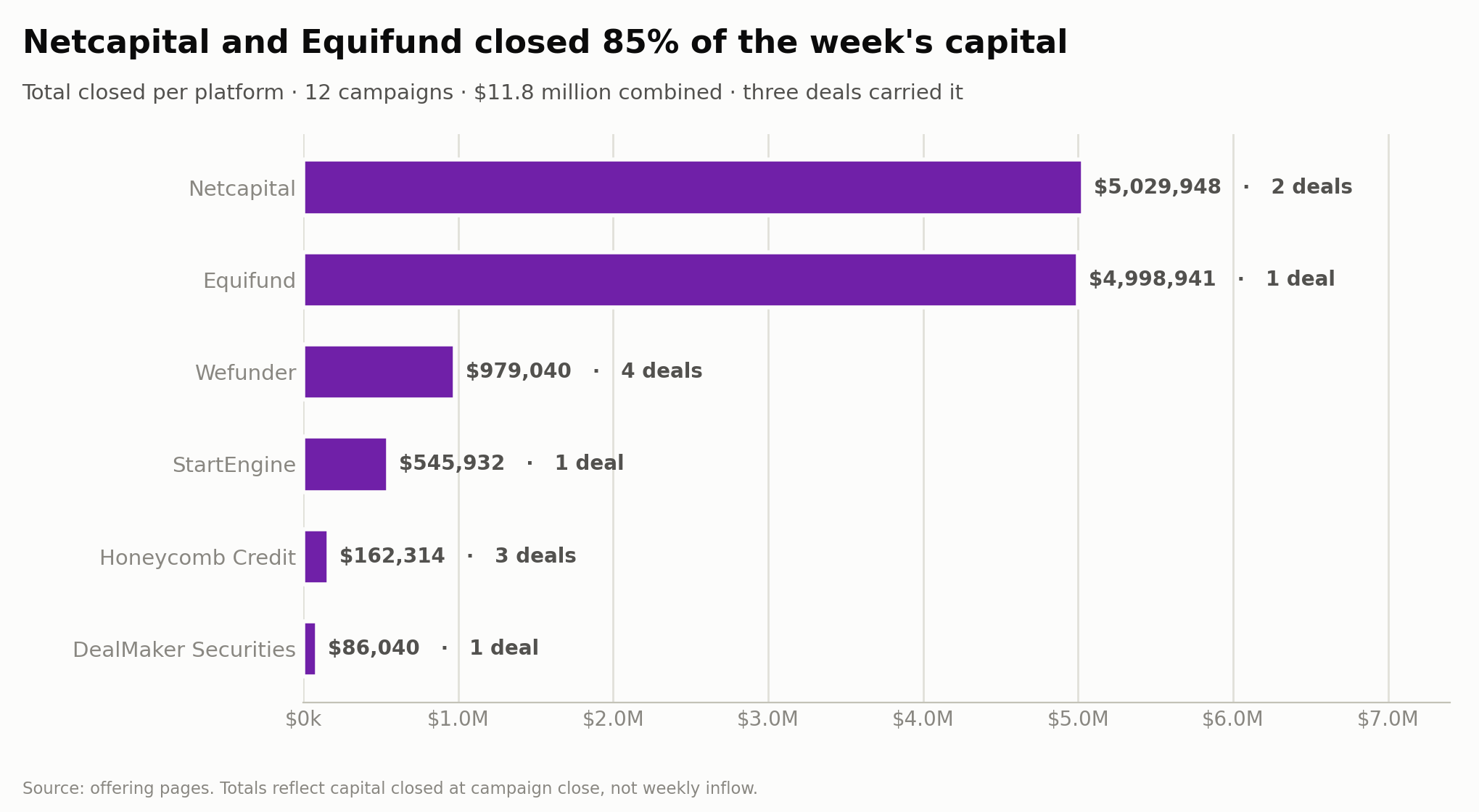
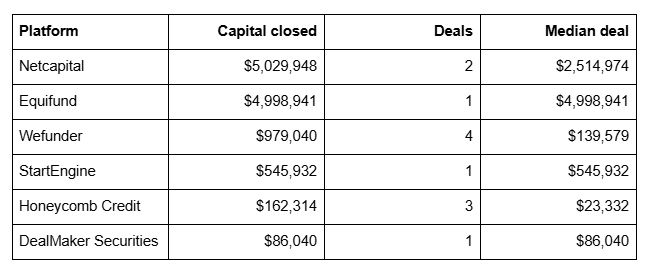
The raw totals are a poor guide to platform quality, because a single cap-maxed deal can swing a portal from last to first in a week. What the table does reveal, read alongside the underlying deals, is that these six businesses are not competing for the same thing.
Netcapital: the deep-tech underwriter
Netcapital closed the week’s largest raise (Avadain, $4,999,990) and one of its smallest (Mylo Medical, $29,958). That spread is not incoherence — it is the signature of a platform that will host a company with a $75.6 million valuation and a licensing agreement with an industrial chemicals manufacturer alongside a first-time founder with a validated prototype and a $6.75 million valuation.
Netcapital’s positioning has increasingly leaned toward technically complex, IP-heavy companies where the investment thesis requires the investor to believe a scientific claim. Avadain is the archetype: the pitch is not “we have customers,” it is “we have solved a materials-science manufacturing problem that others have not.” That requires an audience willing to underwrite technical risk on the strength of patents, third-party validation, and licensing traction rather than revenue multiples.
Best fit: patent-heavy hard tech, materials science, and companies whose credibility rests on institutional or governmental validation rather than consumer traction.
Equifund: the single-thesis, high-conviction house
Equifund appeared once and closed $4,998,941. That is not an accident of sample size — it reflects a model built around fewer, larger, more heavily marketed offerings with substantial investor-education infrastructure around each one.
ORBITBeyond’s raise is instructive. A lunar logistics company with a first mission planned for 2029–30 is asking retail investors to underwrite a nine-figure vision on a five-year horizon with no revenue and no product in market. That is a very hard sell without sustained narrative investment — long-form content, webinars, sequenced email education. Equifund’s structure is built for exactly that: fewer deals, deeper campaigns.
Best fit: ambitious, narrative-driven companies with long time horizons and a story that rewards sustained explanation. Founders who cannot commit to months of investor education should look elsewhere.
Wefunder: the volume and community platform
Wefunder closed four of the twelve deals — the most of any platform — for $979,040, with a median of $139,579. That profile is the whole thesis: breadth, accessibility, and a large standing base of retail investors who browse.
The four deals could not be more different from one another: a dermaplaning device maker (lumohs, $606,872), a battery-swapping network (PopWheels, $165,103), a political documentary (UNFIT TOO, $114,055), and a water-filtration company (EcoSave, $93,010). Two SAFEs, one preferred equity, one revenue share. Wefunder is the only platform in this cohort that hosted more than two security types in a single week.
That versatility is Wefunder’s genuine competitive advantage and also its structural weakness. A founder gets access to the largest retail audience in the category and a flexible instrument menu — but competes for attention against hundreds of live campaigns. Wefunder rewards founders who bring their own crowd. It is a distribution amplifier, not a distribution substitute.
Best fit: consumer-facing and community-anchored companies, founders with an existing audience, and anyone who needs instrument flexibility.
StartEngine: the scaled retail brand
StartEngine’s single deal was rHEALTH at $545,932 — a NASA-validated diagnostics company with 17 issued patents and a $99.8 million valuation. StartEngine’s advantage is a very large, habituated retail investor base that has invested before and will invest again, plus brand recognition that reduces friction for first-time investors.
The trade-off is signal-to-noise. On a platform with a large catalog and a highly transactional audience, differentiation comes from category legibility. “Space-validated blood test” is legible in a way that “precision-engineered dermaplaning workflow” is not.
Best fit: companies with an instantly graspable consumer or health hook and a validation credential (NASA, FDA pathway, major partner) that can be stated in one line.
Honeycomb Credit: the local-economy lender
Honeycomb closed three deals for $162,314 — the smallest capital total, the second-highest deal count, and by some distance the most interesting performance in the cohort.
All three were debt. All three were local, place-based businesses: a living-history farm in Oak Glen, California; a fusion patisserie in Rio Grande, Puerto Rico; a documentary production company in Grand Rapids, Michigan. And all three closed at or near their stated maximums — 99.9%, 93.3%, and 60.3% respectively.
Honeycomb is not trying to be a venture platform, and reading it against venture benchmarks misses the point entirely. It is community lending infrastructure with a securities wrapper. The investor is not underwriting a 100x outcome; they are underwriting a business they can visit, at a stated interest rate, on a defined term. That is a completely different psychological contract, and it produces completely different completion behavior.
Best fit: revenue-generating local businesses with a geographic community, a defined use of proceeds, and no realistic equity exit.
DealMaker Securities: the broker-dealer route
Aevumed’s $86,040 came through DealMaker Securities, a registered broker-dealer rather than a funding portal. The distinction is regulatory and practical: broker-dealers can support concurrent Reg D offerings and give issuers more control over the raise architecture, at the cost of more compliance overhead and typically higher minimums. Aevumed’s $999 minimum — the highest in this cohort by a factor of two — reflects that positioning.
Best fit: companies running a Reg CF alongside an institutional round, or those wanting to own their investor funnel rather than rent a platform’s audience.
What the platform data actually tells founders
The instinct to pick the platform with the biggest weekly number is exactly backwards. A better sequence:
Start with your security. If you are raising debt, Honeycomb and its peers are the market. If you are raising a SAFE, Wefunder is the deepest pool. That decision eliminates most of the field before you compare brands.
Then match your credibility type. Technical validation → Netcapital. Consumer legibility → StartEngine. Community proximity → Honeycomb. Narrative depth → Equifund. Existing audience → Wefunder.
Then ask what you bring. Every platform’s marketing implies it will find you investors. In practice, platforms amplify an existing crowd far more reliably than they manufacture one. The founders in this cohort who hit their ceilings brought something with them — a licensing partner, a NASA credential, a customer base, a town.
Security Type Analysis: Five Structures, Five Different Promises
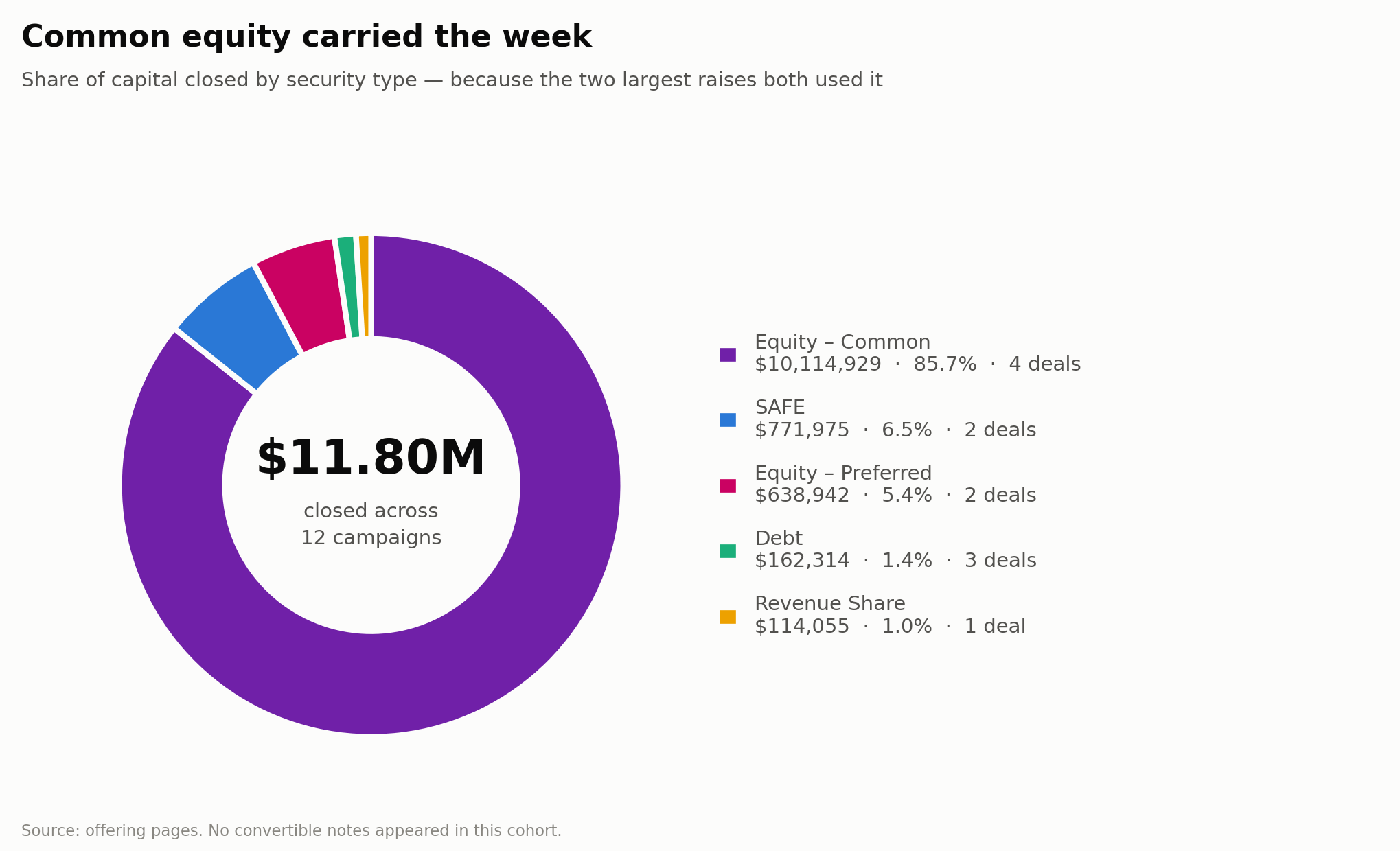
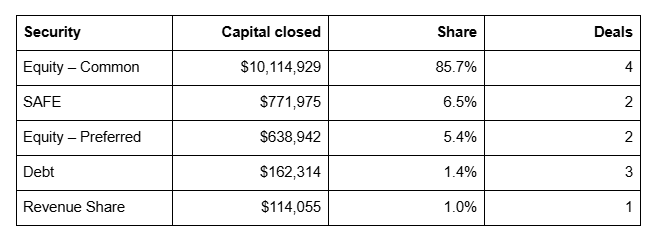
Read the deal counts rather than the dollars and the picture inverts. Common equity’s 85.7% is entirely a function of Avadain and ORBITBeyond both using it and both hitting the cap. By count, the cohort is far more evenly spread — and debt was the second most-used instrument in the week, despite representing 1.4% of the capital.
Note also what is absent: not one convertible note in twelve deals. That is worth pausing on.
Common equity: simple, honest, and quietly expensive
Common stock gives the retail investor the same class of share the founders hold. Its virtue is comprehensibility — no valuation caps, no discount mechanics, no liquidation stack to explain. For a campaign that must convert a first-time investor in a single reading, that clarity is a real conversion asset.
Its cost is that it is the weakest position in the capital structure. Common sits behind every preference in a liquidation, and it is the class most exposed to dilution from every subsequent priced round. An investor buying common at a $75.6 million valuation is making a concentrated bet that the company grows into and past that number before institutional preferred stacks up above them.
For founders, common equity is cleanest when your crowd is genuinely a stakeholder crowd — customers, licensees, believers — and when you do not anticipate a complex preferred stack. It becomes uncomfortable when you later raise institutional money on terms your retail holders will not fully understand and cannot negotiate.
Best suited to: companies with strong non-financial investor motivation, and companies far enough along that a defensible valuation can be stated plainly.
Preferred equity: better protection, more explanation
rHEALTH and EcoSave both used preferred. Preferred typically carries a liquidation preference and sometimes anti-dilution provisions, placing retail investors ahead of common in a downside scenario. For a med-tech company with a long regulatory road — where the distribution of outcomes is genuinely wide — that protection is not decorative.
The trade-off is cognitive load and founder flexibility. Preferred requires explaining a capital stack to people who have never seen one, and it constrains what a founder can offer a future institutional lead who may want the senior position for themselves.
Best suited to: capital-intensive, regulated, long-horizon businesses — medical devices, diagnostics, hard science — where downside protection is a genuine part of the pitch.
SAFEs: founder-friendly, and the least understood instrument in retail
lumohs and PopWheels both used SAFEs, closing $606,872 and $165,103. The SAFE is beloved by founders for good reason: no interest, no maturity, no immediate valuation negotiation, minimal legal cost, and no governance rights transferred.
It is also, in my view, the instrument most likely to produce disappointed retail investors over the next five years — not because it is unfair, but because it is misunderstood. A SAFE is not equity. It is a contractual right to equity upon a triggering event. If no qualifying priced round or liquidity event ever occurs, a SAFE can sit indefinitely, converting nothing, owing nothing, worth nothing on paper and nothing in fact. Many retail investors do not know this. Many believe they have bought shares.
For a company like PopWheels — 50 stations, 1,000 customers, 200,000 swaps in under a year, and an obvious institutional financing path ahead — a SAFE is well-matched to reality. For a company with no realistic priced-round trajectory, a SAFE is a promise whose trigger may never arrive.
Best suited to: early-stage companies with a credible line of sight to an institutional priced round. Poorly suited to: businesses that will grow profitably without ever raising a Series A, which describes a large share of impact companies.
Debt: the most honest instrument in the room
Honeycomb’s three deals were all debt, and they produced the highest completion ratios in the cohort. That is not a coincidence.
Debt makes an explicit, dated, arithmetic promise: principal plus interest, on a schedule. The investor knows what success looks like and when. There is no waiting a decade for an exit that statistically will not come. For a 55-acre living-history farm consolidating debt, or a Puerto Rican patisserie buying equipment, debt is not a consolation prize for companies that could not raise equity — it is the correct instrument, correctly chosen.
The under-appreciated point for founders: debt does not dilute you at all. A profitable local business that sells equity to the crowd has permanently given away a share of an enterprise that may well outlive the founder. A business that borrows from the crowd pays a defined price and keeps everything.
Best suited to: revenue-generating businesses with predictable cash flow and no equity exit path. Which is to say: most businesses.
Revenue share: the structure impact needs and rarely uses
UNFIT TOO was the cohort’s only revenue share, closing $114,055. Revenue share pays investors a percentage of top-line revenue until a defined multiple is returned — typically 1.5x to 3x.
For project-based ventures with a defined revenue event and no exit — a documentary film being the perfect example — this is the structurally correct answer. There is no company to sell. There is a film that will earn money from distribution, licensing, and streaming. Revenue share converts that reality into an investable security without pretending a film is a startup.
I expect revenue share to be one of the fastest-growing instruments in impact Reg CF over the next three years, precisely because so many impact ventures share the film’s shape: real cash flows, real social return, no acquirer.
Best suited to: creative projects, consumer brands with gross margin, and mission-driven businesses that intend to stay independent.
Convertible notes: the dog that did not bark
Zero convertible notes in twelve deals is a small sample, but it fits a multi-year trend. The note’s distinguishing features versus a SAFE — interest accrual and a maturity date — are precisely the features that create awkwardness with retail. A maturity date on a note held by 3,000 small investors is a governance problem nobody wants: at maturity, the issuer must either convert, repay, or negotiate an extension with a crowd that cannot practically be assembled. The SAFE, whatever its faults, has no maturity date to trip over.
The alignment question founders should actually ask
The instrument you choose is a statement about what kind of investor relationship you want for the next decade.
Debt says: I will pay you back on a schedule and then we are square.
Revenue share says: We will share upside as it arrives, and you do not need me to sell the company.
SAFE says: Trust me through an event that has not happened yet.
Common equity says: We are in the same boat, including the part where the boat may take fifteen years.
Preferred says: You are ahead of me if this goes badly.
The most common founder error in Reg CF is choosing the instrument that is cheapest to issue rather than the one that matches the company’s actual cash-flow shape. Founders who raise a SAFE for a business that will never take a priced round have not saved themselves legal fees. They have written a promissory note to their own community with no date on it.
Minimum Investment Analysis: The $100 Consensus and Its Discontents
The minimums in this cohort ranged from $99 (Mylo Medical) to $999 (Aevumed):
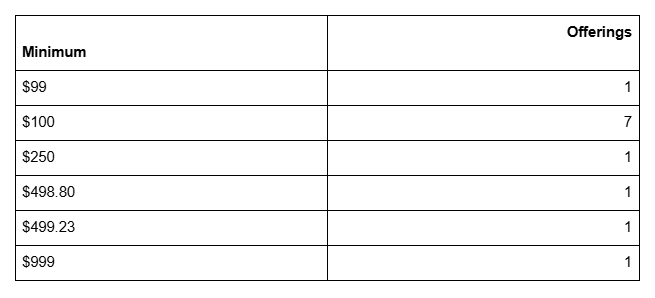
Eight of twelve — two-thirds — opened at $100 or less. That is the market’s revealed consensus, and it is worth understanding why it settled there.
A $100 minimum is not primarily an accessibility decision. It is a funnel decision. At $100, the investment is smaller than a nice dinner. It converts a supporter into an owner at a price point that requires no financial planning, no spousal conversation, no opportunity-cost calculation. What the founder is buying at $100 is not the $100 — it is the shareholder count, and everything a shareholder is: an advocate, a customer, a distribution node, a person with a reason to care.
The odd-looking minimums — $498.80 for ORBITBeyond, $499.23 for rHEALTH, $99 for Mylo Medical — are share-price arithmetic. A round share count at a specific per-share price produces an unround dollar figure. It is a small tell that the issuer priced shares first and derived the minimum second, rather than picking a psychological threshold and backing into it.
Accessibility versus investor quality
The case against low minimums is real and deserves a fair hearing. Every investor, regardless of check size, generates administrative cost: cap table entry, transfer agent fees, tax documents, communications, and support requests. A company with 4,000 investors at $100 has raised $400,000 and acquired a permanent operational obligation. Some founders discover this only afterward.
Higher minimums also do genuine screening work. A $999 minimum, as Aevumed used, produces a smaller and more deliberate investor base. Someone writing $999 has usually read more, thought longer, and is less likely to request a refund or churn out at the first quiet quarter.
But I think the case for low minimums is stronger, for a reason that is easy to miss: in Reg CF, your investors are frequently your market. Mylo Medical’s investors are nurses, caregivers, and family members of patients. That is not incidental — it is precisely the population that will specify, recommend, and buy a better bedpan. A $99 minimum is customer acquisition that pays the company instead of costing it.
What thresholds actually work
Based on this cohort and the broader pattern of the last several years, here is my honest view:
$100 is right for community-anchored and consumer-facing companies. If your investors are your customers, your neighbors, or your audience, optimize for count. Every barrier you add subtracts advocates.
$250–$500 is the sweet spot for technical and capital-intensive companies. High enough to filter for deliberateness, low enough to stay genuinely open. Avadain’s $250 sits exactly here, and it is arguably the best-calibrated minimum in the cohort — accessible, but signalling that this is a considered purchase rather than an impulse.
$999 and above should be a deliberate strategy, not a default. It works when the raise is a complement to an institutional round and the founder wants a compact, sophisticated cap table. It does not work if you are relying on the platform’s audience to find you, because you have narrowed the top of the funnel at the exact moment you need it widest.
Below $100 rarely adds much. The gap between $99 and $100 is not an accessibility gap; it is a rounding artifact. If you want to go lower for symbolic reasons, be honest that it is symbolism.
One caution for investors, stated plainly: a low minimum is a feature of the offering, not a measure of the opportunity. Accessibility and quality are independent variables. The $100 entry is what makes Reg CF democratic; it is not what makes any given deal good.
The Completion Ratio: The Most Revealing Number Nobody Publishes
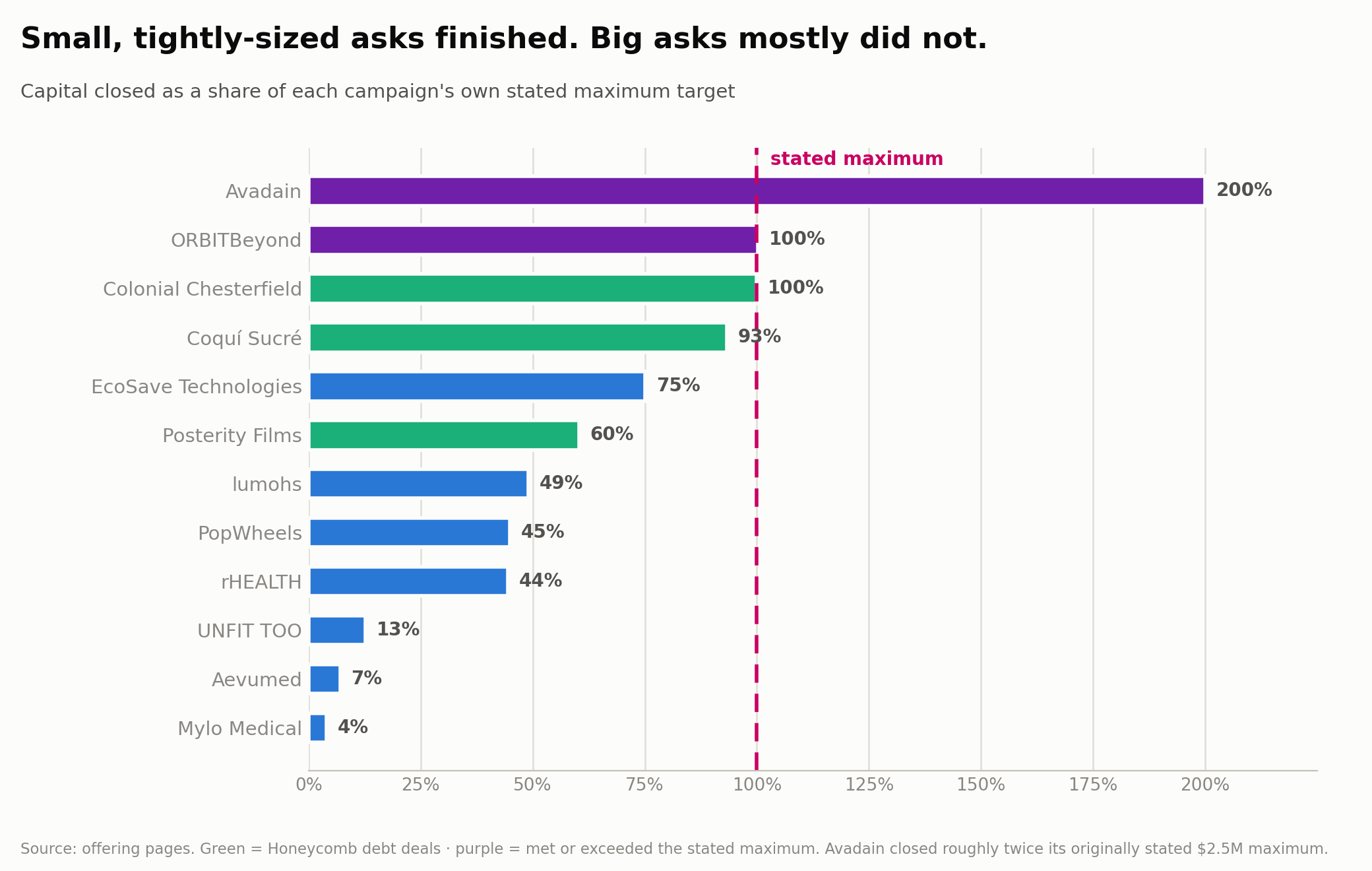
Every Reg CF campaign publishes two numbers most readers ignore: a minimum target (below which the raise fails and money is returned) and a maximum target (the most the issuer will accept). Comparing what closed against the issuer’s own stated maximum produces a metric I find more diagnostic than the raw dollar figure — because it measures the campaign against its own stated ambition rather than against unrelated companies.
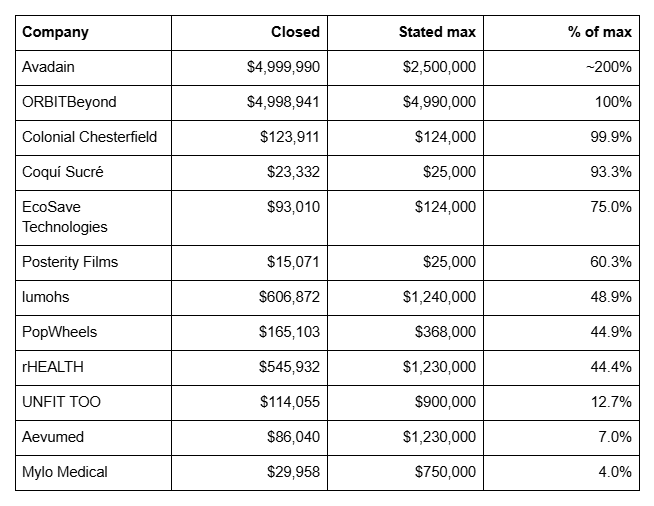
The pattern is stark. The three highest completion ratios below the cap-maxed deals all belong to campaigns with maximums under $130,000. The four lowest all belong to campaigns with maximums between $750,000 and $1.24 million.
This is not evidence that small companies outperform large ones. It is evidence that most founders set maximum targets far above what their campaign could realistically deliver. A $1.23 million maximum that closes at $86,040 is not a failed raise — Aevumed cleared its $9,999 minimum by more than eight times and closed successfully. But the public artifact left behind is a progress bar that sat at 7% for the life of the campaign.
And progress bars are not neutral. Crowdfunding conversion is powerfully social. A campaign showing 90% of goal creates urgency and validation. A campaign showing 7% creates hesitation, regardless of the underlying quality of the company. Founders who set aspirational maximums are, in effect, choosing to display a discouraging number to every visitor for the entire campaign.
Practical guidance for founders
Set your minimum low enough that closing is near-certain. The minimum is not a goal; it is a failure threshold. Aevumed’s $9,999 minimum meant the raise could not fail. That is correct design.
Set your maximum at roughly 1.5x what you honestly expect. Enough headroom to accommodate a strong finish, close enough that the progress bar works for you. A maximum you have a 5% chance of reaching is not ambition; it is a self-inflicted wound.
If you must state a large maximum, plan the campaign so early momentum is concentrated and visible — a committed lead, a matching pledge, a pre-launch list converted in week one.
Remember the cap is real. Avadain and ORBITBeyond closed within four figures of $5,000,000 because that is the maximum a Reg CF issuer may accept in a twelve-month period. If you are planning a raise that might approach it, structure for it in advance rather than discovering the ceiling at the finish line.
Founder and Investor Psychology: Why Some Campaigns Compound
Four of this week’s twelve companies have appeared on Superpowers for Good. Their conversations offer something the offering documents cannot: the founder’s own framing of why they are doing this, in their own words. They also happen to illustrate four distinct psychological engines behind successful retail raises.
Avadain: credibility transferred from institutions to the crowd
Bradley Larschan, CEO
Avadain’s pitch is a materials-science claim that most investors cannot personally evaluate: that the company can produce large, thin, nearly defect-free graphene flakes at industrial volume and reasonable cost. Larschan explains the stakes clearly:
“When you reduce graphite, which is the mother material, to a single atomic layer, it behaves completely differently. It can be the strongest material ever discovered... the best conductor of electricity, the best conductor of heat... What that means is that we have the ability to transform thousands of products with this material.”
The investor cannot verify that claim at the bench. So the campaign does something smarter: it substitutes transferred credibility. Engagement with RAPID — a partnership between the U.S. Department of Energy and the American Institute of Chemical Engineers — and a first license agreement with Harcros Chemicals let an investor reason by proxy. I cannot evaluate graphene manufacturing. I can evaluate whether serious institutions have.
Larschan also names the environmental case in terms an impact investor can act on: “We can replace critical minerals or enhance them through a clean, environmentally responsible process.” That reframes a materials company as a mining-avoidance and efficiency play.
Asked for his superpower, Larschan gave an answer that reads like a description of the crowdfunding process itself:
“There are so many bumps in the road... It’s just so much easier to say, okay, let’s quit or let’s do something different. But that’s not me.”
And on the crowd: “Through democratizing the fundraising, we’ve raised more than $15 million so far... It’s exhilarating and uplifting to have this much support.” Note that figure — it is cumulative across multiple raises, not a single campaign. Avadain is a repeat issuer, and repeat issuance is one of the most reliable predictors of a large close. The second campaign inherits the first campaign’s investors.
The lesson: when your technology exceeds your audience’s ability to evaluate it, do not simplify the science. Import third-party validators the audience can evaluate.
rHEALTH: a credential that answers the objection before it is raised
Eugene Chan, CEO and founder
rHEALTH sells a single-drop blood diagnostic. Every investor who hears that sentence has the same reflex, and it is a reputational problem the company did not create. rHEALTH’s campaign meets it head-on with a credential that is very difficult to fake:
“We tested this technology on the International Space Station with astronaut Samantha Cristoforetti, who operated the device and obtained precise values from single drops of sample. They did the analysis using our device and got absolutely the right answers.”
And on earning that opportunity:
“To be the one company selected to demonstrate our novel technology on the ISS was a huge undertaking.”
NASA validation, 17 issued patents, testing through zero-gravity parabolic flights. This is a masterclass in pre-empting the objection. The Theranos shadow is not ignored, minimized, or argued with; it is answered with an independent institution that had every incentive to be skeptical and was satisfied anyway.
Chan’s superpower — “Staying focused on a North Star” — is the temperamental profile that regulated hardware demands. Diagnostics take years. Retail investors read persistence as risk-reduction, correctly.
The lesson: identify the single strongest objection to your category and answer it with third-party evidence in your first thirty seconds. If your category has a scandal attached, that objection is your pitch.
UNFIT TOO: mission as the entire investment thesis
Dan Partland, director and producer
UNFIT TOO is a documentary sequel to 2020’s #UNFIT, examining American polarization. Partland’s framing:
“Populism is really about power... a ruthless majority. Democracies can easily slip into that.”
And:
“Every single family has been affected by this negative hyper-partisanship... What’s the appropriate disposition towards that problem? How do you engage with people who you feel so different from?”
That second quote is the campaign’s real engine. It converts a political documentary from a subject people have opinions about into a problem people are personally living inside. Nobody funds a film about polarization in the abstract. People fund a film about the argument they had at Thanksgiving.
Partland’s superpower — “Ability to unite people around a meaningful mission” — is the correct one for a revenue-share film raise, where the investor is buying a share of future revenue and, more honestly, a share of the mission.
The campaign closed at $114,055 against a $900,000 maximum. Read only as a percentage, that is the second-lowest completion in the cohort. Read as an outcome, over a hundred thousand dollars for an independent documentary from people who wanted it to exist is a real result — and it cleared its $100,000 minimum, which was the highest minimum target in the cohort and left almost no margin. That was a brave structure.
The lesson: mission-led raises convert on personal stakes, not abstract ones. And if your minimum target is high, you are betting the entire campaign on your community showing up.
Mylo Medical: the smallest raise with the clearest thesis
Nadia Tedeschi, founder
Mylo Medical closed $29,958 — the third-smallest in the cohort. It also has, to my reading, the most emotionally precise pitch of any campaign here. Tedeschi, a former nursing assistant, describes the moment that started it:
“I had a patient look up at me through her tears and say, ‘Nobody should have to live like this.’”
The MyloPan is a redesigned bedpan — a device essentially unchanged for a century. Her framing of the design process is the kind of sentence that belongs in a product-management textbook:
“The current device causes more problems than it solves. We turned every pain point into a feature of our innovative bedpan.”
And on why she chose crowdfunding at all:
“We wanted to make sure we’re the company bridging the gap between medical device companies and end users. Crowdfunding felt perfect for creating that network.”
That is the strategic insight most first-time founders miss. Tedeschi is not using Reg CF because venture capital said no. She is using it because her investors and her end users are the same people, and a cap table full of nurses is a distribution asset a venture round could not buy.
Her superpower — “Listening” — is not a soft answer. It is the entire origin story of the product.
Mylo closed at 4% of its $750,000 maximum, and that is the honest critique: the ask was mis-sized for a company founded in February 2025 with a validated prototype and no revenue. But the $29,958 came with something more durable — a community of caregivers who now have a financial reason to advocate for a device they already wanted.
The lesson: the smallest raises often have the strongest thesis. Do not confuse the size of the close with the quality of the company.
The pattern across all four
Strip these down and the same five ingredients recur in every campaign in this cohort that performed above its cohort median:
A one-sentence problem. Hydraulics leak. Bedpans humiliate. Blood tests require a lab. IPOs exclude retail. If it takes a paragraph, it will not travel.
Transferred credibility. NASA. Department of Energy. A named licensing partner. A signed contract with a port authority. Retail investors cannot do technical diligence, so they do institutional diligence by proxy.
Traction stated in units, not adjectives. PopWheels: 50 stations, 1,000 customers, 200,000 swaps, under one year. That sentence does more work than any deck slide.
A founder whose biography explains the company. A nursing assistant building a better bedpan. A director who made the first film making the sequel. Biography is the cheapest and most durable form of credibility available to a founder.
A pre-existing community. Every campaign that closed near its ceiling brought its own crowd. This is the least glamorous finding and the most important one.
Why retail investors behave differently from institutions
Institutional investors are compensated for returns. Retail impact investors are, in practice, buying a bundle: a financial position, an identity statement, a membership, and a small piece of a future they want to exist. That bundle explains behavior that looks irrational under a pure-returns model:
They will invest in a documentary with no exit.
They will fund a farm’s debt consolidation.
They will back a bedpan at a $6.75 million valuation.
None of that is naive. It is a different objective function. It also means narrative quality is not marketing overhead in Reg CF — it is a substantial component of the product. A founder who treats the campaign page as a compliance document rather than an act of persuasion has misunderstood the instrument.
Impact Investing Through Reg CF: What This Week Suggests About the Field
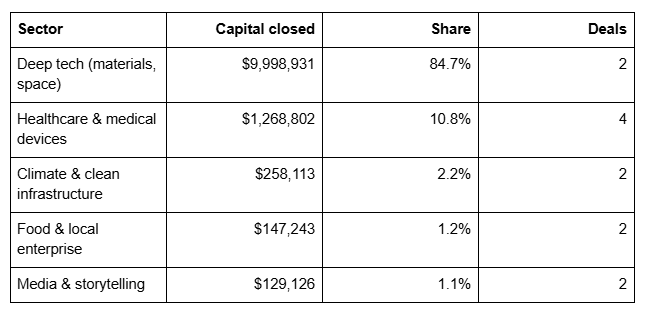
By capital, deep tech dominates. By deal count, healthcare leads with four campaigns, and the remaining eight distribute evenly across climate, food, local business, and media.
That distribution says something important about what “impact investing” has come to mean in the retail context. A decade ago the term was shorthand for a narrow band of activity: microfinance, affordable housing, clean energy project finance. This cohort is far more heterogeneous, and the heterogeneity is the point.
Healthcare has become the largest impact category by volume — and it is being redefined from the bottom up. Three of the four healthcare deals here are not pharmaceutical moonshots. They are dignity, ergonomics, and workflow: a bedpan that does not humiliate patients, a dermaplaning instrument that improves practitioner visibility and safety, orthopaedic implants designed by surgeons to reduce revision risk. This is impact defined as the quality of a human experience inside the healthcare system, not as a mortality statistic. It is an underexplored and, I think, structurally advantaged category for Reg CF, because the people who feel the problem most acutely are numerous, motivated, and reachable.
Climate impact is fragmenting from generation into infrastructure. PopWheels is not a solar company; it is a battery-swapping network for urban delivery riders. EcoSave is not a carbon play; it is a water-filtration system with contracts including the UK Consulate, the San Diego Airport Authority, the UCSD i4X Program, and Scripps Oceanography. Both are picks-and-shovels businesses serving a transition already underway. Retail investors increasingly understand this distinction, and I expect the trend to continue: the next wave of climate crowdfunding will be less about generating clean energy and more about the unglamorous infrastructure that moves, stores, and cleans things.
Local and place-based finance is quietly becoming the most reliable segment. The three Honeycomb deals — a California living-history farm, a Puerto Rican patisserie, a Grand Rapids documentary company — closed at an average of 84% of their stated maximums, the highest of any group here. These raises will never generate headlines. They also, in my estimation, have the highest probability of delivering the returns they promised, because they promised the least exotic thing: interest on a loan to a business with revenue.
Media and cultural production is a real and under-recognized impact category. UNFIT TOO and Posterity Films both used community capital to fund storytelling that commercial financing structurally will not touch. Posterity Films’ flagship, A City Within a City: The Black Freedom Struggle in Grand Rapids, Michigan, is exactly the sort of project that has no venture path and no studio buyer, but has a community with a direct stake in its existence. Reg CF is arguably better matched to cultural production than to startups — the outcome is defined, the timeline is bounded, and the audience is identifiable in advance.
Where impact crowdfunding goes next — five predictions
These are analytical predictions, not certainties. Treat them as a framework for watching the market rather than as forecasts to trade on.
1. Revenue share will take share from SAFEs in impact deals. The mismatch between SAFE mechanics and impact-company cash-flow shapes is becoming visible as early SAFEs age without triggering. Founders building profitable, independent, mission-led companies will increasingly choose an instrument that pays without requiring a sale. Expect platforms to build better revenue-share tooling in response.
2. Healthcare-dignity and healthcare-workflow will outgrow healthcare-moonshot. Devices that solve indignities and inefficiencies are cheaper to develop, faster to market, and dramatically easier to explain to a retail audience than a drug candidate. The four healthcare deals here point at a category that is only beginning to be worked.
3. Local debt will professionalize and grow faster than local equity. The completion ratios in this cohort are not a fluke. Debt matches what small businesses actually need and what neighbours can actually evaluate. I expect purpose-built local-lending portals to grow their deal counts faster than equity portals grow theirs, even as they lag badly on total dollars.
4. The cap will become a live policy conversation again. When the two largest campaigns in a week both stop within four figures of the statutory maximum, the ceiling is binding on real demand. Whether the $5 million limit should rise is a genuine policy question with arguments on both sides — investor protection versus capital access — and it is a conversation this industry should expect to have.
5. Repeat issuance becomes the dominant success strategy. Avadain’s cumulative $15 million across multiple raises is the template. The first campaign is expensive and slow because you are building the list. The second is faster and larger because you already have it. Founders should increasingly plan campaign one as an investment in campaign two.
Broader Market Trends for 2026
Retail investor behavior is maturing, unevenly
The retail investor of 2026 is a different animal from the retail investor of 2021. More of them have now held a Reg CF position for three or four years. Many have learned, experientially, that liquidity is scarce, that updates go quiet, and that a SAFE can sit for years. That experience is producing more discriminating behavior at the top of the market — more attention to instruments, more questions about exit paths, more scrutiny of valuation.
But maturity is unevenly distributed. Every week brings genuinely first-time investors who have never read a cap table. The $100 minimum that makes the market democratic also guarantees a permanent inflow of the inexperienced. Both things are true simultaneously, and platforms are still, in my view, under-investing in the education layer that would reconcile them.
AI is quietly changing due diligence on both sides
This is the trend I would watch most closely over the next eighteen months. Retail investors now have access to analytical capability that was, until recently, the exclusive province of institutions. An individual can pull an issuer’s Form C from SEC EDGAR, extract the financials, compare the valuation against sector comparables, summarize the risk factors, and check the founders’ claimed history — in minutes, at effectively zero cost.
Three consequences seem likely:
Valuation discipline tightens. When any investor can benchmark a $41 million pre-money against comparable companies in seconds, aggressive valuations become harder to sustain. Some campaigns in this very cohort carry valuations that will invite that scrutiny.
Disclosure quality becomes a competitive advantage. Issuers whose Form C is thorough and whose numbers reconcile will benefit; issuers relying on enthusiasm to outrun scrutiny will find it harder. This is a good outcome for the industry.
Founders get better preparation. The same tools help founders model dilution, stress-test their own claims, and anticipate objections. The capability gap between a well-advised issuer and an unadvised one is narrowing — which should raise the average quality of what reaches the market.
The obvious caution: AI-assisted analysis is only as good as the disclosure it is fed, and Reg CF disclosure is thin by design. A confident-sounding machine summary of a sparse Form C is still a summary of a sparse Form C. The tools reduce the cost of analysis; they do not manufacture information that was never disclosed.
Community-driven finance is becoming infrastructure
The most durable trend visible in this cohort is not a sector or an instrument. It is the steady normalization of the idea that a business can be financed by the people it serves.
Colonial Chesterfield at Riley’s Farm has operated since 1997 and consolidated debt with money from people who take their children there. Coquí Sucré is being equipped by a community in Rio Grande, Puerto Rico. Posterity Films is being financed by the Grand Rapids community whose history it documents. None of these transactions required a venture capitalist, a bank committee, or an exit.
That is not a small thing. It is a parallel financing system for the enormous category of enterprises that are economically viable, socially valuable, and permanently uninteresting to institutional capital. Reg CF’s most important long-run contribution may have very little to do with startups.
Actionable Takeaways
For founders
Choose the instrument that matches your cash-flow shape, not the one that is cheapest to issue. If you will never raise a priced round, do not issue a SAFE. If you have revenue, seriously price debt or revenue share before you sell equity you can never buy back.
Right-size your maximum target. Set it near 1.5x your realistic expectation. A progress bar stuck at 7% costs you more conversions than a higher ceiling could ever have earned you.
Set your minimum where failure is impossible. The minimum is a failure threshold, not an aspiration. UNFIT TOO’s $100,000 minimum was courageous; most founders should be less brave.
Bring your own crowd. Every campaign in this cohort that closed near its ceiling had one. Platforms amplify audiences; they very rarely create them.
Import credibility you cannot generate yourself. A DOE-affiliated partnership, a NASA test, a named licensee, an airport authority contract. Retail investors evaluate your validators when they cannot evaluate your technology.
Match the minimum investment to your investor thesis. If your investors are your customers, go to $100. If your raise complements an institutional round, go higher deliberately.
Plan campaign one as the list-building exercise for campaign two. The compounding is real, and it is the clearest path to a cap-level raise.
For investors
Read “closed” correctly. A campaign that closed at $5 million last week did not raise $5 million last week. Check the campaign’s open date before you infer momentum.
Know what you are buying. A SAFE is not stock. Revenue share is not equity. Common sits behind preferred. These distinctions determine whether you are ever paid.
Look up the completion ratio yourself. Compare the amount closed to the issuer’s stated maximum. It tells you how the market received the deal, and it is right there in the offering documents.
Underwrite the valuation, not the story. Several companies in this cohort carry valuations in the $22–$99.8 million range at pre-revenue or early-revenue stages. Those numbers may prove justified. They should still be examined rather than assumed.
Ask about the liquidity path explicitly. For a documentary revenue share, the path is distribution revenue. For a Honeycomb loan, it is a payment schedule. For a SAFE in a pre-revenue device company, it may be a decade away or never. All three can be reasonable; only one of them is usually understood.
Size positions to the risk. The $100 minimum exists to make participation possible, not to make concentration wise. Early-stage private companies fail at high rates, and Reg CF positions are generally illiquid.
The Full Cohort
*Total closed is the cumulative amount each campaign had committed at the moment it closed — not the amount raised during the past week. Several of these campaigns were open for many months.
A Closing Thought
The most striking thing about this cohort is not the $11.8 million. It is that a single week of American impact crowdfunding contained a graphene manufacturer, a lunar lander company, a bedpan, a Puerto Rican bakery, a documentary about political polarization, a battery-swapping network for delivery riders, a 55-acre living-history farm, and a documentary about Black history in Grand Rapids — and that all eight of those things successfully raised money from ordinary people who chose to fund them.
There is no institutional capital allocator on earth with a mandate broad enough to have funded that list. The reason it exists is that Regulation Crowdfunding does not require one. It requires only that enough individual people, each investing an amount they can afford, agree that a thing should exist.
That is a strange and rather wonderful piece of financial infrastructure. The $5 million ceiling constrains it. Thin disclosure limits it. Illiquidity is a genuine and permanent cost to the investor. But every week it funds a slice of the economy that would otherwise go unfunded, and every week the list is more varied than the week before.
Two campaigns wrote the headline. The other ten wrote the story.
Superpowers for Good should not be considered investment advice. This analysis is educational and reflects the author’s opinions about market structure and trends. All investing carries risk, and early-stage private companies fail at high rates. Seek professional counsel before making investment decisions.
Sources
Featured on Superpowers for Good
Graphene Innovation: Transforming Industries with Avadain’s Technology — Bradley Larschan, CEO, Avadain · Watch
From Space to StartEngine: Revolutionizing Blood Diagnostics — Eugene Chan, CEO and founder, rHEALTH · Watch
The Psychology of Divided Politics — Dan Partland, director and producer, UNFIT TOO · Watch
Reinventing the Bedpan: A Simple Yet Powerful Innovation — Nadia Tedeschi, founder, Mylo Medical · Watch
Offering profiles
Regulatory reference

SuperCrowd Investment Directory
Search our Database of 200+ Devin’s Impact Pick of the Week Offerings and Preliminary Diligence Reports on New Offerings

We’ve created a new perk for our Impact Members: a searchable directory of live offerings. To be clear, the database isn’t yet complete, but already includes almost 300 offerings, including a bunch that met the screening requirements to be chosen as one of “Devin’s Impact Pick of the Week” selections.
Each investment offering on the list is open to all investors with no wealth or expertise test. We’ve also prepared a due diligence review—either preliminary or detailed as one of my weekly impact picks. Check it out and let us know what you think.
Support Our Sponsors
Our generous sponsors make our work possible, serving impact investors, social entrepreneurs, community builders and diverse founders. Today’s advertisers include Supercrowd.tv. Learn more about advertising with us here.
Max-Impact Members
(We’re grateful for every one of these community champions who make this work possible.)
Brian Christie, Brainsy | Cameron Neil, Lend For Good | Carol Fineagan, Independent Consultant | Eric Coury, Arthia AI | Joey Hayes, thru | John Berlet, CORE Tax Deeds, LLC. | Justin Starbird, The Aebli Group | Ken Steele, Rotarian | Lory Moore, Lory Moore Law | Marcia Brinton, High Desert Gear | Mark Grimes, Networked Enterprise Development | Mike Babbit | Coledger Solutions | Mike Green, Envirosult | Nick Degnan, Unlimit Ventures | Paul Lovejoy, Stakeholder Enterprise | Pearl Wright, Global Changemaker | Scott Thorpe, Philanthropist | Sharon Samjitsingh, Health Care Originals
Upcoming SuperCrowd Event Calendar
If a location is not noted, the events below are virtual.
Join the SuperCrowd Impact League! You can be recognized for making impact investments via Reg CF. See how your activity compares to your peers. It’s free. Win valuable prizes. Start now!
SuperCrowd Impact Member Networking Session: Impact (and, of course, Max-Impact) Members of the SuperCrowd are invited to a private networking session on September 8th at 8:00 PM ET/5:00 PM PT. Mark your calendar. We’ll send private emails to Impact Members with registration details. Upgrade to Impact Membership today!
Apply for the Superpowers for Good Live Pitch: Are you raising capital through Regulation Crowdfunding? Apply by September 2 for the September 30 Superpowers for Good Live Pitch. Selected founders pitch free to investors and gain exposure through SuperCrowd.tv, e360tv, social media, and our 10,000-subscriber newsletter. We especially encourage social entrepreneurs, women and underrepresented entrepreneurs to apply.
Visit Our Complete Community Event Calendar
If you would like to submit an event for us to share with the 10,000+ changemakers, investors and entrepreneurs who are members of the SuperCrowd, click here.
We utilized AI to efficiently gather data and analyze key success factors, enabling us to deliver an overview of these successful crowdfunding campaigns.
We share educational information—not investment advice. Some links may generate compensation. See our full disclosure.