


You can advertise in Superpowers for Good. Click to learn more about our affordable options.

The landscape of community capital and Regulation Crowdfunding (Reg CF) is maturing rapidly. As we navigate through the middle of 2026, the intersection of impact investing, retail capital, and founder ingenuity has created a dynamic ecosystem where everyday investors are directly funding the future they want to see.
Over the past two weeks, a fascinating cohort of impact-driven crowdfunding campaigns successfully funded and closed their offerings. It is important to clarify that these companies did not necessarily raise all of these funds during the past two weeks; rather, they successfully completed and formally closed their campaigns during this period, marking the culmination of months of community building and capital formation.
This comprehensive analysis dives deep into the data, platform dynamics, security structures, and psychological drivers behind these successful raises. Whether you are a founder contemplating a community round or an investor looking to refine your due diligence process, this report offers actionable insights into the current state of impact crowdfunding.

The Superpowers for Good Methodology
Before diving into the data, it is essential to understand the lens through which these offerings were evaluated. Each week, Superpowers for Good shares a list of new impact-related offerings added to FINRA-registered crowdfunding portals and by broker-dealers. Using our classification methodology, we highlight offerings with social impact, women in leadership, and underrepresented founder leadership.
This curated approach ensures that the companies analyzed below represent more than just financial opportunities—they represent community resilience, environmental stewardship, and the democratization of capital access.
Data Visualization: The Capital Landscape
Platform Analysis: Where Capital Meets Community
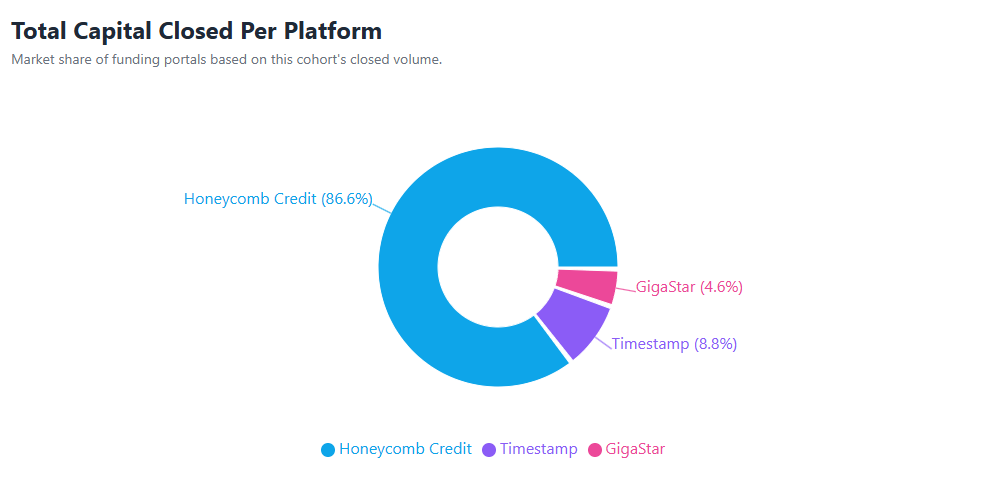
The choice of funding portal is one of the most critical decisions a founder makes. The platforms represented in this recent cohort—Honeycomb Credit, Timestamp, and GigaStar—each serve distinct market segments and attract different investor audiences.
Honeycomb Credit: The Champion of Main Street
Honeycomb Credit facilitated the lion’s share of the capital in this cohort, closing six of the eight offerings and raising a combined USD 682,353. Honeycomb has carved out a powerful niche in debt crowdfunding for local, tangible businesses.
Strengths: Honeycomb excels at mobilizing local communities. Their platform is optimized for small businesses—breweries, restaurants, pet stores, and local solar projects—that have existing customer bases eager to transition from patrons to stakeholders.
Investor Audience: The audience here leans heavily toward “Main Street” investors who value tangible community impact. They want to walk into a taproom or a local store and know they helped build it.
Sector Fit: Ideal for brick-and-mortar retail, local food and beverage, and regional infrastructure projects (like community solar).
Timestamp: The Frontier of Decentralized Tech
Timestamp hosted Shopstr Markets, which successfully closed USD 69,036. Timestamp positions itself as a platform for forward-looking, often tech-centric or Web3-adjacent startups.
Strengths: Timestamp appeals to investors who are comfortable with higher-risk, higher-reward profiles and complex technological narratives.
Investor Audience: Tech-savvy retail investors, crypto-adjacent communities, and early adopters looking for the next big digital disruption.
Sector Fit: Software, decentralized platforms, AI, and scalable digital marketplaces.
GigaStar: Monetizing the Creator Economy
GigaStar facilitated the raises for two YouTube channels, Word On The Street and Naziyah Kahliya, totaling USD 36,250. GigaStar represents a fascinating evolution in crowdfunding: the securitization of digital creator revenue.
Strengths: GigaStar provides a highly specialized infrastructure for content creators to raise capital against future revenue streams.
Investor Audience: Fans, subscribers, and niche media investors. This is the ultimate expression of “investing in what you watch.”
Sector Fit: Digital creators, YouTubers, podcasters, and independent media brands.
Security Type Analysis: Aligning Risk and Reward
[Placeholder: A stacked bar chart comparing the usage of Debt, Equity, SAFE, and Revenue Share across the eight closed campaigns.]
The diversity of security types in this cohort highlights the flexibility of Reg CF. Understanding these structures is paramount for both founders managing dilution and investors managing risk.
Debt (Promissory Notes)
Used by: Tatleaux, Loteria Grill, Harding House Brewing Co, Creature Comforts
Founder Incentives: Debt is non-dilutive. Founders retain full ownership and control of their company. It enforces financial discipline, as regular repayments are required.
Investor Risks & Returns: Lower risk compared to equity, with predictable yield. However, upside is capped at the interest rate.
Best For: Cash-flow positive businesses (or those with clear paths to near-term revenue) like restaurants, retail, and energy projects with Power Purchase Agreements (PPAs).
Equity (Preferred)
Used by: National Energy Improvement Fund (NEIF)
Founder Incentives: Raises capital without the immediate cash-flow burden of debt. Preferred equity often comes with specific dividend rights or liquidation preferences.
Investor Risks & Returns: Investors get actual ownership and potential for significant upside if the company scales or is acquired. Risk is high, as liquidity events can take years.
Best For: Growth-stage companies with proven business models needing substantial capital to scale operations, like NEIF’s nationwide energy financing platform.
SAFE (Simple Agreement for Future Equity)
Used by: Shopstr Markets
Founder Incentives: Extremely fast and cheap to execute. Delays the complex process of setting a hard valuation until a future priced round.
Investor Risks & Returns: High risk. Investors do not hold equity until a triggering event (like a Series A) occurs. If the company never raises a priced round or fails, the SAFE may expire worthless.
Best For: Early-stage, high-growth tech startups where current valuation is difficult to determine and rapid capital deployment is necessary.
Revenue Share
Used by: Word On The Street, Naziyah Kahliya
Founder Incentives: Non-dilutive, and payments scale with the business. If revenue drops, payments drop, providing a safety net during slow months.
Investor Risks & Returns: Returns are tied directly to top-line performance, bypassing the risk of “Hollywood accounting” at the net profit level.
Best For: Digital creators, media properties, and businesses with high gross margins and predictable revenue streams.
Minimum Investment Analysis: Accessibility vs. Quality
[Placeholder: A scatter plot showing the correlation between minimum investment amounts and total capital raised.]
The minimum investment thresholds in this cohort range from a highly accessible USD 88 (Word On The Street) to a premium USD 1,000 (NEIF).
The Accessibility Argument:
Lower minimums (USD 88 to USD 100), seen in the GigaStar and most Honeycomb campaigns, are designed to maximize participation. For a local brewery or a YouTube creator, the goal is often to acquire brand ambassadors as much as capital. A fan who invests USD 100 is highly likely to visit the taproom or watch every new video, driving organic growth.
The Investor Quality Argument:
NEIF’s USD 1,000 minimum serves a different purpose. It filters for higher-conviction investors. While it reduces the total number of investors (and thus the administrative burden of managing a massive cap table), it attracts individuals who are likely more experienced and capable of deploying follow-on capital.
Actionable Insight: Founders should match their minimum investment to their strategic goals. If you need 1,000 local evangelists, set the minimum at USD 100. If you need 500 serious impact investors to fund a national infrastructure rollout, set it at USD 1,000.
Founder and Investor Psychology: Why Campaigns Succeed
Crowdfunding is not just a financial transaction; it is a psychological phenomenon. The founders who succeed in this space master the art of storytelling, community building, and credibility.
The Power of Tangible Impact
Why did NEIF raise nearly half a million dollars? Because climate anxiety is real, and retail investors are desperate for actionable ways to combat it. NEIF’s founders, Peter J. Krajsa and Matthew H. Brown, have been in the space since 2007. They brought immense credibility (having financed over USD 651 million in projects). Investors weren’t just buying preferred equity; they were buying into a proven, veteran-led engine for decarbonization.
The “Third Place” Phenomenon
Harding House Brewing Co and Loteria Grill succeeded because they offer a “third place”—a social environment outside of home and work. Investors in these campaigns are driven by a desire for civic pride and community preservation. The psychology here is highly localized: “I want my neighborhood to have a great craft brewery, and I want my name on the investor wall.”
The Parasocial Investment
The GigaStar campaigns (Naziyah Kahliya and Word On The Street) tap into parasocial relationships. Viewers spend hours every week with these creators. When Naziyah Raymond (who boasts 254,000 subscribers) asks her audience to invest, she isn’t pitching a business plan; she is inviting her community to share in the upside of the culture they helped create together.
Impact Investing Analysis: The Evolution of Community Capital
Impact investing via Reg CF is broadening its definition. It is no longer just about clean energy, though that remains a dominant force.
Climate and Infrastructure: Campaigns like NEIF and Tatleaux (a solar project on a remediated Superfund site) show that retail investors are eager to fund hard assets and infrastructure that institutional capital sometimes overlooks due to scale or complexity.
Local Economic Resilience: Creature Comforts (a pet supply store in Westport, NY) represents micro-economic impact. In small towns, funding a local retail store prevents commercial real estate vacancies and keeps capital circulating locally.
Digital Empowerment: Shopstr Markets represents a different kind of impact—financial inclusion and permissionless global trade, appealing to those who view decentralized tech as a tool for social equity.
Prediction: We will see a surge in “hybrid impact” models, where local businesses (like a brewery) incorporate climate tech (like on-site solar or water recycling), allowing them to appeal to both local patrons and national climate investors simultaneously.
Featured Offering Analysis: Deep Dives
Standout 1: National Energy Improvement Fund (NEIF)
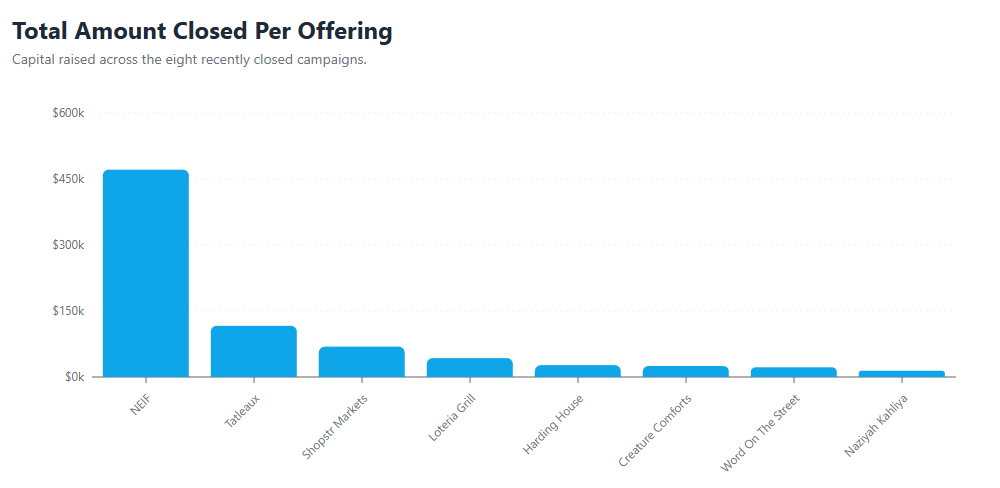
The Catalyst: NEIF’s success (USD 471,169 raised) stems from its massive existing traction. With a USD 124.7 million loan portfolio, this was not a speculative startup. It was a de-risked growth opportunity.
The Lesson: For later-stage companies, Reg CF is a powerful tool for mezzanine financing. Investors will write larger checks (hence the USD 1,000 minimum) when they see deep historical data and veteran leadership.
Standout 2: Tatleaux - NJ Community Solar
The Catalyst: Raising USD 116,305 in debt, Tatleaux succeeded by offering a highly predictable narrative: a 40-year PPA at a fixed rate with an annual escalator.
The Lesson: Cash flow visibility is king in debt crowdfunding. By clearly outlining the projected USD 15.4 million lifetime revenue, the founder (Joseph Cortes) transformed a complex real estate/energy play into a simple, attractive fixed-income product for retail investors.
Standout 3: Naziyah Kahliya Channel Drop
The Catalyst: Valued at USD 380,000, this YouTube channel raised USD 14,250 via revenue share. The genius here is the alignment of incentives.
The Lesson: The creator economy is ripe for securitization. Traditional banks will not underwrite a teenager’s GRWM (Get Ready With Me) video revenue. But her 254,000 subscribers understand the value of her engagement metrics implicitly.
Market Predictions and Trends for the Rest of 2026
As we look toward the second half of 2026, several key trends are emerging from the data:
AI-Assisted Due Diligence: Retail investors are increasingly utilizing AI tools to analyze Reg CF filings, read through Form C disclosures, and model potential returns. Founders must ensure their financial disclosures are not only compliant but structured in a way that machine-learning models can easily parse and validate.
The Rise of Revenue Share: As interest rates remain volatile, both founders and investors are seeking alternatives to traditional debt and highly dilutive equity. Revenue share agreements will likely capture a larger percentage of the Reg CF market, especially for digital and service-based businesses.
Hyper-Localism as an Asset Class: The success of platforms like Honeycomb proves that “Main Street” is a viable asset class. We predict a rise in municipal-level crowdfunding, where city governments partner with portals to incentivize local residents to fund neighborhood revitalization projects.
The Maturation of the Crowd
The latest wave of successful community capital raises demonstrates that Regulation Crowdfunding is no longer a fringe alternative to venture capital; it is a primary vehicle for impact, community alignment, and strategic growth.
For founders, the mandate is clear: build your community before you ask for their capital, choose the security type that aligns with your cash flow, and tell a story that resonates on a human level.
For investors, the opportunity has never been richer. From remediated Superfund sites in New Jersey to decentralized marketplaces and local taprooms in Tennessee, the power to shape the economy is quite literally in the palm of your hand. The data proves it: when capital is democratized, the impact is profound.

Make an Impact with Exclusive Investment Insights

Are you ready to align your investments with your values? Impact Members of the SuperCrowd receive exclusive weekly picks from Devin Thorpe, spotlighting innovative ventures that drive social good while offering potential financial returns.
Gain access to carefully selected opportunities that empower communities, promote sustainability, and deliver real change. Don’t just invest—make an impact.
Disclaimer:
This article is for informational and educational purposes only. It does not constitute financial advice, investment advice, or a recommendation to buy or sell any securities. Crowdfunding investments are speculative, illiquid, and carry a high degree of risk, including the total loss of principal. Past performance is not indicative of future results. Investors should conduct their own due diligence and consult with financial advisors before making investment decisions.
Support Our Sponsors
Our generous sponsors make our work possible, serving impact investors, social entrepreneurs, community builders and diverse founders. Today’s advertisers include Kaylaan and Mission Booster Procurement. Learn more about advertising with us here.
Max-Impact Members
(We’re grateful for every one of these community champions who make this work possible.)
Brian Christie, Brainsy | Cameron Neil, Lend For Good | Carol Fineagan, Independent Consultant | Hiten Sonpal, RISE Robotics | John Berlet, CORE Tax Deeds, LLC. | Justin Starbird, The Aebli Group | Lory Moore, Lory Moore Law | Marcia Brinton, High Desert Gear | Mark Grimes, Networked Enterprise Development | Matthew Mead, Hempitecture | Michael Pratt, Qnetic | Mike Babbit | Coledger Solutions | Mike Green, Envirosult | Nick Degnan, Unlimit Ventures | Dr. Nicole Paulk, Siren Biotechnology | Paul Lovejoy, Stakeholder Enterprise | Pearl Wright, Global Changemaker | Scott Thorpe, Philanthropist | Sharon Samjitsingh, Health Care Originals
Upcoming SuperCrowd Event Calendar
If a location is not noted, the events below are virtual.
Join the SuperCrowd Impact League! You can be recognized for making impact investments via Reg CF. See how your activity compares to your peers. It’s free. Win valuable prizes. Start now!
SuperCrowd Impact Member Networking Session: Impact (and, of course, Max-Impact) Members of the SuperCrowd are invited to a private networking session on June 9th at 8:00 PM ET/5:00 PM PT. Mark your calendar. We’ll send private emails to Impact Members with registration details. Upgrade to Impact Membership today!
Devin Thorpe will lead SuperCrowdHour June on June 17, 2026, at 12:00 PM Eastern. In this insightful session, “How to Benchmark Your Impact Crowdfunding Portfolio v. the Stock Market,” Devin will explore how impact investors can evaluate the performance of their regulated investment crowdfunding portfolios alongside traditional stock market benchmarks. Drawing on his experience as a former investment banker, impact investor, and crowdfunding advocate, he will break down practical methods for measuring returns, assessing risk, and understanding the broader value created through impact investing. Attendees will gain a clearer understanding of how private impact investments compare with public market performance, what metrics matter most, and how to build a more informed long-term investment strategy. Whether you’re an experienced impact investor or just beginning to build your crowdfunding portfolio, this SuperCrowdHour will provide valuable insights to help you evaluate both financial and social returns with greater confidence and clarity.
SuperCrowd26 featuring PurposeBuilt100™️: This August 25–27, founders, investors, and ecosystem leaders will gather for a three-day, broadcast-quality global experience focused on disciplined capital formation, regulated investment crowdfunding, and purpose-driven growth. We’re bringing together leading voices in impact investing, compliance, digital marketing, and circular economy innovation to deliver practical frameworks, real-world case studies, and actionable strategies. The event culminates in the PurposeBuilt100™️ Showcase, recognizing 100 of the fastest-growing purpose-driven companies in the U.S. Register now to secure your seat and get all the details. August 25–27, streaming worldwide.
Share the application for the PurposeBuilt100™: Purpose-driven founders deserve recognition. The PurposeBuilt100™ application window is now open—celebrating the fastest-growing companies building profit with purpose. If you know a founder creating real impact and real growth, please share this opportunity. Applications are free and confidential. Explore the program and apply today: PurposeBuilt100.com.
Community Event Calendar
Successful Funding with Karl Dakin, Tuesdays at 10:00 AM ET - Click on Events.
Interested in joining the invitation-only discussion with impact giant Jed Emerson at the Business Response to Authoritarian Threats discussion on June 10th at 4:00PM ET? Send a message to Devin Thorpe.
On June 18th at 5pm ET, join Tampa Bay Innovation and Menlo Park Patents for the Q2 Pitch Showcase, a live gathering for founders, inventors, investors, and startup supporters. Watch selected entrepreneurs pitch bold ideas, network with the innovation community, and see winners earn valuable prizes, including patent, valuation, and investor-meeting opportunities in St. Petersburg, Florida.
Register Now! October 20th and 21st will be the Crowdfunding Professional Association Regulated Investment Crowdfunding Summit for 2026. This is the event of the year for everyone in the crowdfunding ecosystem.
If you would like to submit an event for us to share with the 10,000+ changemakers, investors and entrepreneurs who are members of the SuperCrowd, click here.
We utilized AI to efficiently gather data and analyze key success factors, enabling us to deliver an overview of these successful crowdfunding campaigns.
We share educational information—not investment advice. Some links may generate compensation. See our full disclosure.