


You can advertise in Superpowers for Good. Click to learn more about our affordable options.

The landscape of venture capital and startup funding has undergone a seismic and irreversible shift. As we navigate through the spring of 2026, the democratization of capital is no longer just a theoretical concept or a niche alternative to traditional Sand Hill Road venture capital—it is a highly functional, deeply impactful, and massive economic reality. Last week alone, a staggering $44,211,602.00 was successfully raised across various FINRA-registered crowdfunding portals. This capital didn’t just flow into software-as-a-service (SaaS) echo chambers or speculative crypto assets; it poured into climate technology, life-saving healthcare innovations, community-driven entertainment, sustainable agriculture, and deep-tech infrastructure.
The sheer volume of capital moving through these portals indicates a maturation of the retail investor class and a strategic pivot by founders who recognize the power of community-backed cap tables. In this extensive research and analysis report, we will dissect this $44.2 million week. We will explore where the capital is flowing, analyze the strategic implications of minimum investments and security types, profile the evolving psychology of modern founders and investors, and provide deep-dive analyses into the specific companies that successfully closed their rounds.
Our Filtering Process: Finding the Signal in the Noise
The sheer volume of companies launching equity crowdfunding campaigns can be overwhelming for even the most seasoned investor. To combat this, a rigorous curation process is essential. Each week, Superpowers for Good shares a list of new impact-related offerings added to FINRA-Registered crowdfunding portals and by broker-dealers.
This filtering process is not merely about identifying companies that can generate a financial return; it is about identifying enterprises that possess a “superpower for good”—a core business model that inherently solves a societal, environmental, or medical problem. We look for alignment with the United Nations Sustainable Development Goals (SDGs), evaluating whether a company’s success scales its positive impact. We analyze the leadership team’s commitment to ethical governance, the scientific or technological viability of their claims, and the structural fairness of the financial offering presented to the crowd. The companies discussed in this report have navigated this ecosystem successfully, proving that purpose and profit are not mutually exclusive, but rather deeply synergistic.

Spotlight: Featured on the Superpowers For Good Show
Before we dive into the broader macroeconomic trends and sector analyses, we must highlight a select group of extraordinary companies. From the massive list of successfully funded offerings this past week, THE FOLLOWING OFFERINGS are featured on the Superpowers For Good show:
1. My Diabetes Tutor (My Diabetes Health)
Raising $438,898 on StartEngine at an $18.06 million valuation, My Diabetes Health is tackling one of the most pervasive chronic health crises of our time. By delivering insurance-covered telehealth diabetes education nationwide, they have already served over 8,600 patients, achieving clinically meaningful A1C reductions. This is a perfect example of scalable impact: utilizing technology to democratize access to specialized healthcare education that fundamentally alters patient outcomes.
2. Frontier Bio
Securing $413,064 on Wefunder, Frontier Bio operates at the bleeding edge of biotechnology. Valued at $24 million, the company is on a mission to end the reliance on animal testing and address the global organ shortage by engineering implantable human tissue. Their development of a living, tissue-engineered vascular graft represents a paradigm shift in regenerative medicine. For impact investors, this is the holy grail: a company that simultaneously advances human health and eliminates animal suffering.
3. All Better Co.
Raising $59,185 on Wefunder, All Better Co. is reimagining the stagnant first-aid industry. Valued at $8 million, the company formulates plant-based, clean, and effective first-aid products, from bamboo bandages to relief pens. Their success highlights a massive consumer shift toward clean ingredients and sustainable packaging in everyday household items, proving that even the most commoditized sectors are ripe for purpose-driven disruption.
4. Just Her Rideshare
Securing $73,750 on Wefunder, Just Her Rideshare addresses a critical safety and comfort gap in the gig economy. Built for women, by women, the platform has already onboarded 10,000 riders with an astonishing 88% repeat ride rate. This high retention rate demonstrates the intense market demand for safe, community-centric transportation alternatives, showcasing how targeted demographic focus can build an impenetrable brand moat.
5. Elmwood Park
Raising $105,750 via Revenue Share on Wefunder, Elmwood Park proves that impact isn’t limited to tech and healthcare. This psychological thriller explores youth, mental health, and institutional failure. By using narrative film to spark critical societal conversations, founder Gregory Falatek is leveraging the emotional resonance of cinema as a superpower for good.
6. SohoMD
With $117,417 raised on Wefunder against a $60 million valuation, SohoMD is scaling mental healthcare. Having catered to over 70,000 patients and generated $115 million in lifetime revenues, their intelligent platform delivers personalized care plans. Their success underscores the critical need for affordable, accessible mental health infrastructure in a post-pandemic world.
7. Positive Polar
Raising $124,142 on Wefunder, Positive Polar combines eco-tourism with deep-tech environmental restoration. Valued at $10 million, the company uses whale biomimicry technology to convert ship waste to support marine life. By pledging 5% of ticket revenues to R&D, they have created a regenerative business model where the act of exploring the ocean actively heals it.
8. Neopenda
Securing $284,035 on Wefunder at a $17 million valuation, Neopenda is revolutionizing global health equity. Their neoGuard vital signs monitoring device provides critical insights to doctors and nurses, preventing patient decline in vulnerable settings. Recognized by the WHO and UNITAID, Neopenda exemplifies how patented, award-winning technology can be deployed to save lives in resource-constrained environments.
9. NOVICA
Raising $297,984 on StartEngine at a $74.18 million valuation, NOVICA is a titan of ethical commerce. By connecting global artisans directly with consumers, they have delivered $142 million directly to creators, bypassing exploitative middlemen. Their platform is a masterclass in using digital infrastructure to preserve cultural heritage and build sustainable micro-economies in developing nations.
Platform Performance and Capital Flow
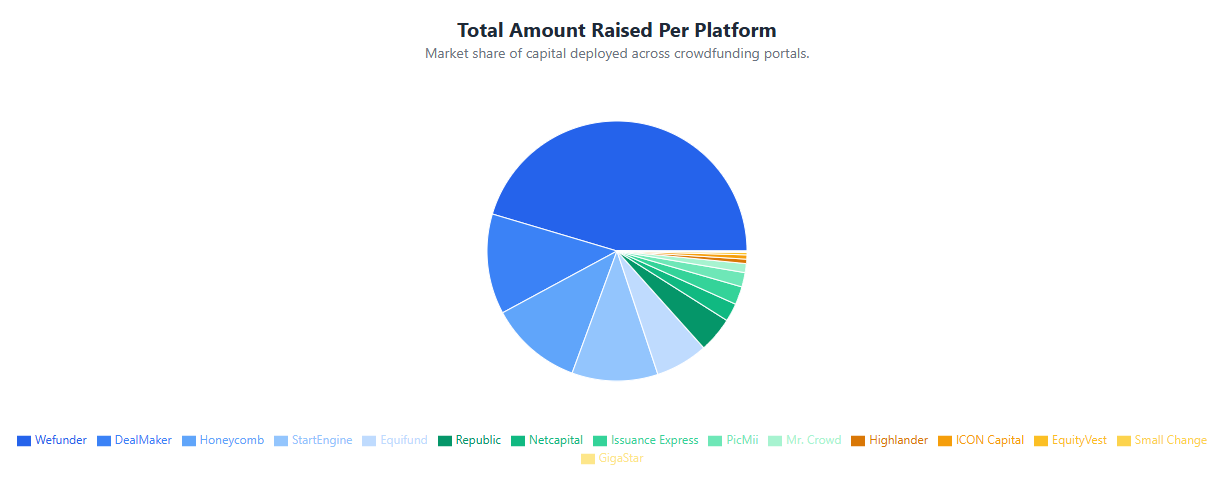
To understand the crowdfunding ecosystem, we must analyze the infrastructure facilitating it. The $44.2 million raised last week was distributed across a variety of platforms, each catering to different investor demographics and company profiles.
Analyzing the Platform Data:
The Debt Anomaly: Honeycomb Credit
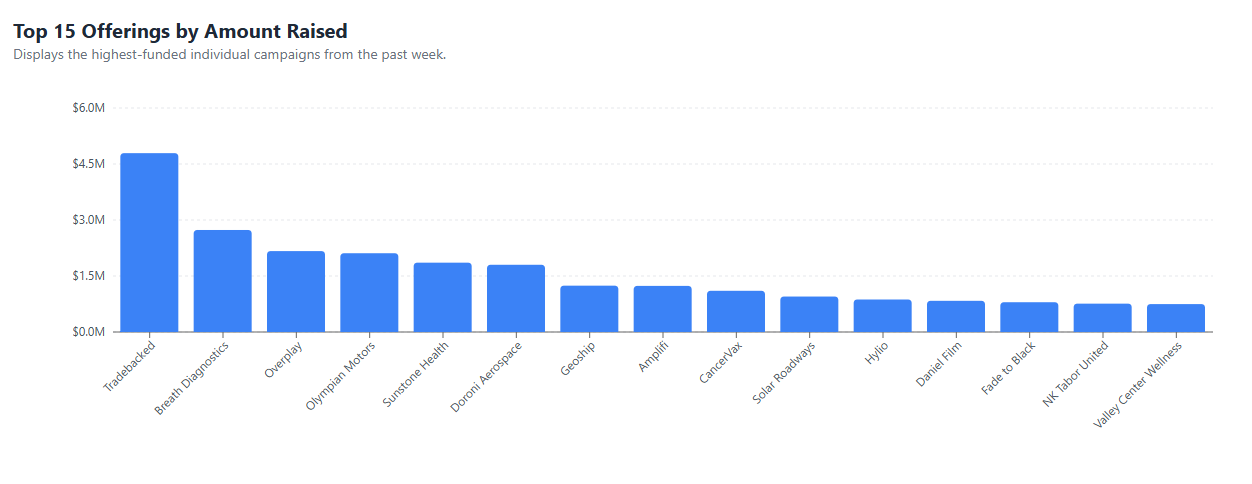
The single largest raise of the week did not come from a flashy AI startup, but from a private credit firm. Tradebacked secured an astonishing $4,790,500.00 on Honeycomb Credit. Honeycomb is traditionally known for localized, Main Street small business debt (like the $25,549 raised by Lone Wolf restaurant). However, Tradebacked’s massive raise signals a maturation of crowdfunding into sophisticated private credit and inventory financing. Investors are hungry for yield, and debt structures provide a predictable return profile that equity cannot guarantee.The Volume King: Wefunder
Wefunder continues to dominate in sheer deal volume. From Overplay ($2.16M) and Olympian Motors ($2.1M) down to community spaces like The Witch’s Cottage ($174K), Wefunder is the undisputed hub for consumer-facing brands, entertainment, and early-stage tech. Their platform’s social features and community-driven ethos make it the default choice for founders looking to turn customers into evangelists.High-Ticket Equity and Hardware: DealMaker Securities & StartEngine
When companies need to raise massive capital for hardware, deep-tech, or infrastructure, they turn to DealMaker and StartEngine. DealMaker facilitated huge rounds for Doroni Aerospace ($1.8M), Geoship ($1.24M), and StorEn Technologies ($565K). StartEngine similarly powered CancerVax ($1.1M) and Hylio ($870K). These platforms excel at attracting high-net-worth retail investors willing to back capital-intensive, long-horizon projects.The Niche Powerhouses: Equifund, Republic, and Issuance Express
Breath Diagnostics pulled in a massive $2.73M on Equifund, proving that specialized platforms can drive immense capital to life sciences. Republic continues to attract sophisticated tech and fintech plays like Amplifi ($1.23M) and Pluto7 ($311K). Issuance Express showed strength with Nico Ventures ($510K) and UgenticAI ($431K).
The Strategy of Minimum Investments: Accessibility vs. Cap Table Management
One of the most critical strategic decisions a founder makes when structuring a community round is setting the minimum investment threshold. The data from last week reveals a fascinating dichotomy in how founders approach this.
The $100 Micro-Angel Approach:
The vast majority of campaigns on Wefunder (e.g., Frontier Bio, Neopenda, SohoMD, Just Her Rideshare) opted for a $100 minimum.
A $100 minimum is fundamentally a marketing strategy. It is designed to remove all friction for retail consumers, allowing a company to acquire thousands of brand ambassadors. For consumer packaged goods (CPG) companies like Culprit Underwear or entertainment projects like Fade to Black, having 5,000 investors who will buy your product, watch your movie, and promote it on social media is infinitely more valuable than the capital itself. However, it requires robust cap table management software (like Carta) to handle the sheer volume of micro-investors.
The $500 to $1,000 Commitment:
Companies dealing in B2B SaaS, deep-tech, or real estate tend to set higher floors. Doroni Aerospace ($998), Valley Center Wellness ($1,000), Geoship ($888), and Amplifi ($1,000) are prime examples.
Higher minimums act as a filter for high-intent, sophisticated investors. If you are building an eVTOL aircraft or a zero-carbon ceramic home, you need investors who understand long R&D cycles and regulatory hurdles. A $1,000 minimum ensures that the investors on your cap table have skin in the game and reduces the administrative burden on the founder.
What is Best?
There is no one-size-fits-all answer. If your business relies on viral consumer adoption and community network effects, set the minimum as low as the platform allows ($100). If you are a capital-intensive B2B or deep-tech company where the investor’s network is less relevant than their capital, a $500 to $1,000 minimum is the optimal sweet spot to balance accessibility with administrative efficiency.
Security Types Demystified: What Are Investors Actually Buying?
The type of security offered dictates the long-term financial relationship between the founder and the investor. Last week’s data showcases a diverse mix of financial instruments, reflecting a highly sophisticated market.
1. SAFE (Simple Agreement for Future Equity)
The Trend: SAFEs remain the dominant instrument for early-stage tech, AI, and high-growth startups (Overplay, Handprint, Olympian Motors, Pluto7).
Analysis: SAFEs are incredibly founder-friendly. They are fast, cheap to execute, and allow founders to delay the complex process of pricing their company until a future institutional round. However, in 2026, retail investors are becoming more discerning. Because a SAFE does not grant immediate equity or voting rights, and only converts upon a triggering liquidity event, investors are taking on maximum risk. Founders using SAFEs must clearly articulate their path to a Series A or acquisition to justify this risk.
2. Equity (Common and Preferred)
The Trend: Priced equity rounds are standard for later-stage companies, hardware manufacturers, and biotech firms (Breath Diagnostics, Sunstone Health, Doroni Aerospace, CancerVax).
Analysis: Offering actual shares (whether Common or Preferred) provides investors with a tangible sense of ownership. Preferred equity, which often comes with liquidation preferences, is highly attractive to retail investors as it offers a layer of downside protection. For impact investors backing companies like Geoship or Solar Roadways, holding real equity aligns their financial upside directly with the company’s physical impact on the world.
3. Debt and Convertible Notes
The Trend: As seen with Tradebacked ($4.7M) and Lone Wolf, pure debt is rising. Convertible Notes (Neopenda, Just Her Rideshare, Asarasi) offer a hybrid approach.
Analysis: In a fluctuating macroeconomic environment, debt is king. Investors are increasingly looking for yield and predictable repayment schedules. Convertible notes offer the downside protection of debt (with an interest rate) combined with the upside potential of equity conversion. This is an excellent tool for companies bridging the gap between major funding rounds.
4. Revenue Share
The Trend: Revenue share agreements absolutely dominate the entertainment and local business sectors (Fade to Black, The King of Con, Daniel Film, Elmwood Park).
Analysis: Rev-Share is the ultimate alignment of incentives for project-based businesses. An independent film cannot guarantee an IPO, but it can guarantee investors a percentage of box office receipts or streaming licensing fees until a multiple (e.g., 120% or 150%) of their principal is returned. This structure is revolutionizing indie Hollywood.
The Evolution of Founders and Investors in 2026
Thoughts on the Modern Impact Founder:
The founders represented in this data set are a new breed. Gone are the days when “impact” meant sacrificing financial returns for idealism. Today’s impact founders are ruthless pragmatists. Leaders like Mathias Boissonot of Handprint or Ryan Davies of CancerVAX understand that to scale their mission globally, they must build highly profitable, defensible business models. They are leveraging advanced technologies—Agentic AI, robotics, and synthetic biology—not as buzzwords, but as fundamental operational tools to drive down costs and expand margins. They view retail crowdfunding not as a last resort, but as a strategic weapon to build an army of loyal advocates.
Thoughts on the Modern Retail Investor:
The retail investor of 2026 is highly sophisticated. They are no longer throwing $100 at a flashy Kickstarter gadget that may never ship. They are reading FDA clinical trial data for PhorMed, analyzing the patent portfolios of StorEn Technologies, and evaluating the unit economics of Nude Foods Market. Impact investors, specifically, are demanding “double-bottom-line” returns. They want their capital to cure sepsis (Eliaz Therapeutics) or clean the oceans (Positive Polar), but they also expect a 5x to 10x financial return. This demand for excellence is forcing founders to elevate their pitches, resulting in a healthier, more robust private market.
Sector Deep Dives: Where the $44.2 Million Went
To truly understand the impact of this funding, we must categorize and analyze the companies by sector. The breadth of innovation funded last week is staggering.
1. The Vanguard of Healthcare, Biotech, and MedTech
The crowd is increasingly stepping in to fund life sciences, bridging the “Valley of Death” in early-stage clinical trials.
Breath Diagnostics ($2.73M): Valued at $32.1M, this company is revolutionizing oncology. By detecting cancer compounds in human breath, they are making screening faster, cheaper, and less invasive. The $2.7M raised will push their FDA submissions and R&D, proving that the crowd will heavily back non-invasive diagnostics.
CancerVAX ($1.1M): Using the body’s immune system to fight cancer by disguising cancer cells as measles. This pre-clinical biotech company is offering an alternative to the devastating side effects of chemotherapy.
PhorMed ($222K): Valued at $52.5M, PhorMed is using gene therapy (RP-323) to target Hodgkin’s Lymphoma and Parkinson’s. Having completed Phase 1 trials, crowd capital is now fueling their Phase 2 journey.
Eliaz Therapeutics ($641K): Tackling sepsis—one of the leading causes of death in hospitals—with their XGal-3 device. Backed by 60 patents, this is a high-reward play for investors looking to solve acute critical care crises.
Neurocarrus ($200K): Addressing the opioid epidemic head-on with N-001, a non-addictive, long-acting pain relief drug.
Synovation Medical Group ($243K): A massive $109M valuation company operating 40 clinics, proving that brick-and-mortar healthcare infrastructure can successfully raise from the crowd to optimize operations.
illumicell AI ($220K) & DNA Chat Corporation ($92K): Both companies are merging AI with biology. illumicell uses computer vision for cellular diagnostics (starting with fertility), while DNA Chat uses AI and full-genome sequencing to enable precision medicine via telehealth.
Epinal ($80K) & SofPulse ($134K): Epinal is building multi-drug breathalyzers to combat the narcotics epidemic, while SofPulse uses FDA-cleared electroceutical technology to reduce post-operative pain without opioids.
2. Climate Tech, Energy, and Sustainable Infrastructure
Hardware is hard, but it is where the most significant environmental impact lies. Investors deployed massive capital into physical climate solutions last week.
Geoship ($1.24M): Valued at $111M, Geoship is fundamentally rethinking human habitation. Their zero-carbon, fireproof, and non-toxic ceramic domes have a $500M customer pipeline. This is a direct response to the global housing crisis and climate-induced natural disasters.
Solar Roadways ($949K): A legacy crowdfunding darling, Solar Roadways continues to raise capital to turn driving surfaces into clean energy grids. With DoD and DOT grants under their belt, they represent the ultimate infrastructure moonshot.
StorEn Technologies ($565K): Moving beyond lithium, StorEn is developing all-vanadium flow batteries for residential energy storage. As the grid becomes more unstable, decentralized energy storage is a massive growth sector.
Paladin Power ($600K) & Innovus Power ($171K): Both companies are decentralizing the grid. Paladin offers stackable residential energy storage, while Innovus provides on-site microgrid power systems to compete with centralized utilities.
Handprint ($220K): A SaaS marketplace valued at $23M that allows companies to buy verified Nature Credits to offset carbon footprints, rewriting capitalism with ecosystem restoration.
Windlift ($275K) & Halcium Energy ($338K): Rethinking wind power. Windlift uses tethered drones to generate electricity in flight, while Halcium builds small, moving-part-free wind turbines for urban environments.
InfiniCell ($154K): Developing non-flammable, resource-abundant battery chemistry for EVs and grid storage, highlighting the urgent need to diversify away from rare-earth metals.
Renewables ($11K): Pioneering solar-electric, autonomous tractors (e2T) for sustainable agriculture, reducing emissions and operational costs for farmers.
Future Proof Climate Intelligence ($26K): Using AI to connect homeowners and insurers with property-hardening plans against extreme weather, a vital adaptation tool in 2026.
3. The Future of Mobility, Aerospace, and Transportation
The crowd is funding the vehicles of tomorrow, from the streets to the skies.
Olympian Motors ($2.1M): Valued at $70M, Olympian is taking on Tesla and Rivian by manufacturing light-passenger EVs in New York. With 547 pre-orders, they are proving that boutique, design-forward EV manufacturing has a dedicated market.
Doroni Aerospace ($1.8M): Valued at $223.6M, Doroni is bringing the sci-fi dream of personal eVTOL (flying cars) to reality. With over 600 pre-orders, retail investors are funding the regulatory and manufacturing push for their H1-X showroom model.
Rally ($131K): A rideshare platform for buses. Having generated $120M in revenue, Rally proves that optimizing existing mass transit through dynamic routing is highly profitable.
Swift Ride ($65K): An app-based car subscription service built specifically for gig workers, solving the vehicle access problem for the modern independent workforce.
Apex Resource Center Partners ($67K): A unique motorsport team utilizing crowdfunding to sponsor and develop young racing talent like Wesley Gundler.
4. Artificial Intelligence, SaaS, and Fintech
AI is no longer a separate vertical; it is the foundational layer for modern software and financial infrastructure.
Overplay ($2.16M): Valued at $50M, Overplay uses AI to turn passive video content into interactive games. This is the future of creator monetization and user engagement.
Amplifi ($1.23M): Democratizing access to large-scale private markets (real estate, VC, private credit) through an SEC-compliant interval fund structure.
CYBR International ($164K): Valued at $16M, CYBR uses AI to detect illicit file activity that traditional safeguards miss, securing partnerships with IBM and AWS.
Nico Ventures ($510K): Building YourNews.com, a decentralized content distribution platform with a built-in pay model for journalists, combating media consolidation.
Pluto7 ($311K): Moving supply chains from legacy ERPs to AI agents. Endorsed by Google, their Planning-in-a-Box solution offers 10x faster autonomous planning.
UgenticAI ($431K): An AI venture studio that spots market gaps and rapidly builds, tests, and launches Agentic AI tools to a massive customer base.
Oner Network ($176K): An AI-native payment infrastructure processing micro-transactions globally in under one second for under one cent, enabling machine-to-machine payments.
Share-ify ($65K): An AI food safety platform trusted by 5 million companies across 59 countries to prevent recalls and ensure compliance.
Value Buddy ($101K): Using AI to power valuations for SMB acquisition loan underwriting, reducing risks and fees for SBA and non-SBA loans.
NOYACK ($136K): An AI-driven wealth management platform acting as a financial coach and personal portfolio agent for retail investors.
Musaffa ($293K): An Islamic fintech platform providing global access to halal investments for over 580,000 users.
5. Food, Beverage, and Agricultural Innovation
Sustainable sourcing, clean ingredients, and agricultural robotics dominated this sector.
Hylio ($870K): Valued at $201M, Hylio builds automated drone systems for precision agriculture. With $35M in lifetime revenue and clients like the USDA, they are reducing chemical runoff and increasing crop yields.
Rich Nuts ($225K) & Pacha ($327K): Both companies are scaling ultra-clean, organic foods. Rich Nuts offers sprouted, additive-free nuts, while Pacha is scaling a two-ingredient, organic sprouted buckwheat bread with nationwide Whole Foods distribution.
Fire Grounds Coffee ($243K): A mission-driven coffee roaster dedicating top-quality Colombian coffee to first responders and veterans, building a cult-like brand loyalty.
The Empanada Maker ($186K): A California-based gourmet restaurant concept raising capital to fuel franchise and wholesale expansion.
Nude Foods Market ($714K): A sustainable grocery store in Boulder operating on a closed-loop, zero-waste jar system, having already saved over 1 million pieces of single-use packaging.
Asarasi Sparkling Tree Water ($165K): Extracting and bottling sugar-free sap water discarded by the maple industry, creating a sustainable beverage while protecting groundwater reserves.
Beverage Brands (Franzese Wine, Kapena Tequila, RMBR, Uncle Waithley’s, AMASS Brands, Lode, Ofrenda Spirits Mezcal, Shankar Distillers, Vampire Corporation): This massive cohort proves that craft, story-driven, and functional beverages (including hemp-infused and non-alcoholic options) are highly successful at raising community capital to fund inventory and distribution expansion.
The Farmer’s Cow ($193K): Empowering small family farms by diversifying revenue through clean energy (turning farm waste into RNG), retail branding, and fast-casual dining.
Plainview Beef Co. ($123K): Distributing pure, traceable, grass-fed beef with significantly higher nutritional profiles, catering to the health-conscious carnivore market.
6. The Democratization of Media and Entertainment
Hollywood is being decentralized. Creators are bypassing traditional studio greenlights and going straight to their audiences.
The King of Con ($325K) & Fade to Black ($797K): Both projects utilized Wefunder to raise massive capital for production. Fade to Black is a feature film exploring Hollywood ambition, while The King of Con is a docuseries about a notorious FBI informant.
Daniel Film ($835K): A Biblical epic leveraging a powerhouse marketing team and faith-based community support for a theatrical release.
Starfish Film ($158K), A Dream For Amy ($80K), We Could Be Heroes ($145K), Hiking Buddies ($54K), Elmwood Park ($105K), Marilyn Exposed ($60K): From sci-fi dramas about cloning to female-led vampire films and off-Broadway musicals, independent creators are using Revenue Share agreements to fund diverse, niche storytelling that traditional studios deem too risky.
19XX 2nd Channel Drop ($18K): A YouTube true-crime documentary channel raising capital to expand its digital footprint, proving that the creator economy can leverage equity crowdfunding.
Same Same But Different Music Festival ($401K): An independent music festival in California using crowd capital to fund stages, lighting, and marketing, rewarding their loyal attendee base with equity.
The Elysian ($112K): A fascinating publishing project where investors fund the live writing of a book about equity and ownership, participating in the creative process.
7. Consumer Goods, Retail, and Community Spaces
Physical retail and consumer products are thriving when backed by a strong community ethos.
MAGFAST ($445K): Valued at $43M, this electronics company has generated over $21M in pre-orders for its premium magnetic charging products, using Netcapital to fund manufacturing and fulfillment.
Solgaard ($136K): Valued at $171M, Solgaard upcycles ocean plastic into premium travel gear. With over $200M in lifetime revenue, they are the gold standard for sustainable consumer products.
PARKIT ($311K) & LIVSN Designs ($159K): Both companies are innovating in the outdoor lifestyle space. PARKIT creates premium utility folding chairs, while LIVSN designs versatile, ethically made outdoor apparel.
Tender Loving Empire ($254K): A retail store chain supporting independent artists and makers, raising capital to service debt and expand inventory.
Groomit ($251K) & Ava’s Pet Palace ($67K) & CheckMyPet XP ($11K) & Jasper ($83K): The pet economy is booming. Groomit offers on-demand grooming, Ava’s makes organic treats, CheckMyPet provides at-home health testing, and Jasper offers a grief support app for pet loss.
Community Spaces (The Witch’s Cottage, Magnolia Fund HTX, Grotto, Right Proper Brewing, Art’s Cafe, Richmond Revival): From witch-themed cafes and communal bathhouses to community-owned commercial kitchens and real estate redevelopments, local businesses are using platforms like Wefunder and Small Change to let neighbors invest in the physical spaces they frequent.
Culprit Underwear ($73K) & Slabmags ($183K) & Bumbo ($22K) & Aura by TruMeasure ($86K): Niche consumer products—from viral, sustainable underwear and trading card protectors to ergonomic baby gear and AI-customized bras—are successfully leveraging their highly engaged customer bases for growth capital.
NK Tabor United ($759K): A Slovenian soccer club raising capital to achieve top-tier status, allowing fans to literally own a piece of their favorite sports team.

Predictions for the Future of Impact Crowdfunding
Based on the data, the text, and the macroeconomic indicators of May 2026, we can make several high-conviction predictions for the next 12 to 24 months in the impact crowdfunding space:
1. The Rise of “Agentic AI” as a Baseline Requirement
We are moving past the phase where simply having an “AI chatbot” was enough to secure funding. Companies like Pluto7 and UgenticAI are deploying Agentic AI—systems that do not just assist, but autonomously execute complex workflows. Prediction: By late 2027, retail investors will expect every SaaS, logistics, and fintech company pitching on these platforms to clearly demonstrate how Agentic AI is fundamentally reducing their headcount and operational overhead. Companies that fail to integrate this will be viewed as legacy businesses and will struggle to raise.
2. The Hardware Renaissance Will Accelerate
For the last decade, venture capital was heavily skewed toward software due to its infinite scalability and high margins. However, the climate crisis and supply chain vulnerabilities have shifted the focus back to the physical world. Prediction: Platforms like DealMaker and StartEngine will see a massive surge in mega-rounds ($5M+) for deep-tech hardware, robotics (Artly), aerospace (Doroni), and physical infrastructure (Geoship). Retail investors are showing a unique patience for the long R&D cycles of hardware, provided the total addressable market (TAM) is massive.
3. Debt and Yield-Bearing Instruments Will Rival Equity
The success of Tradebacked’s $4.79 million raise on Honeycomb Credit is a watershed moment. As retail investors look to balance their portfolios against market volatility, the demand for fixed-income, yield-bearing assets will skyrocket. Prediction: We will see a proliferation of private credit, inventory financing, and revenue-share models across all major platforms. Founders who have steady cash flow but do not want to dilute their equity will increasingly turn to the crowd for debt financing.
4. The Complete Decentralization of Indie Entertainment
The sheer volume of films, docuseries, and musicals funded last week (Fade to Black, King of Con, Daniel Film) proves that creators no longer need traditional studio backing. Prediction: Within the next two years, a crowdfunded independent film or series will break into mainstream, top-tier commercial success (e.g., a top 10 box office weekend or a massive Netflix acquisition). The built-in marketing engine of having thousands of retail investors acting as financially incentivized street-team promoters is a mathematical advantage that traditional studios simply cannot replicate.
5. Biotech Crowdfunding Will Bridge the “Valley of Death”
Biotech startups often die in the “Valley of Death”—the capital-intensive void between promising pre-clinical data and Phase 2 human trials. Traditional VC is often too risk-averse to bridge this gap alone. Prediction: Companies like Breath Diagnostics and CancerVAX are proving that retail investors, particularly those motivated by personal or familial experiences with diseases, are willing to fund life-saving R&D. Crowdfunding will become a standard, expected tranche of capital in the Series A/B rounds of major life science companies.
Conclusion: The Superpower of the Crowd
The $44,211,602.00 deployed last week is not just a financial statistic; it is a profound societal indicator. It represents a collective decision by thousands of everyday people to allocate their capital toward the future they wish to inhabit. They are funding the cure for sepsis, the transition to zero-carbon housing, the safety of female gig workers, and the preservation of global artisan cultures.
For Founders, the message is unequivocal: If you are building a company with a genuine superpower for good, a transparent business model, and a defensible moat, the capital is available. You must treat your retail investors with the same rigor, respect, and communication cadence that you would a Tier-1 institutional venture capitalist. Build your community before you need their capital, and they will support you through the inevitable turbulence of company building.
For Investors, the opportunity set has never been richer or more diverse. You now have a seat at the table for clinical-stage biotech, revolutionary aerospace hardware, and paradigm-shifting artificial intelligence. However, with this access comes the responsibility of rigorous due diligence. Understand the difference between a SAFE and Preferred Equity. Evaluate the founder’s pragmatism alongside their idealism. Continue to use your capital as a superpower for good, and you will not only drive the innovation of the 2020s but stand to reap the financial rewards of being early to the future.

Make an Impact with Exclusive Investment Insights

Are you ready to align your investments with your values? Impact Members of the SuperCrowd receive exclusive weekly picks from Devin Thorpe, spotlighting innovative ventures that drive social good while offering potential financial returns.
Gain access to carefully selected opportunities that empower communities, promote sustainability, and deliver real change. Don’t just invest—make an impact.
Disclaimer:
This article is for informational and educational purposes only. It does not constitute financial advice, investment advice, or a recommendation to buy or sell any securities. Crowdfunding investments are speculative, illiquid, and carry a high degree of risk, including the total loss of principal. Past performance is not indicative of future results. Investors should conduct their own due diligence and consult with financial advisors before making investment decisions.
Support Our Sponsors
Our generous sponsors make our work possible, serving impact investors, social entrepreneurs, community builders and diverse founders. Today’s advertisers include Emission Free Generators and Climatize. Learn more about advertising with us here.
Max-Impact Members
(We’re grateful for every one of these community champions who make this work possible.)
Brian Christie, Brainsy | Cameron Neil, Lend For Good | Carol Fineagan, Independent Consultant | Hiten Sonpal, RISE Robotics | John Berlet, CORE Tax Deeds, LLC. | Justin Starbird, The Aebli Group | Lory Moore, Lory Moore Law | Marcia Brinton, High Desert Gear | Mark Grimes, Networked Enterprise Development | Matthew Mead, Hempitecture | Michael Pratt, Qnetic | Mike Babbit | Coledger Solutions | Mike Green, Envirosult | Nick Degnan, Unlimit Ventures | Dr. Nicole Paulk, Siren Biotechnology | Paul Lovejoy, Stakeholder Enterprise | Pearl Wright, Global Changemaker | Scott Thorpe, Philanthropist | Sharon Samjitsingh, Health Care Originals
Upcoming SuperCrowd Event Calendar
If a location is not noted, the events below are virtual.
SuperCrowd Impact Member Networking Session: Impact (and, of course, Max-Impact) Members of the SuperCrowd are invited to a private networking session on May 19th at 8:00 PM ET/5:00 PM PT. Mark your calendar. We’ll send private emails to Impact Members with registration details. Upgrade to Impact Membership today!
SuperCrowdHour, May 20, 2026, at 12:00 PM Eastern. Devin Thorpe will lead a session on “How to File Your Form C-AR Yourself for Free!” Designed for founders and issuers navigating regulated investment crowdfunding, this practical session will walk attendees through the annual Form C-AR filing process and show how to complete it independently—without unnecessary legal or filing expenses. Devin will explain what information is required, common mistakes to avoid, important deadlines to remember, and how staying compliant helps build trust with investors while protecting your raise. Whether you’ve recently closed an offering or are preparing for your first annual report, this SuperCrowdHour will provide a clear, cost-effective roadmap to filing your Form C-AR with confidence. Register here: https://thesupercrowd.com/20may26
SuperCrowd26 featuring PurposeBuilt100™️: This August 25–27, founders, investors, and ecosystem leaders will gather for a three-day, broadcast-quality global experience focused on disciplined capital formation, regulated investment crowdfunding, and purpose-driven growth. We’re bringing together leading voices in impact investing, compliance, digital marketing, and circular economy innovation to deliver practical frameworks, real-world case studies, and actionable strategies. The event culminates in the PurposeBuilt100™️ Showcase, recognizing 100 of the fastest-growing purpose-driven companies in the U.S. Register now to secure your seat and get all the details. August 25–27, streaming worldwide.
Share the application for the PurposeBuilt100™: Purpose-driven founders deserve recognition. The PurposeBuilt100™ application window is now open—celebrating the fastest-growing companies building profit with purpose. If you know a founder creating real impact and real growth, please share this opportunity. Applications are free and confidential. Explore the program and apply today: PurposeBuilt100.com.
Superpowers for Good Live Pitch on e360tv — June 3, 2026. Purpose-driven founders raising capital through Regulation Crowdfunding are invited to apply by May 6, 2026, for a chance to pitch live to a national audience of investors and impact champions.
Community Event Calendar
Successful Funding with Karl Dakin, Tuesdays at 10:00 AM ET - Click on Events.
Earthstock Summit, Ojai, CA, May 29-31: The Earthstock Regenerative Summit in Ojai brings together leaders and community members for panels, workshops, films, music, and hands-on projects focused on regenerative agriculture, ecological design, resilience, health, and sustainable living.
Save the Date! October 20th and 21st will be the Crowdfunding Professional Association Regulated Investment Crowdfunding Summit for 2026. This is the event of the year for everyone in the crowdfunding ecosystem.
If you would like to submit an event for us to share with the 10,000+ changemakers, investors and entrepreneurs who are members of the SuperCrowd, click here.
We utilized AI to efficiently gather data and analyze key success factors, enabling us to deliver an overview of these successful crowdfunding campaigns.
We share educational information—not investment advice. Some links may generate compensation. See our full disclosure.