


You can advertise in Superpowers for Good. Click to learn more about our affordable options.

The democratization of capital formation through Regulation Crowdfunding (Reg CF) has evolved from a niche alternative funding mechanism into a sophisticated, multi-trillion-dollar institutional and retail ecosystem. In this market report, we conduct a deep-dive analysis of 13 Regulation Crowdfunding campaigns that successfully completed and formally closed their offerings over the past two weeks, raising a collective $3,588,775.00 from thousands of everyday retail backers, accredited angel investors, and community stakeholders.
This cohort spans an extraordinary spectrum of modern venture archetypes: from high-growth consumer packaged goods (CPG) brands generating millions in annual revenue to deep-tech biotech ventures, cell-cultivated food innovation, transmedia gaming studios, and grassroots main street businesses revitalizing local economies through hyper-local debt instruments.
Through rigorous examination of platform mechanics, financial structures, founder demographics, minimum investment thresholds, and investor behavior, this analysis provides actionable intelligence for founders preparing to enter the market and investors seeking risk-adjusted impact returns in 2026.

Superpowers for Good Classification & Methodology
To analyze the broader equity crowdfunding landscape, our data selection relies on a clear, purpose-driven filtering model.
Each week, Superpowers for Good shares a list of new impact-related offerings added to FINRA-registered crowdfunding portals and by broker-dealers. Using our classification methodology, we highlight offerings with social impact, women in leadership, and underrepresented founder leadership.
By overlaying this lens across the recent cohort of closed campaigns, we gain unique insight into how diverse founder leadership, environmental stewardship, and social missions intersect with retail capital commitment. In this dataset, offerings led by female founders (such as Freeland Spirits, Green Compass, Giulia, and Gheelicious) and mission-driven initiatives supporting underrepresented global supply chains (such as Mutombo Coffee) represented a significant portion of both total closed dollars and overall campaign volume.
Macro Ecosystem Analysis & Data Visualizations
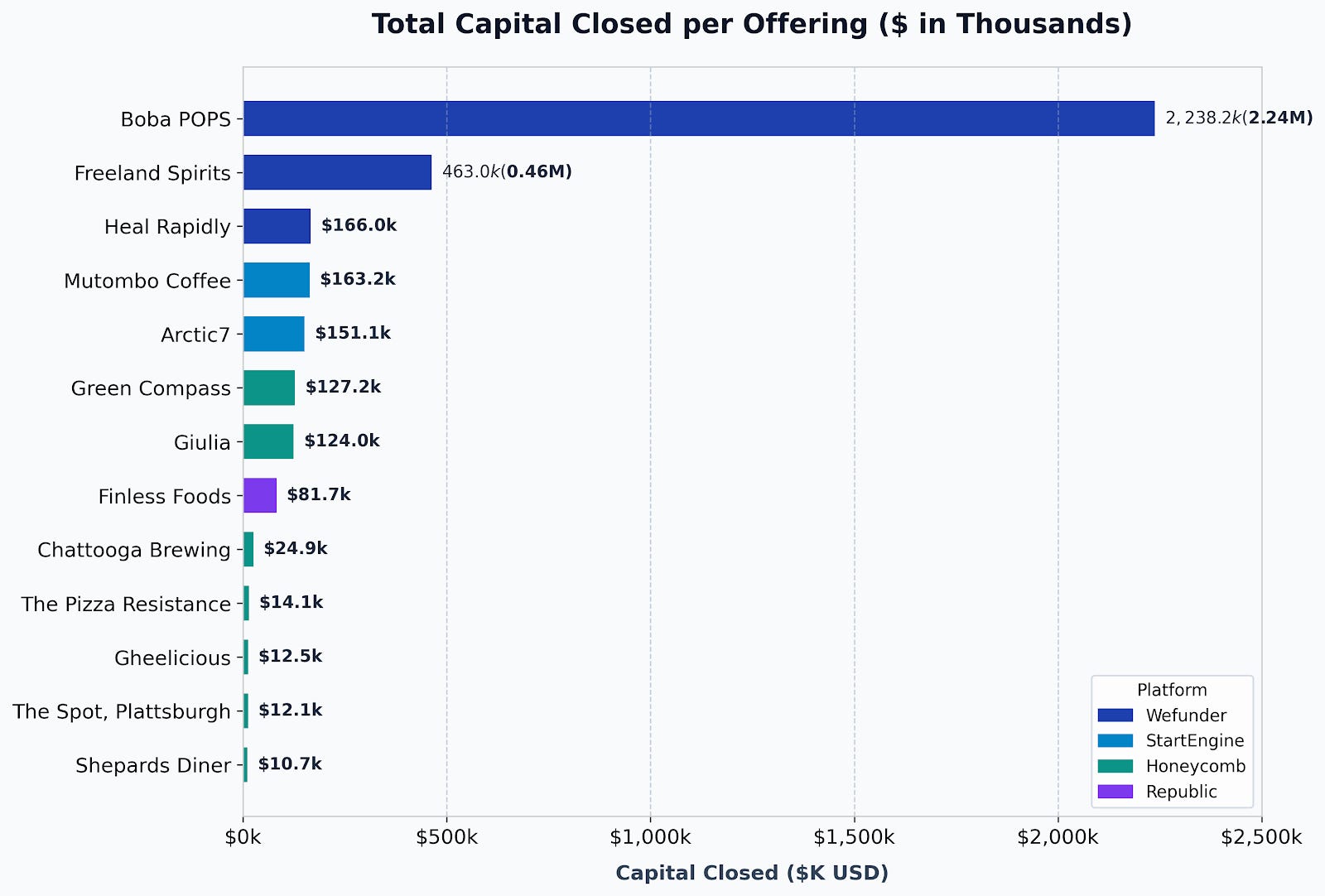
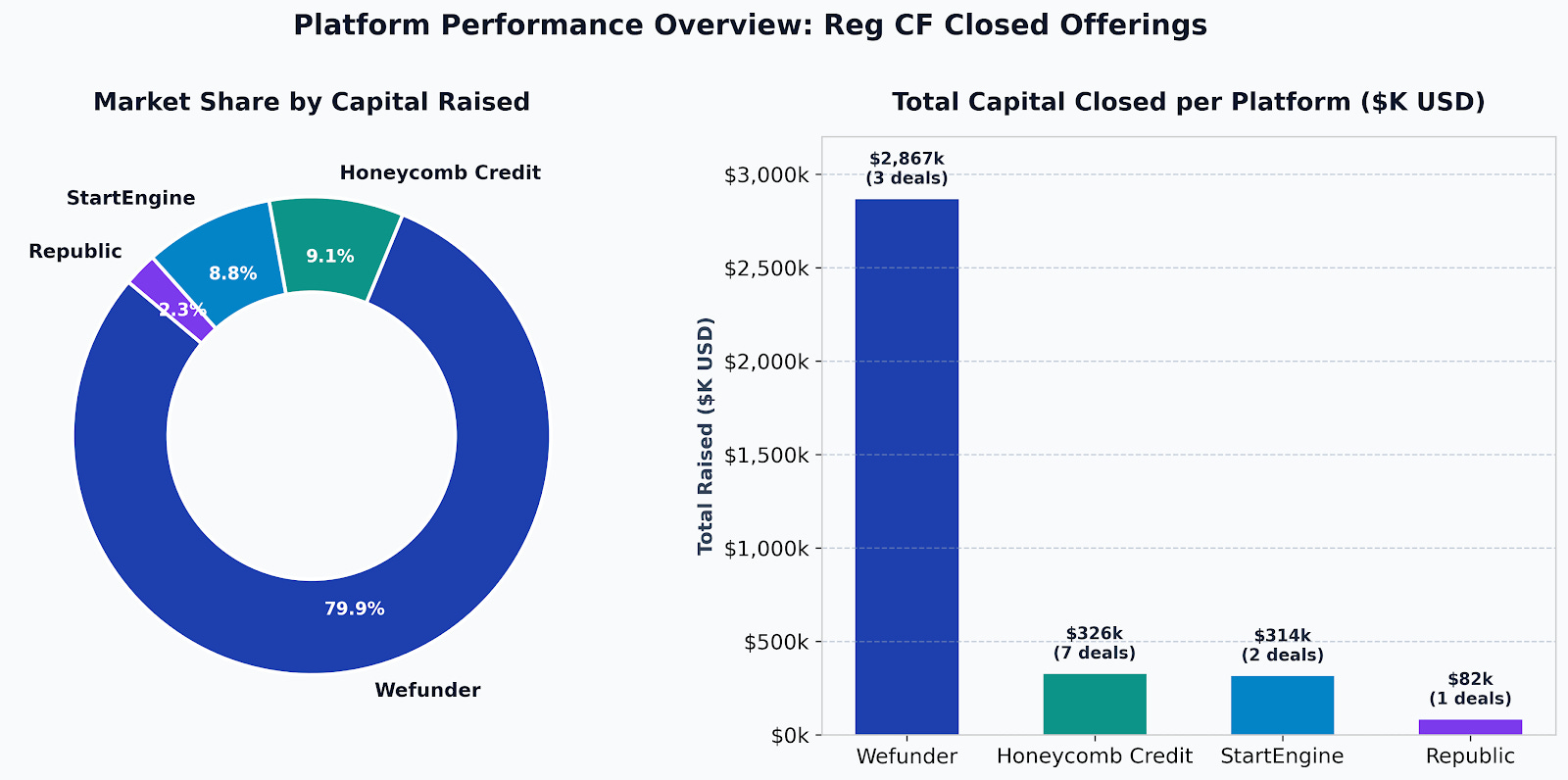
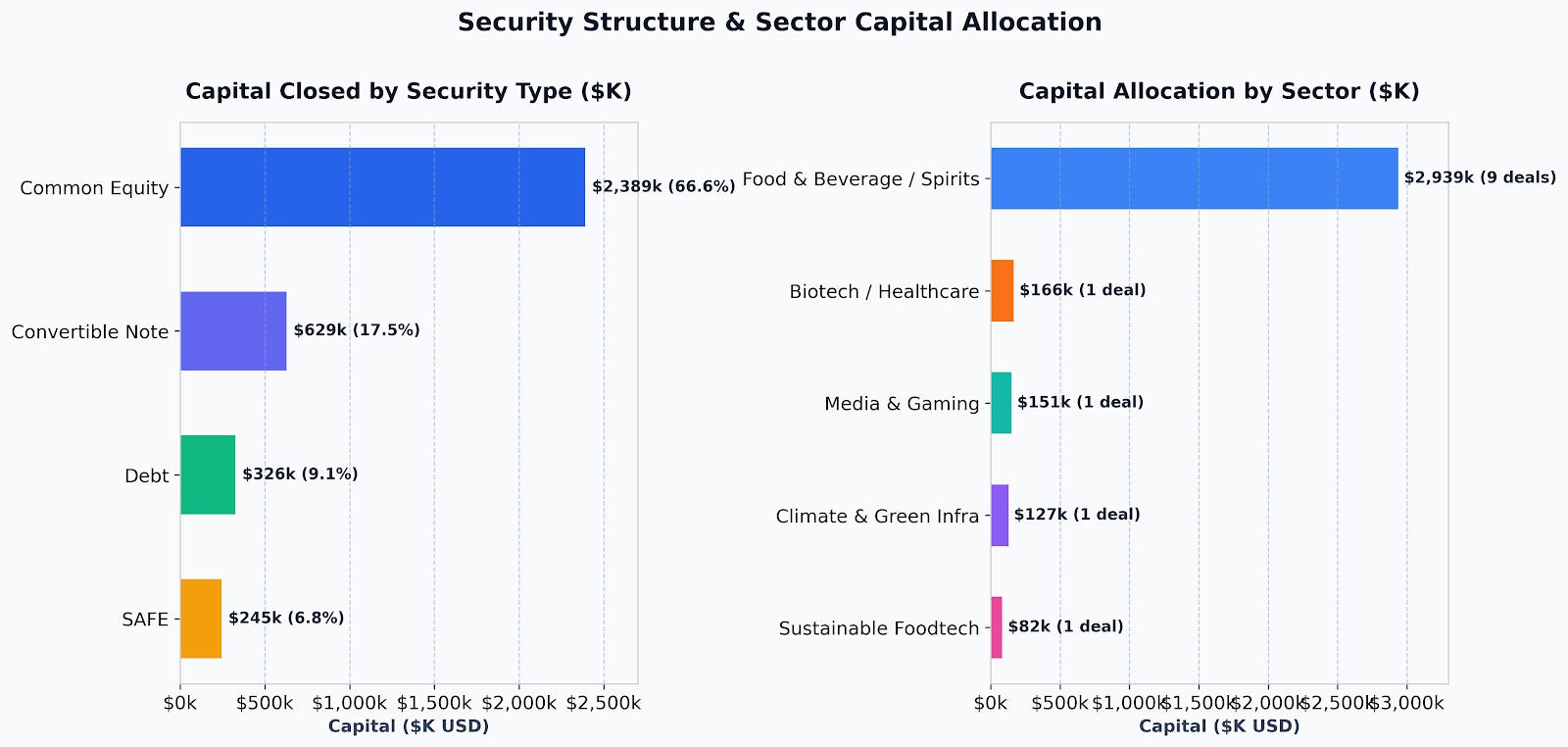
To visualize how capital was allocated across this cohort of 13 successfully closed campaigns, the following charts illustrate the distribution across individual offerings, primary funding portals, security types, and minimum investment thresholds.
Aggregate Campaign Performance Summary
The table below details all 13 offerings that successfully closed their Reg CF campaigns during the past two-week window:
Platform Analysis: Positioning, Ecosystem Strengths, and Target Audiences
The Reg CF market is not homogeneous; funding portals operate as specialized venues tailored to distinct company stages, capital structures, and investor personas.
1. Wefunder: The High-Volume Consumer & Growth Engine
Wefunder accounted for 79.89% ($2,867,185.00) of the total capital closed in this dataset across just three campaigns. Wefunder’s strength lies in its ability to rally retail consumer bases around viral, highly tangible consumer brands (Boba POPS) and established craft lifestyle companies (Freeland Spirits).
Platform Strengths: Flexible instrument support (Common Equity, SAFE, Convertible Notes), strong UX for retail discovery, and a culture that encourages founders to activate their existing community.
Investor Demographics: A healthy balance of tech-savvy retail investors, consumer brand enthusiasts, and early-stage angels looking for high-upside growth equity.
Optimal Sector Fit: High-velocity CPG, direct-to-consumer (DTC) brands, regional beverage powerhouses, and early-stage healthtech/biotech.
2. Honeycomb Credit: The Main Street Debt & Local Impact Authority
Honeycomb Credit closed 7 out of 13 campaigns in this cohort, capturing $325,608.00 (9.07%). While its total dollar amount is smaller due to the nature of local business debt, Honeycomb achieved a 100% campaign success rate across its offerings.
Platform Strengths: Standardized, fixed-income term notes that allow local businesses to borrow from their customers rather than banks. Provides clear, immediate yield structures for backers.
Investor Demographics: Community-centric investors, local neighborhood supporters, and yield-focused retail backers seeking regular yield payouts rather than long-horizon equity liquidity.
Optimal Sector Fit: Restaurants, regional craft breweries, specialized food brands, boutique hospitality, and urban climate/infrastructure projects with visible local impact.
3. StartEngine: Brand Expansion & Retail Investor Trading Culture
StartEngine captured $314,287.00 (8.76%) across two offerings (Mutombo Coffee and Arctic7). StartEngine excels at presenting growth-stage companies with established operational track records or strong celebrity/founder positioning.
Platform Strengths: Native secondary trading features (StartEngine Secondary), aggressive digital marketing engine, and an investor base accustomed to growth equity valuations.
Investor Demographics: Active retail equity investors, tech enthusiasts, gamer-investors, and followers of high-profile brand ambassadors.
Optimal Sector Fit: Gaming, media transmedia, web3/entertainment, and purpose-driven venture brands with national scale potential.
4. Republic: Deep Tech, Frontier VC, & Institutional Cross-Over
Republic captured $81,695.00 (2.28%) with Finless Foods. Republic operates at the intersection of retail crowdfunding and institutional venture capital, often listing high-valuation, venture-backed startups.
Platform Strengths: Global investor reach, sleek institutional interface, strong syndicate network, and cross-border investor access.
Investor Demographics: Tech workers, institutional-lite retail angel networks, crypto/fintech investors, and ESG/deep-tech backers.
Optimal Sector Fit: Cell-cultivated biotech, deep climate tech, frontier hardware, and global SaaS platforms.

Security Type Analysis: Structural Comparison & Alignment
Choosing the right security structure determines a company’s capital stack, dilution profile, and long-term investor governance. The 13 closed offerings used four distinct financial instruments:
1. Common Equity (priced Rounds)
Used by Boba POPS ($17.7M valuation) and Arctic7 ($19.95M valuation).
Founder Incentives: Establishes a concrete, priced valuation valuation baseline. Aligns retail investors directly with institutional shareholders holding common units.
Investor Risks & Liquidity: Full exposure to equity downside; liquidity is deferred until an M&A, secondary transfer, or IPO event occurs.
Strategic Alignment: Best suited for scaling companies with proven revenue, predictable unit economics, and clear exit horizons.
2. Convertible Notes
Used by Freeland Spirits and Heal Rapidly ($3.5M cap).
Founder Incentives: Defers valuation negotiations to a future institutional round while providing immediate growth capital. Accrues interest (typically 6–10%) that converts into equity.
Investor Risks: Investors carry downside risk without immediate equity ownership, but benefit from valuation caps and conversion discounts (typically 15–20%).
Strategic Alignment: Ideal for seed-stage companies needing growth runway to hit key operational milestones before pricing a full equity round.
3. SAFE (Simple Agreement for Future Equity)
Used by Mutombo Coffee ($20M valuation cap) and Finless Foods ($5M valuation cap).
Founder Incentives: Highly founder-friendly instrument with no interest rate, maturity dates, or immediate debt burden.
Investor Risks: Without a maturity date, if a company operates indefinitely without raising a qualified pricing round or exiting, SAFE holders may remain un-converted indefinitely.
Strategic Alignment: Perfect for early-stage deep-tech, biotech, or early CPG brands where regulatory approvals or long R&D timelines make setting a current valuation difficult.
4. Debt Instruments (Term Notes / Promissory Notes)
Used by all seven Honeycomb Credit issuers (Green Compass, Giulia, Chattooga Brewing, The Pizza Resistance, Gheelicious, The Spot, and Shepards Diner).
Founder Incentives: 100% non-dilutive. Founders retain total equity ownership and voting control while servicing principal and interest through monthly operational cash flow.
Investor Risks: Risk of business insolvency or default; however, risk is mitigated by asset backing, personal guarantees, and predictable monthly cash distributions.
Strategic Alignment: The gold standard for cash-flow-positive small businesses, local retail, restaurants, and environmental retrofits with predictable revenue streams.
Minimum Investment Thresholds: Strategic Trade-Offs
Minimum investment thresholds play a critical role in campaign design, directly influencing retail accessibility and investor distribution.
Accessibility vs. Cap Table Management
The $100 Floor (Democratic Access): Nine out of 13 campaigns selected a $100 minimum entry point. This low barrier to entry democratizes participation, allowing community supporters to back businesses they love. While managing thousands of micro-investors was historically challenging, modern transfer agents, SPVs (Special Purpose Vehicles), and custodian arrangements on platforms like Wefunder and Honeycomb have virtually eliminated cap-table friction.
The $250–$500 Floor (Signaling & Investor Quality): Selected by Boba POPS ($250), Finless Foods ($250), Mutombo Coffee ($500), and Arctic7 ($499.29). A higher threshold filters for investors with higher conviction and increases the average ticket size, reducing digital marketing acquisition costs per raised dollar.
Key Takeaway for Founders: Setting a lower minimum ($100) maximizes community building and viral referral marketing for consumer brands. Raising the minimum ($250–$500) works best when targeting sophisticated retail investors, accredited networks, or niche tech offerings.
The Psychology of Community Capital: Why Retail Investors Back Winners
Retail investor behavior differs fundamentally from traditional venture capital dynamics. While institutional VC funds prioritize financial metrics like internal rate of return (IRR) and total addressable market (TAM), retail investors are driven by a combination of emotional connection, mission alignment, tangible brand experiences, and strong social proof.
1. The Power of Tangible Innovation & Sensory Appeal
The top capital generator in this cohort—Boba POPS ($2,238,180.00)—capitalized on an instantly understandable, novel product experience: patented, alcohol-infused popping boba pearls. Investors do not need a computer science degree to understand the appeal of an innovative beverage product expanding across 10,000 retail points of distribution.
2. Purpose-Driven Founders & Mission-Driven Supply Chains
Mutombo Coffee ($163,182.00) built its investment story around sourcing directly from women-led farms in Africa and Latin America, bypassing traditional intermediaries to pay above-market rates. Retail investors rewarded this combination of social responsibility, economic empowerment, and commercial scalability.
3. Founder Authenticity & Local Pride
In craft spirits and dining, authenticity is paramount. Freeland Spirits ($463,015.00) highlighted its identity as a women-owned, award-winning Pacific Northwest craft distillery with over $15 million in lifetime sales. Investors felt connected to the founder’s vision of creating a major craft brand and expanding into flagship airport locations.
Standout Featured Offering Deep Dives
To better understand what drives successful fundraising campaigns, let us analyze seven highlighted offerings from this closed cohort.
1. Boba POPS (Wefunder) — $2,238,180 Closed
Valuation: $17,700,000 (Common Equity)
Minimum Investment: $250.00
Key Metrics: $2.8 million revenue in 2025; 10,000+ distribution points (including Total Wine, Publix, and Albertsons).
Why It Resonated: Boba POPS delivered the ideal crowdfunding narrative: high growth, proprietary patented technology, and immediate national retail visibility. Investors were backing an established, high-growth consumer product with proven revenue momentum, drastically lowering perceived execution risk.
2. Freeland Spirits (Wefunder) — $463,015 Closed
Security: Convertible Note ($100 Min Investment)
Key Metrics: $15M+ lifetime revenue; distribution across 27 states; multiple “Best Distillery” accolades.
Why It Resonated: Craft spirits brands enjoy strong community customer loyalty. Freeland Spirits leveraged a clear, exciting expansion narrative—opening a high-foot-traffic flagship space at Portland International Airport—allowing investors to directly participate in the brand’s next phase of growth.
3. Green Compass (Honeycomb Credit) — $127,231 Closed
Superpowers for Good Feature Highlight: Green Compass was featured on the Superpowers For Good show, hosted by Devin Thorpe, highlighting founder Nicole Whalen’s innovative stormwater management and climate tech solutions designed to combat urban emissions and localized flooding.
Security: Promissory Debt Note ($100 Min Investment)
Key Metrics: 8 green stormwater infrastructure systems deployed in Washington, DC; 5.3 million gallons of runoff captured annually.
Founder: Nicole Whalen.
Why It Resonated: Green Compass offers a clear, tangible solution to urban climate challenges. By combining stormwater mitigation with clean energy retrofits, Nicole Whalen created a sustainable business model that generates predictable revenue while delivering measurable, localized environmental impact.
4. Mutombo Coffee (StartEngine) — $163,182 Closed
Valuation Cap: $20,000,000 (SAFE)
Minimum Investment: $500.00
Key Metrics: Direct-trade partnerships with women-led African and Latin American farms; multi-format distribution (K-cups, RTD, bagged).
Why It Resonated: Mutombo Coffee effectively merged an ethical, impact-driven supply chain with a high-margin, scalable CPG product category. Investors responded strongly to the company’s commitment to paying above-market rates to women farmers while expanding distribution across mainstream retail channels.
5. Arctic7 (StartEngine) — $151,105 Closed
Valuation: $19,950,000 (Common Equity)
Minimum Investment: $499.29
Key Metrics: $20M+ lifetime revenue; active deal pipeline exceeding $60 million across gaming, film, and TV.
Why It Resonated: Arctic7 bridged the gap between video game development, film production, and transmedia story IP. With over $20M in realized revenue and an active $60M pipeline, the executive team demonstrated strong enterprise execution capabilities, appealing to tech and media-focused retail investors.
6. Heal Rapidly (Wefunder) — $165,990 Closed
Valuation Cap: $3,500,000 (Convertible Note)
Minimum Investment: $100.00
Key Metrics: Completed safety and stability studies; patent-pending liquid band-aid spray shown to accelerate wound healing by 11–13%.
Why It Resonated: Medical innovation that addresses everyday healthcare challenges resonates strongly with retail investors. Heal Rapidly presented a clear value proposition: an FDA-regulated, patent-pending liquid bandage that speeds up healing, backed by robust safety studies and an accessible $3.5M valuation cap.
7. Finless Foods (Republic) — $81,695 Closed
Valuation Cap: $5,000,000 (SAFE)
Minimum Investment: $250.00
Key Metrics: Pioneer in cell-cultivated Wild Pacific Bluefin Tuna; FDA regulatory review underway; mercury and microplastic-free protein.
Why It Resonated: Finless Foods targets a critical environmental issue: overfishing and ocean health. As a pioneer in cell-cultivated seafood, the company offered retail backers an opportunity to invest in a potentially transformative biotech platform addressing global food security.

Macro Impact Investing Trends & 2026 Market Predictions
Analyzing this closed cohort reveals broader shifts in impact investing and community capital formation in 2026. Reg CF has matured into a mainstream capital mechanism where sustainability, community focus, and financial returns converge.
Key Trends & Market Outlook
1. The Rise of Hyper-Local Fixed Income
As interest rates remain structured above zero, retail investors are increasingly seeking yield through debt crowdfunding. Platforms like Honeycomb Credit allow local communities to serve as their own neighborhood bank. This trend will accelerate as main street businesses seek transparent, non-dilutive capital while offering local backers steady quarterly distributions.
2. Artificial Intelligence in Retail Due Diligence
In 2026, retail investors increasingly use AI tools to analyze Form C filings, evaluate balance sheet metrics, and assess competitive positioning. This shift raises the bar for campaign transparency, favoring founders who present clear financial metrics, realistic valuations, and well-structured offerings.
3. Purpose-Driven Consumer Brands Gain Market Share
Consumers increasingly align their spending and investing with their values. Brands that integrate impact directly into their core business model—such as Mutombo Coffee’s ethical supply chain or Finless Foods’ microplastic-free seafood—continue to stand out in competitive crowdfunding markets.
Actionable Playbook for Founders & Investors
Strategic Guidelines for Founders
Select the Right Financial Instrument: Choose debt instruments if you operate a cash-flow-positive small business to avoid equity dilution. For high-growth startups, align your equity or convertible terms with standard VC benchmarks.
Build Momentum Early: Successful campaigns secure 20% to 30% of their target funding from their existing network before launching publicly, creating immediate social proof.
Optimize Investment Minimums: Keep entry barriers accessible ($100–$250) to convert customers and brand enthusiasts into active advocates.
Strategic Guidelines for Investors
Evaluate Structural Alignment: Review security mechanics carefully. Ensure SAFE or Convertible Note caps offer appropriate upside potential for the underlying execution risk.
Assess Post-Campaign Cash Flow: For debt investments, review existing cash flow coverage ratios to confirm the business can comfortably service its debt obligations.
Diversify Across Sectors: Build a balanced portfolio across high-growth equity opportunities and yield-generating local debt to manage liquidity and overall risk.
Final Thoughts
The $3.58 million closed across these 13 offerings highlights the continued growth and maturity of Regulation Crowdfunding in 2026. From cutting-edge cell-cultivated seafood to urban climate retrofits and thriving main street businesses, community-driven capital continues to reshape how capital is allocated, empowering both founders and everyday investors to build a more inclusive and sustainable economy.
SuperCrowd Investment Directory
Search our Database of 200+ Devin’s Impact Pick of the Week Offerings and Preliminary Diligence Reports on New Offerings

We’ve created a new perk for our Impact Members: a searchable directory of live offerings. To be clear, the database isn’t yet complete, but already includes almost 300 offerings, including a bunch that met the screening requirements to be chosen as one of “Devin’s Impact Pick of the Week” selections.
Each investment offering on the list is open to all investors with no wealth or expertise test. We’ve also prepared a due diligence review—either preliminary or detailed as one of my weekly impact picks. Check it out and let us know what you think.
Disclaimer:
This article is for informational and educational purposes only. It does not constitute financial advice, investment advice, or a recommendation to buy or sell any securities. Crowdfunding investments are speculative, illiquid, and carry a high degree of risk, including the total loss of principal. Past performance is not indicative of future results. Investors should conduct their own due diligence and consult with financial advisors before making investment decisions.
Support Our Sponsors
Our generous sponsors make our work possible, serving impact investors, social entrepreneurs, community builders and diverse founders. Today’s advertisers include Supercrowd.tv, Make Money with Impact Crowdfunding, and Crowdfunding Made Simple. Learn more about advertising with us here.
Max-Impact Members
(We’re grateful for every one of these community champions who make this work possible.)
Brian Christie, Brainsy | Cameron Neil, Lend For Good | Carol Fineagan, Independent Consultant | Eric Coury, Arthia AI | John Berlet, CORE Tax Deeds, LLC. | Justin Starbird, The Aebli Group | Ken Steele, Rotarian | Lory Moore, Lory Moore Law | Marcia Brinton, High Desert Gear | Mark Grimes, Networked Enterprise Development | Mike Babbit | Coledger Solutions | Mike Green, Envirosult | Nick Degnan, Unlimit Ventures | Paul Lovejoy, Stakeholder Enterprise | Pearl Wright, Global Changemaker | Scott Thorpe, Philanthropist | Sharon Samjitsingh, Health Care Originals
Upcoming SuperCrowd Event Calendar
If a location is not noted, the events below are virtual.
Join the SuperCrowd Impact League! You can be recognized for making impact investments via Reg CF. See how your activity compares to your peers. It’s free. Win valuable prizes. Start now!
SuperCrowd Impact Member Networking Session: Impact (and, of course, Max-Impact) Members of the SuperCrowd are invited to a private networking session on August 11th at 8:00 PM ET/5:00 PM PT. Mark your calendar. We’ll send private emails to Impact Members with registration details. Upgrade to Impact Membership today!
SuperCrowd26 featuring PurposeBuilt100™️: This August 25–27, founders, investors, and ecosystem leaders will gather for a three-day, broadcast-quality global experience focused on disciplined capital formation, regulated investment crowdfunding, and purpose-driven growth. We’re bringing together leading voices in impact investing, compliance, digital marketing, and circular economy innovation to deliver practical frameworks, real-world case studies, and actionable strategies. The event culminates in the PurposeBuilt100™️ Showcase, recognizing 100 of the fastest-growing purpose-driven companies in the U.S. Register now to secure your seat and get all the details. August 25–27, streaming worldwide.
Community Event Calendar
Successful Funding with Karl Dakin, Tuesdays at 10:00 AM ET - Click on Events.
Register Now! October 20th and 21st will be the Crowdfunding Professional Association Regulated Investment Crowdfunding Summit for 2026. This is the event of the year for everyone in the crowdfunding ecosystem.
If you would like to submit an event for us to share with the 10,000+ changemakers, investors and entrepreneurs who are members of the SuperCrowd, click here.
We utilized AI to efficiently gather data and analyze key success factors, enabling us to deliver an overview of these successful crowdfunding campaigns.
We share educational information—not investment advice. Some links may generate compensation. See our full disclosure.