


You can advertise in Superpowers for Good. Click to learn more about our affordable options.
An important clarification before we begin. Every figure in this analysis represents the total amount a campaign closed with, not the amount it raised during the past week.
How These Offerings Were Selected
Each week, Superpowers for Good shares a list of new impact-related offerings added to FINRA-registered crowdfunding portals and by broker-dealers. Using our classification methodology, we highlight offerings with social impact, women in leadership, and underrepresented founder leadership. This edition inverts the usual lens: instead of newly opened offerings, we examine the impact-classified campaigns that successfully funded and closed.
The difference is not cosmetic. New offerings tell you what founders and platforms believe the market wants. Closed offerings tell you what the market actually did — after months of exposure, real money, and real deadlines. One is a hypothesis; the other is a result.
“Successfully funded” has a precise meaning under Reg CF. An issuer sets a minimum target and a maximum target. Miss the minimum by the deadline and every commitment is cancelled and returned. All fifteen campaigns here cleared their minimums. That is a genuine bar — many campaigns fail it — but it is a floor. As we will see, the distance between a campaign’s floor and its ceiling is the single most revealing number in this dataset, and almost nobody publishes it.
The Shape of the Week
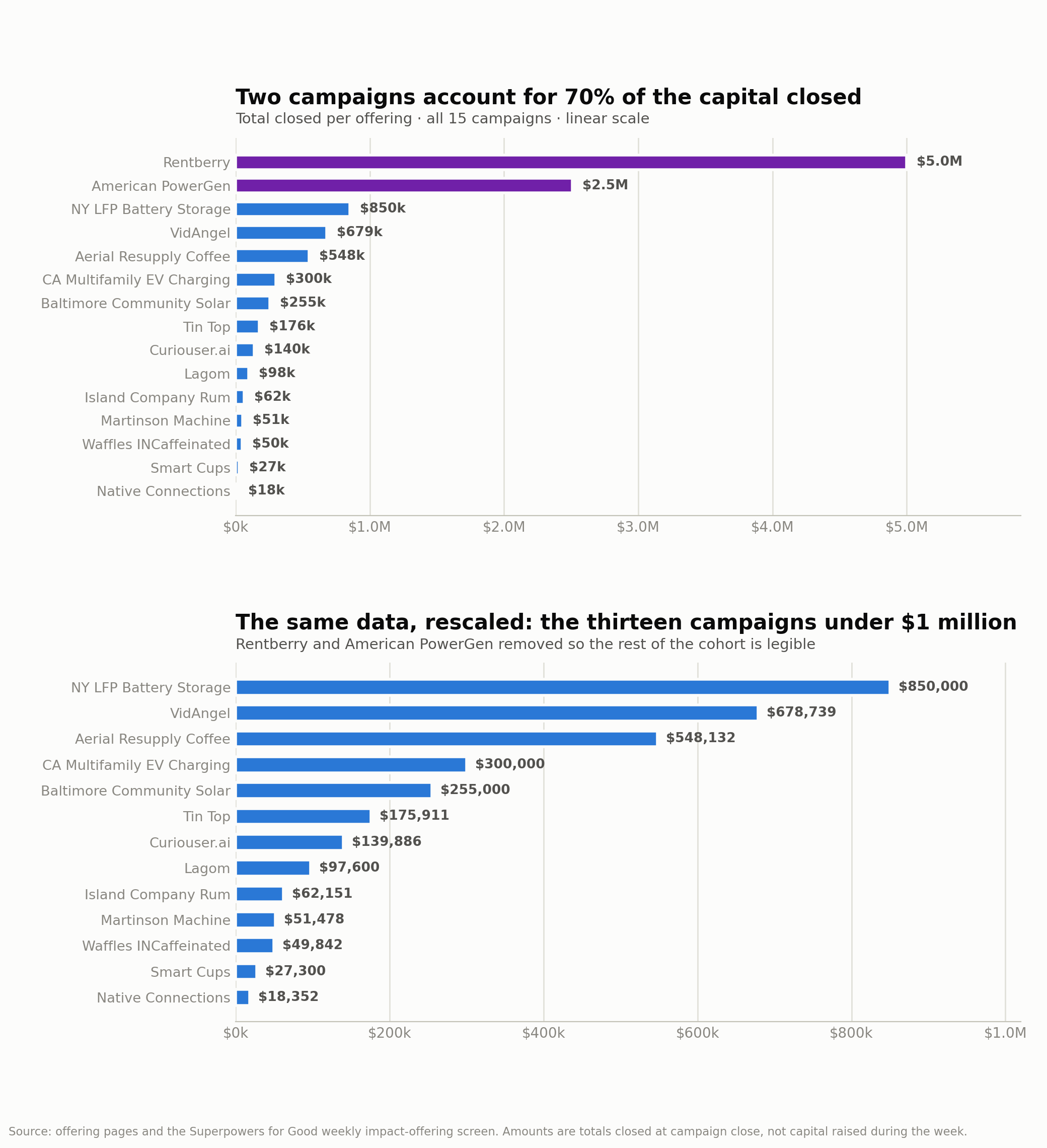
Rentberry closed at $4,999,998 — two dollars beneath the $5,000,000 statutory maximum a Reg CF issuer may accept in any twelve-month period. American PowerGen closed at $2,509,534. Together: $7,509,532, or 69.8% of the week.
Rentberry’s result is not a demand signal. It is a legal ceiling. The campaign stopped because federal law told it to, not because investors ran out of appetite. When a raise finishes at the cap, the number tells you nothing about how much more the crowd would have committed — the statute censors the data. Read cap-maxed raises as evidence of demand at least this large, never as a measurement of demand.
The distribution behaves exactly as crowdfunding distributions always do. The mean campaign closed at $717,595. The median closed at $175,911. The mean is 4.1 times the median, describing a typical week that essentially no individual campaign experienced.
Remove the top two and the remaining thirteen closed $3,254,391 combined — with a top performer at $850,000 and a floor at $18,352. That is what an ordinary week of impact Reg CF looks like beneath the headline: a handful of six-figure raises, a cluster of five-figure community deals, and a long tail invisible on any chart scaled for a $5 million outlier.
Founders benchmarking against the headline will conclude they are failing when they are performing at or above the median. Benchmark against the median.
Platform Analysis: Seven Portals, Seven Different Businesses
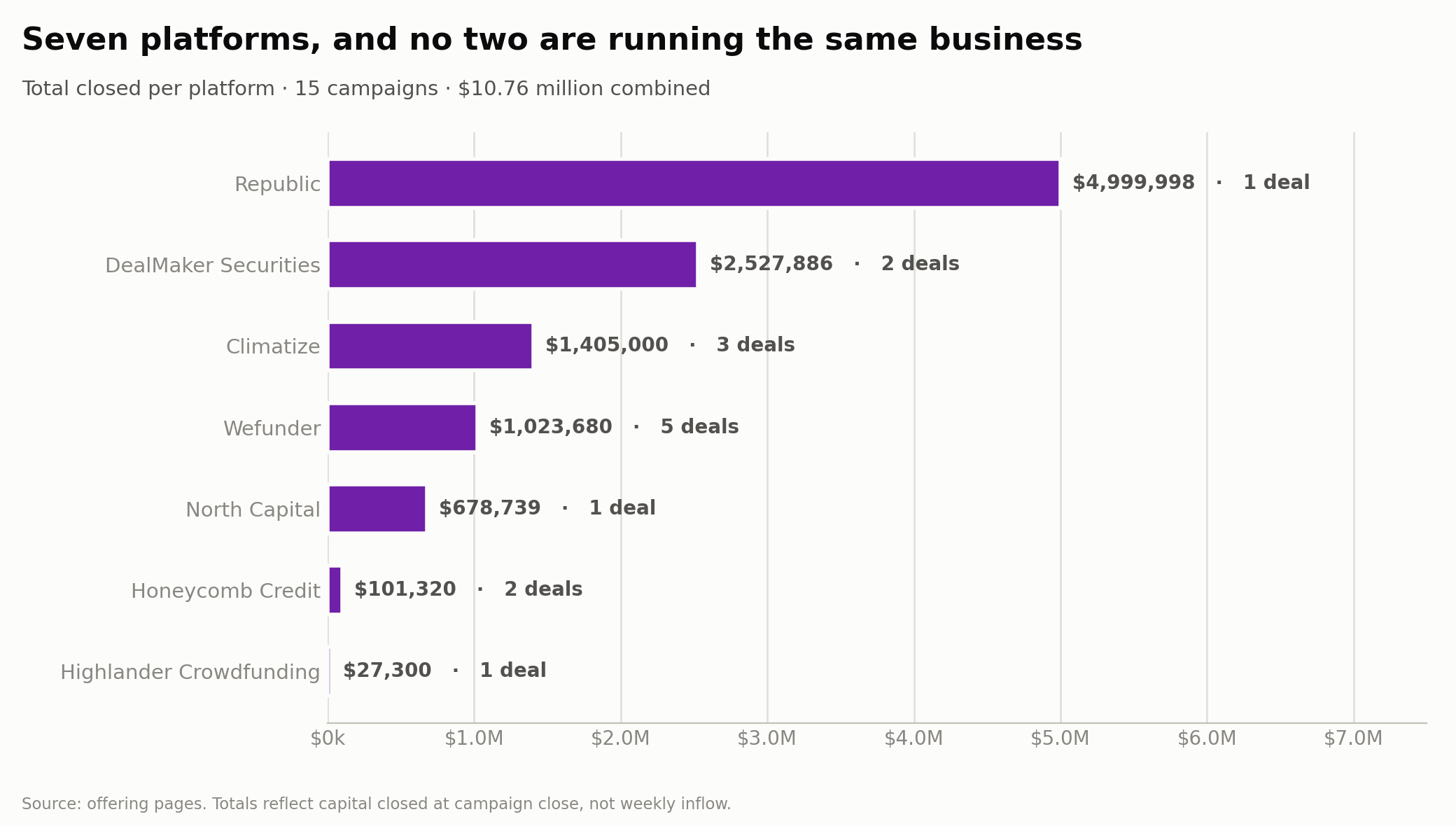
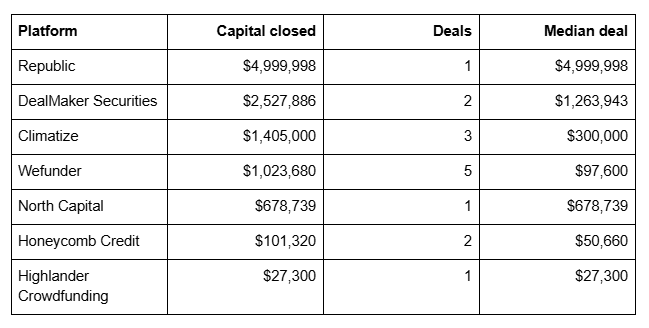
Seven platforms in a fifteen-deal week is unusual, and the totals are a poor proxy for quality — one cap-maxed raise can move a portal from last to first. What the underlying deals reveal is that these seven are not competing for the same founders at all.
Republic: the global consumer brand
Republic hosted one deal and it hit the ceiling. Rentberry — 5 million users, 20 million properties, 90 countries, 70 partnerships, 100% revenue growth — is precisely the profile Republic’s audience responds to: a platform business with international scale, a recognizable category (rental marketplaces), and an AI angle.
Republic’s advantage is brand and a large, internationally distributed investor base habituated to writing checks into technology companies. Its $500 minimum in this deal signals the audience it expects: not casual browsers, but people making a considered allocation.
Best fit: scaled technology platforms with international footprints, network-effect businesses, and companies whose category can be named in three words.
DealMaker Securities: the broker-dealer for founder-controlled raises
DealMaker appeared twice, at opposite extremes: American PowerGen at $2,509,534 and Native Connections at $18,352. That spread is the tell. As a registered broker-dealer rather than a funding portal, DealMaker gives issuers control over their own investor funnel — the raise typically lives at the company’s own domain (invest.americanpowergen.com, invest.nativeconnections.com) rather than in a platform catalog.
That architecture has a sharp consequence: you get almost exactly the traffic you generate. There is no platform browse tab to rescue an underperforming campaign. American PowerGen, with a paid-media operation behind it and a $1,000 minimum, closed $2.5 million. Native Connections, with a genuinely compelling mission and far less distribution firepower, closed $18,352 against a $1.24 million maximum.
Best fit: companies running Reg CF alongside an institutional round, or with the budget and skill to drive their own traffic. Poor fit: founders expecting the platform to supply an audience.
Climatize: the most interesting performance in the cohort
Climatize closed three deals for $1,405,000 — third by capital, and by some distance the most analytically striking result here. All three were debt. All three were specific infrastructure projects rather than companies. All three had a $10 minimum. And all three closed at exactly 100% of their stated maximum.
NY Lithium Iron Phosphate Battery Storage — $850,000 of $850,000
Charging California’s Multifamily Future — $300,000 of $300,000
Baltimore Low-Income Community Solar — $255,000 of $255,000
That is not luck. It is a structurally different product. Climatize is not selling shares in a startup whose future is unknowable; it is syndicating a defined capital requirement for a defined asset with a defined revenue contract behind it. A 4.5 MW/15 MWh battery system awarded through National Grid’s Non-Wires Alternative program needs a specific sum. When the sum is raised, the raise is done.
This is project finance wearing a Reg CF wrapper, and it produces the tightest completion behavior of any model in the market. The $10 minimum is the other half of the design: at ten dollars, participation costs less than lunch, and the platform is optimizing for the number of people connected to the energy transition rather than the size of any individual check.
Best fit: shovel-ready infrastructure with grant backing, utility awards, or offtake contracts — projects where the capital need is a number, not a range.
Wefunder: the volume platform
Wefunder closed five deals — the most of any platform — for $1,023,680, at a median of $97,600. Breadth is the entire proposition, and the five deals could hardly be more varied: veteran-owned coffee (revenue share), a Western drama series (revenue share), a reflective-AI startup (SAFE), a prefab housing company (SAFE), and a luxury rum brand (SAFE).
Wefunder is the only platform here that hosted more than two security types in one week. That flexibility is a real advantage and a real hazard: founders get the largest retail audience in the category and an instrument menu, but compete against hundreds of live campaigns for attention. Wefunder amplifies an existing crowd far more reliably than it manufactures one.
Best fit: consumer-facing and community-anchored companies, founders arriving with an audience, and anyone needing instrument flexibility.
North Capital: the specialist broker-dealer
VidAngel closed $678,739 through North Capital — a broker-dealer route chosen by a company with an unusually specific and unusually loyal constituency. Content filtering for movies and television is not a mass-market pitch; it is a values pitch to families who want it badly. North Capital’s model suits an issuer whose investors will arrive because of who the company is, not because they were browsing.
Worth noting from the disclosed use of proceeds: alongside marketing and platform development, funds are earmarked for investor buyout. That is a legitimate and disclosed use, and it is also a meaningfully different proposition from growth capital. Investors should read use-of-proceeds language closely enough to know which one they are funding.
Best fit: companies with a defined values-aligned constituency that will convert without platform discovery.
Honeycomb Credit: the local lender
Honeycomb closed two debt deals for $101,320 — the second-smallest total and, again, near-perfect completion behavior. Waffles, INCaffeinated closed $49,842 of a $50,000 maximum — 99.7%. Martinson Machine closed 51.5%.
Honeycomb is community lending infrastructure with a securities wrapper, and it should not be benchmarked against venture platforms. The investor is not underwriting a 100x outcome; they are lending to a business at a stated rate on a defined term. Different contract, different psychology, different completion behavior.
One detail worth flagging: the campaign is titled Waffles, INCaffeinated #2 — a second Honeycomb raise by the same operator. The repeat borrower nearly maxed out. Repeat issuance is one of the most reliable predictors of completion in this entire market, and it shows up here in the smallest deals just as clearly as in the largest.
Best fit: revenue-generating local businesses with a geographic community and no realistic equity exit.
Highlander Crowdfunding: the distribution question
Smart Cups closed $27,300 on Highlander — the smallest platform total in the cohort, against a $618,000 maximum. Smart Cups is not an obscure company: patented microencapsulation printing that removes liquid from consumer packaged goods, with coverage in FOX, ABC 7, Time, and Forbes, and a $20.8 million valuation.
A company with that profile closing 4.4% of its maximum is a distribution outcome, not a product outcome. Newer and smaller portals can offer attentive service and lower competition for attention, but they cannot offer an audience they do not yet have. For a founder, this is the trade-off to price honestly before signing.
Best fit: founders bringing their own fully-formed crowd who value service and simplicity over platform reach.
What founders should actually take from the platform data
Choosing the platform with the biggest weekly number is exactly backwards. A better sequence:
Start with the security. Debt on infrastructure projects → Climatize. Debt on Main Street businesses → Honeycomb. SAFE or revenue share → Wefunder. That single decision eliminates most of the field.
Then be honest about traffic. Broker-dealer routes (DealMaker, North Capital) hand you control and hand you the burden. Portals with catalogs give you some ambient discovery. Neither substitutes for your own list.
Then match credibility type. Utility award or government grant → Climatize. International platform scale → Republic. Values constituency → North Capital. Neighborhood → Honeycomb.
Security Type Analysis: Debt Led on Count, Common Equity Led on Dollars
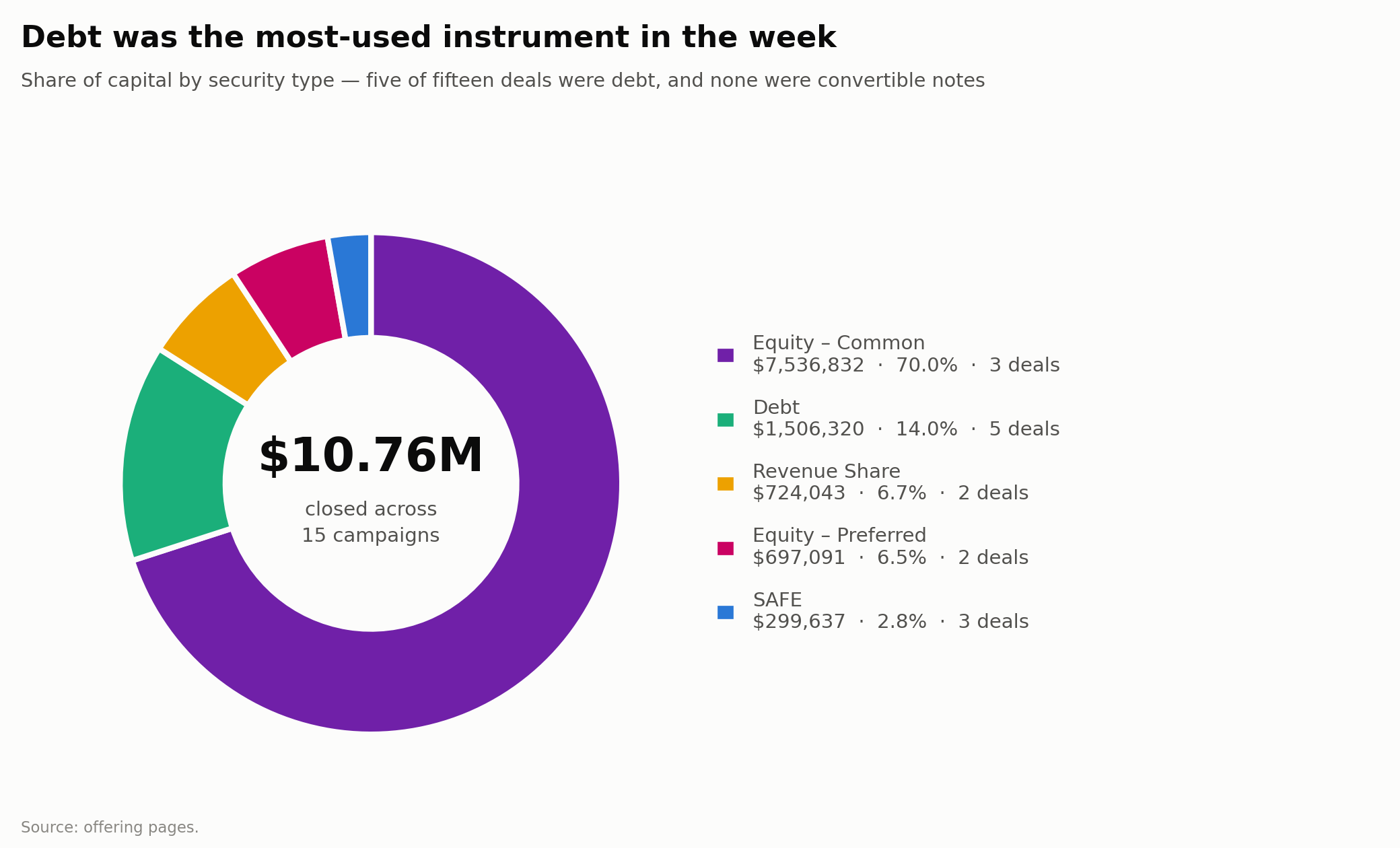

Read the dollars and common equity dominates. Read the deal counts and the picture inverts: debt was the most-used instrument of the week, appearing in five of fifteen campaigns. Common equity’s 70% is three deals, two of which were very large.
And once again: not one convertible note. As in recent weeks, the instrument has effectively vanished from impact Reg CF.
Common equity: comprehensible, and structurally the weakest seat
Common stock gives retail investors the same class the founders hold. Its virtue is that it needs no explanation — no valuation cap, no conversion discount, no liquidation waterfall. For a campaign converting a first-time investor in a single reading, that clarity is a conversion asset.
Its cost is position. Common sits behind every preference in a liquidation and absorbs dilution from every subsequent priced round. An investor buying common in a company at a $27.2 million valuation is betting it grows into and well past that figure before institutional preferred stacks above them.
Common works best when the crowd is genuinely a stakeholder crowd — users, customers, believers — and when a complex preferred stack is unlikely. It gets uncomfortable when institutional money later arrives on terms retail holders cannot negotiate and may not fully understand.
Best suited to: later-stage companies with defensible valuations and strong non-financial investor motivation.
Debt: the honest instrument, and the one that finishes
Five debt deals, three of them at exactly 100% of target. Debt makes a dated, arithmetic promise: principal plus interest, on a schedule. The investor knows what success looks like and when it arrives. No decade-long wait for an exit that statistically will not come.
The point founders routinely miss: debt does not dilute you at all. A profitable local business that sells equity has permanently given away a share of an enterprise that may outlive the founder. A business that borrows pays a defined price and keeps everything. For Waffles, INCaffeinated — a fifteen-year-old restaurant funding a franchise expansion — equity would have been the wrong answer to the right question.
Best suited to: revenue-generating businesses and defined-asset projects with predictable cash flow and no equity exit path.
Revenue share: the structure impact keeps needing
Two revenue-share deals closed $724,043, and one of them — Aerial Resupply Coffee at 88.7% of maximum — produced the best non-debt completion in the cohort.
Revenue share pays investors a percentage of top-line revenue until a defined multiple is returned. For businesses with real gross margin and no intention of selling, this is structurally correct in a way equity is not. Aerial Resupply Coffee is a veteran-owned omnichannel coffee brand with a loyal national customer base — a business that can plausibly pay 1.5x to 3x out of revenue and never needs an acquirer. Tin Top, a television series, is even more clearly shaped for it: there is no company to sell, only episodes that will earn at $3.99 each.
I expect revenue share to keep gaining share in impact Reg CF, because so many impact ventures share this shape — real cash flows, real social return, no buyer.
Best suited to: creative projects, margin-carrying consumer brands, and mission-driven companies that intend to stay independent.
Preferred equity: protection at the cost of explanation
VidAngel and Native Connections both used preferred, which typically carries a liquidation preference placing retail ahead of common in a downside. For companies facing long build-outs and wide outcome distributions — tribal broadband infrastructure being a clear example — that protection is substantive, not decorative.
The costs are cognitive load and future flexibility. Preferred requires explaining a capital stack to people who have never seen one, and it constrains what a founder can later offer an institutional lead who wants seniority.
Best suited to: capital-intensive, long-horizon businesses where downside protection is genuinely part of the pitch.
SAFEs: three deals, $299,637, and the instrument I worry about most
Curiouser.ai, Lagom, and Island Company Rum all used SAFEs, together closing less than any other instrument in the cohort. Founders love the SAFE for good reason: no interest, no maturity, no immediate valuation negotiation, minimal legal cost, no governance transferred.
It is also, in my view, the instrument most likely to disappoint retail investors over the next five years — not because it is unfair, but because it is misunderstood. A SAFE is not equity. It is a contractual right to equity upon a triggering event. If no qualifying priced round or liquidity event ever occurs, a SAFE can sit indefinitely: converting nothing, owing nothing, worth nothing. Many retail investors believe they have bought shares. They have bought a conditional promise.
For a company on a credible institutional-financing path, the SAFE matches reality. For a profitable business that will never take a Series A, it is a promise with no date on it.
Best suited to: early-stage companies with a genuine line of sight to a priced round. Poorly suited to: businesses that will grow profitably without ever raising institutional capital — which describes a large share of impact companies.
Convertible notes: absent again
Zero notes in fifteen deals. The note’s distinguishing features versus a SAFE — accruing interest and a maturity date — are precisely what makes it awkward with a retail crowd. A maturity date on a note held by thousands of small investors creates a governance problem nobody wants: at maturity the issuer must convert, repay, or renegotiate with a crowd that cannot practically be convened. The SAFE, whatever its flaws, has no date to trip over. Expect the note to stay rare.
The alignment question worth asking
Your instrument is a statement about the relationship you want for the next decade.
Debt: I will pay you back on a schedule, and then we are square.
Revenue share: We share upside as it arrives, and you don’t need me to sell.
SAFE: Trust me through an event that hasn’t happened yet.
Common equity: Same boat — including the part where the boat takes fifteen years.
Preferred: You’re ahead of me if this goes badly.
The most common founder error in Reg CF is choosing the instrument that is cheapest to issue rather than the one that matches the company’s actual cash-flow shape.
The Completion Ratio: The Number That Explains the Week
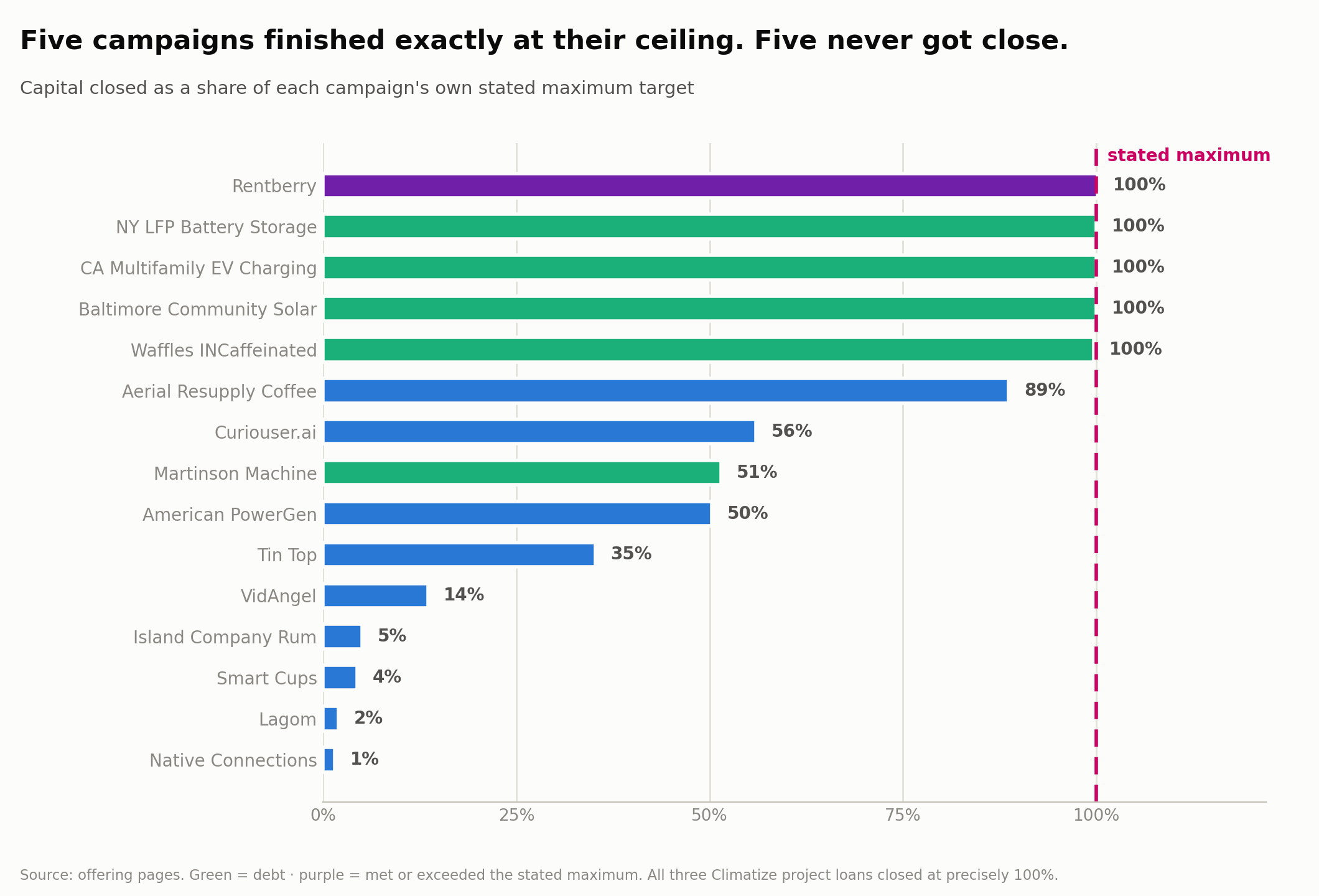
Every Reg CF campaign publishes two numbers most readers skip: a minimum target (below which the raise fails) and a maximum target (the most the issuer will accept). Measuring what closed against the issuer’s own stated maximum is more diagnostic than any raw dollar figure, because it judges the campaign against its own stated ambition.
The pattern is unmistakable. Every campaign that finished at or near its ceiling had a maximum under $900,000 — with the single exception of Rentberry, which was constrained by federal law rather than by demand. Every campaign below 15% had a maximum of $500,000 or more, and the four worst all had maximums between $618,000 and $5,000,000.
This is not evidence that small campaigns outperform large ones. It is evidence that most founders set maximum targets far above what their campaign could realistically deliver — and then live with the consequences in public.
Because progress bars are not neutral. Crowdfunding conversion is powerfully social. A page showing 90% funded creates urgency and validation. A page showing 2% creates hesitation, regardless of the company behind it. A founder who states an aspirational maximum is choosing to display a discouraging number to every visitor for the entire life of the campaign.
Native Connections is the clearest case. The mission — high-speed internet on tribal lands, with tribal citizens trained and employed to build, operate, and eventually own the networks — is as strong as anything in this cohort. The company cleared its $25,000 minimum. But against a $1.24 million maximum, the visible number was 1.5% for the duration.
Practical guidance
Set the minimum where failure is near-impossible. It is a failure threshold, not a goal.
Set the maximum at roughly 1.5x what you honestly expect. Enough headroom for a strong finish; close enough that the progress bar works for you.
If you must state a large maximum, front-load visible momentum: a committed lead, a matching pledge, a pre-launch list converted in week one.
Copy the project-finance discipline. Climatize’s three deals succeeded partly because the maximum was the capital requirement. When your ask equals a real number rather than an aspiration, investors can tell.
Minimum Investment Analysis: From $10 to $1,000
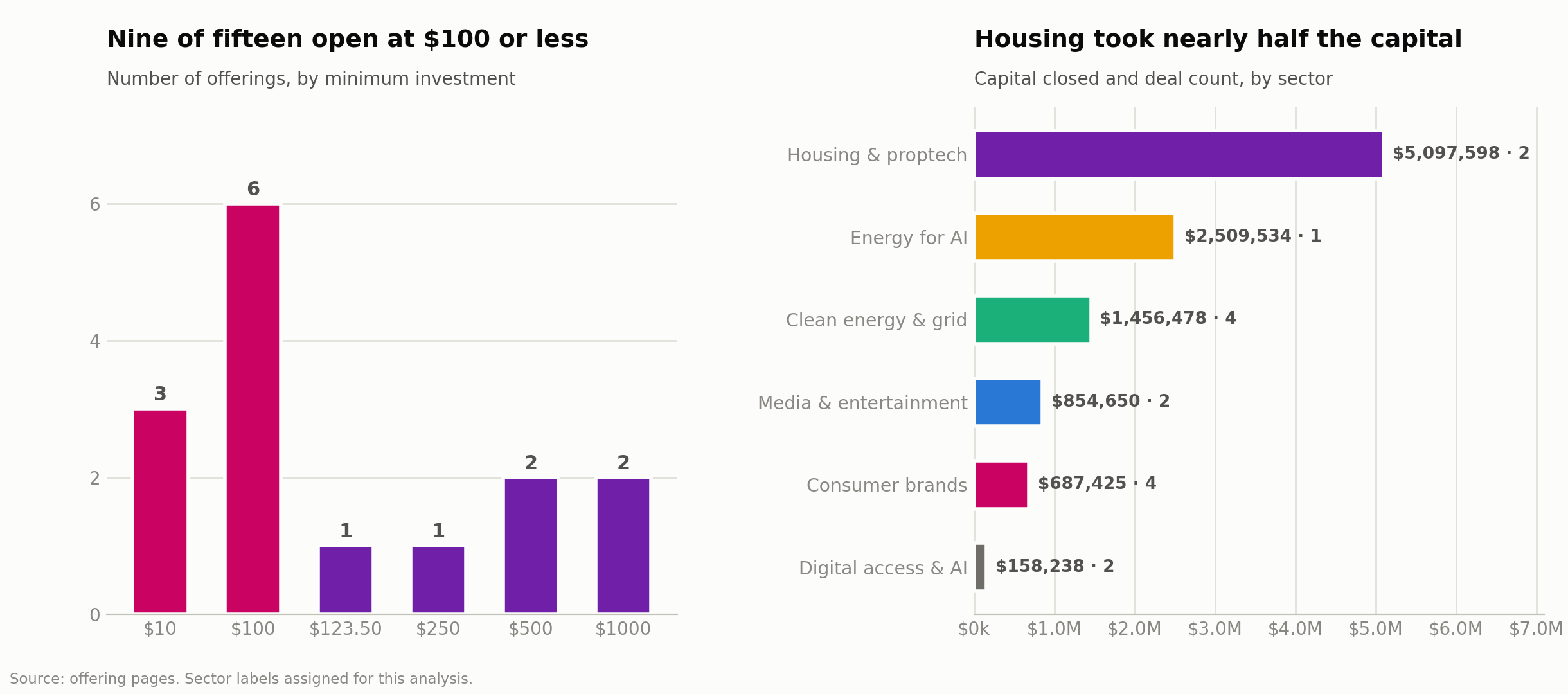
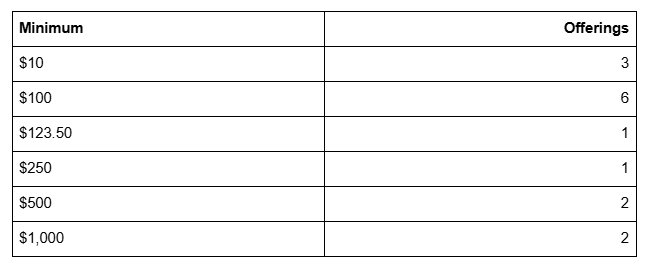
Nine of fifteen opened at $100 or less, and three opened at $10 — the lowest minimums in this market, all three on Climatize.
A $10 minimum is not primarily an accessibility decision; it is a participation decision. At ten dollars, the transaction requires no financial planning and no household conversation. What the issuer buys is not the ten dollars — it is a person newly connected to a battery project in New York or a rooftop solar array in West Baltimore. For community-benefit infrastructure, where the political and social license to operate matters as much as the capital, that connection may be worth more than the money.
The odd-looking minimums are share-price arithmetic. Native Connections’ $123.50 is a round share count at a specific per-share price — a small tell that the issuer priced shares first and derived the minimum second.
Accessibility versus investor quality
The case against low minimums is real. Every investor generates administrative cost regardless of check size: cap table entry, transfer agent fees, tax documents, communications, support. A company with 3,000 investors at $100 has raised $300,000 and acquired a permanent operational obligation.
Higher minimums do genuine screening work. Someone writing $1,000 has usually read more and thought longer.
But the case for low minimums is stronger in most impact contexts, for a reason easy to miss: in Reg CF, your investors are frequently your market, your advocates, or your neighbours. Baltimore Low-Income Community Solar will deliver 51% of generated energy to low- and moderate-income households at a 25% discount for twenty years. A $10 minimum lets the people receiving that benefit also own a piece of the loan financing it. That is not charity; it is alignment.
What thresholds actually work
$10 is right for community infrastructure where broad participation is itself an objective. Climatize’s results validate the choice.
$100 is right for consumer-facing and community-anchored companies. If your investors are your customers, optimize for count.
$250–$500 suits technical and capital-intensive companies — high enough to filter for deliberateness, low enough to stay genuinely open.
$1,000 should be a deliberate strategy, not a default. It works when the raise complements an institutional round and you want a compact cap table. It works poorly when you need volume.
That last point deserves a specific example. Tin Top — a Western drama with a 300,000-strong social following — set a $1,000 minimum and closed 35% of its maximum. A large, engaged, non-wealthy audience met a threshold that priced most of it out. I cannot prove a $100 minimum would have closed more, but the mismatch between audience profile and entry price is the most conspicuous strategic question in this cohort.
For investors: a low minimum is a feature of the offering, not a measure of the opportunity. Accessibility and quality are independent variables.
Founder and Investor Psychology: Why Some Campaigns Compound
Strip the fifteen campaigns down and the ones that performed above the cohort median share the same five ingredients.
1. A one-sentence problem. Batteries stabilize the grid. Renters can’t charge EVs. Bedpans — from a previous week, but the principle holds — humiliate people. If the problem takes a paragraph, it will not travel.
2. Transferred credibility. Retail investors cannot perform technical diligence, so they perform institutional diligence by proxy. A National Grid Non-Wires Alternative award. A California Energy Commission REACH 3.0 grant. Maryland’s community solar program. Institutional validation from the University of Florida. These are not decorations; they are the mechanism by which a non-expert reaches a decision.
3. Traction in units, not adjectives. Rentberry: 5 million users, 20 million properties, 90 countries, 100% revenue growth. Island Company Rum: 35 states, 700% growth from 2022 to 2023. Tin Top: 300,000 followers, $3.99 per episode. Numbers do work that adjectives cannot.
4. A founder whose biography explains the company. Skip Hulsey’s 26 years in the industry explains Lagom. Oliver Semans’ work explains a tribal broadband company that trains and employs tribal citizens. Biography is the cheapest durable credibility a founder has.
5. A pre-existing community. The least glamorous finding and the most important. Aerial Resupply Coffee’s veteran and first-responder base. VidAngel’s values constituency. Waffles’ fifteen years of Beaver, Pennsylvania customers. Every campaign that closed near its ceiling brought its own crowd.
Why retail investors behave differently from institutions
Institutions are compensated for returns. Retail impact investors are buying a bundle: a financial position, an identity statement, a membership, and a piece of a future they want to exist. That bundle explains behavior that looks irrational under a pure-returns model — funding a documentary with no exit, lending to a waffle restaurant, backing a rooftop solar array at ten dollars a share.
None of it is naive. It is a different objective function. It also means narrative quality is not marketing overhead in Reg CF — it is a substantial component of the product. A founder who treats the campaign page as a compliance document has misunderstood the instrument.
Featured on SuperCrowd.TV: Lagom and the Four-Hour House
Solving the Housing Crisis with Sustainable, Attainable Homes
Lagom Development’s Founder Skip Hulsey Aims to Revolutionize Housing with Scalable Solutions and Regulated Crowdfunding
Skip Hulsey did not arrive at prefabricated housing through a spreadsheet. He arrived through an observation about who was being priced out.
“I saw that teachers, first responders, and service industry folks could no longer afford starter homes.”
That sentence is the whole thesis, and it is worth noting how specific it is. Not “housing is unaffordable” — a claim so broad it motivates nobody — but three named professions whose exclusion from homeownership readers can picture in their own towns.
Lagom’s answer is manufacturing discipline applied to a craft industry. The company operates three integrated verticals — Lagom Panel, Lagom Development, and Lagom Homeowner Services — covering manufacture, delivery, and sale. Its 200,000-square-foot factory has capacity for panels supporting more than 23,000 homes annually, against a development pipeline exceeding 8,800 lots. The construction target Hulsey describes is startling:
“Our target is four hours from slab to a dried-in home.”
The environmental case is framed in the only currency that reliably moves homebuyers — money:
“By our calculations, it’s roughly equivalent to an additional mortgage payment every year in utility savings.”
Structural Insulated Panels are not new. What Lagom is attempting is vertical integration around them at a scale intended to address a national shortfall Hulsey puts at ten million homes. Asked for his superpower, he named the thing that vertical integration actually requires: “Getting others on board and believing in being able to achieve a shared mission.”
The campaign result deserves honest treatment, because the lesson in it is more useful than praise. Lagom closed $97,600 — clearing its $50,000 minimum, but against a stated maximum of $5,000,000, the full federal ceiling. That is a completion ratio of 2.0%, the second-lowest in the cohort.
This is not, in my reading, a verdict on the company. Lagom carries a $50 million valuation, a factory, a pipeline, and a founder with 26 years of industry experience and a master’s in real estate development. It is a verdict on ask-sizing. A campaign that names the statutory maximum as its target must sustain a visible progress bar against that number for months. At $5 million, every visitor saw a page that appeared to be failing — even as it succeeded on its own minimum and raised real money from real people.
Had Lagom stated a $250,000 maximum, the identical $97,600 would have displayed as 39% funded, and social proof would have worked for the campaign instead of against it. The capital raised would likely have been higher, not lower. The maximum target is a marketing decision disguised as a financial one, and it may be the single most under-analyzed choice a Reg CF founder makes.
Deeper Looks: Four Campaigns Worth Studying
Rentberry — the ceiling as a compliment
Closing two dollars short of $5,000,000 is as complete an outcome as Reg CF permits. Rentberry brought exactly what converts a large retail audience: enormous stated scale, a category anyone can name, a growth figure (100% revenue growth), and a forward number ($50 million ARR path). The $500 minimum concentrated the raise among deliberate participants.
The honest caution for investors: cap-maxed raises reveal demand at least this large and nothing about quality. A campaign hitting the ceiling proves the marketing worked. Diligence still starts at zero.
American PowerGen — the fastest money in the cohort, and the hardest question
American PowerGen closed $2,509,534 — 50.3% of its maximum, and the second-largest close of the week — for a company founded in December 2025. Ground-up energy development: land, permits, grid interconnection, and long-term gas supply assembled into shovel-ready sites sold to AI data-center operators, with a 3 GW plant slated to begin construction in 2026 and multiple acquisition offers already reported.
The market read here is unambiguous: retail investors will fund AI infrastructure faster than they will fund almost anything else. A company eight months old with a $27.2 million valuation raised more than every clean-energy deal in this cohort combined.
We will return to what that means for impact investing shortly, because it is the most important question in the dataset.
Aerial Resupply Coffee — the best-executed raise of the week
At 88.7% of maximum, this is the strongest non-debt completion in the cohort, and the reasons are legible. A veteran-owned coffee and tea brand serving first responders, active military, veterans, and their families is a company whose customers, community, and investors are the same people. Revenue share matches that reality — the business generates margin now and needs no acquirer. And the $618,000 maximum was proportionate to what a brand of that size could plausibly close.
Mission, instrument, community, and ask-size all pointing the same direction. That is the template.
Curiouser.ai — the counter-narrative that found its audience
Curiouser.ai closed $139,886 at 56% of maximum with a $100 minimum — a solid result in the most crowded narrative category in the market. Its positioning is the interesting part. Where most AI startups promise automation, Curiouser’s product, Alice, is built as a reflective thinking partner: guided conversation intended to help people challenge assumptions and reason more clearly rather than hand tasks off.
In a market where retail investors are simultaneously excited by AI and uneasy about it, a human-centered position is a genuine differentiator rather than a softer version of the same pitch. The traction — a growing base of paying users — matters more here than in most categories, because it demonstrates that the counter-narrative converts to revenue and not merely to sympathy.
Impact Investing Through Reg CF: The Tension in This Week’s Data
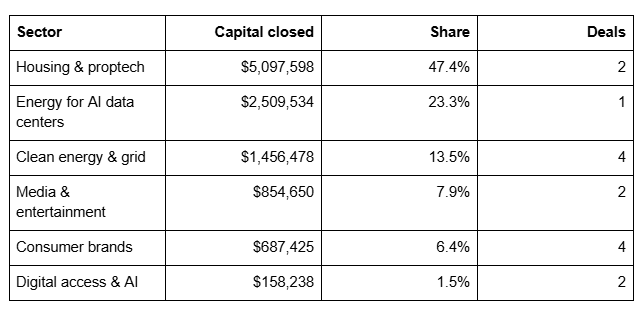
Housing took nearly half the capital on two deals. Consumer brands and clean energy tied for the most deals at four each. But the number that should occupy anyone thinking seriously about impact capital is the second row.
The gas-for-AI question
American PowerGen closed $2,509,534 developing gas-supplied power capacity for AI data centers. All four clean-energy campaigns in this cohort closed $1,456,478 combined. Fossil-adjacent AI infrastructure out-raised community solar, grid batteries, EV charging, and commercial solar together — by 1.7 to 1.
There is a serious argument that this belongs in an impact conversation. Grid capacity is the binding constraint on nearly everything, including electrification. Shovel-ready interconnection is genuinely scarce. Someone will build this capacity, and a company that assembles permits and interconnection rights is doing difficult, unglamorous work.
There is an equally serious argument the other way. Long-term gas supply contracts create decades of emissions lock-in. Data-center load growth is precisely the pressure driving new fossil generation. And retail investors evaluating a campaign in the language of “energy development” may not distinguish between adding clean capacity and adding gas capacity.
I do not think this has a clean answer, and I am wary of publications that pretend otherwise. But the field should notice what happened: when AI-infrastructure framing met community-benefit framing in the same week, AI infrastructure raised more, faster, from a younger company. If impact investors want clean infrastructure to compete for retail capital, the honest conclusion is that clean infrastructure needs better distribution — not better intentions.
What else the sector data shows
Housing is becoming a serious Reg CF category. Rentberry and Lagom approach the same crisis from opposite ends — one digitizing the rental transaction, the other industrializing construction. Housing is unusually well-suited to retail capital because the problem is universally felt and locally visible.
Climate impact is fragmenting from generation into infrastructure. None of the four clean-energy deals here is a technology bet. They are a grid battery, EV charging for renters, community solar for low-income households, and Energy-as-a-Service for commercial clients. Picks and shovels for a transition already underway.
Digital equity is under-capitalized relative to its importance. Native Connections is attacking last-mile broadband on tribal lands with an ownership model that transfers the networks to the communities that use them. It closed $18,352. That gap between social significance and capital raised is the clearest market failure in this cohort.
Media and entertainment keeps proving it belongs. VidAngel and Tin Top closed $854,650 between them. Reg CF may be better matched to cultural production than to startups: the outcome is defined, the timeline is bounded, and the audience is identifiable in advance.
Five predictions
These are analytical views, not forecasts to trade on.
1. Project finance becomes the highest-completion segment in Reg CF. Climatize’s three-for-three at exactly 100% is a structural result, not a lucky week. When the maximum equals a real capital requirement backed by a grant or utility award, campaigns finish. Expect more platforms to adopt project-level rather than company-level offerings.
2. Sub-$100 minimums spread beyond climate. The $10 entry point converts participation into ownership at a scale no equity campaign can match. Any category where community buy-in has strategic value — local infrastructure, cooperatives, cultural institutions — will experiment with it.
3. AI infrastructure will keep out-raising AI applications, and impact investors will have to decide how they feel about that. Physical capacity for compute is where the capital is going. The impact community’s position on it is currently unformed.
4. Revenue share continues taking share from SAFEs. As early SAFEs age without triggering, the mismatch between SAFE mechanics and impact cash-flow shapes will become visible to investors and uncomfortable for founders.
5. Ask-sizing becomes a taught discipline. Right now, maximum targets are set by ambition. Within a few years I expect platforms to advise on them explicitly, because the completion-ratio data is too consistent to ignore.
Broader Market Trends for 2026
Retail investors are maturing, unevenly
The 2026 retail investor is different from the 2021 version. Many have now held a Reg CF position for three or four years and learned experientially that liquidity is scarce, updates go quiet, and a SAFE can sit indefinitely. That produces more discriminating behavior — more attention to instruments, more questions about exit paths, more scrutiny of valuation.
But maturity is unevenly distributed, and a $10 minimum guarantees a permanent inflow of first-time investors who have never read a cap table. Both things are true at once. Platforms remain, in my view, under-invested in the education layer that would reconcile them.
AI is quietly changing due diligence on both sides
This is the trend worth watching most closely. Retail investors now have analytical capability that was recently institutional-only. An individual can pull an issuer’s Form C from SEC EDGAR, extract the financials, benchmark the valuation against comparables, summarize risk factors, and check founders’ claimed history — in minutes, at effectively zero cost.
Three consequences seem likely.
Valuation discipline tightens. When anyone can benchmark a $20.8 million pre-money in seconds, aggressive valuations get harder to sustain. Several valuations in this very cohort will invite that scrutiny.
Disclosure quality becomes competitive advantage. Issuers whose Form C is thorough and whose numbers reconcile will benefit. Issuers relying on enthusiasm to outrun scrutiny will find it harder. Good for the industry.
Founders get better prepared. The same tools help founders model dilution, stress-test claims, and anticipate objections — narrowing the gap between well-advised and unadvised issuers.
The caution: AI analysis is only as good as the disclosure it consumes, and Reg CF disclosure is thin by design. A confident machine summary of a sparse Form C is still a summary of a sparse Form C. These tools reduce the cost of analysis; they do not manufacture information nobody disclosed.
Community-driven finance is becoming infrastructure
The most durable trend here is neither a sector nor an instrument. It is the normalization of the idea that a business or a project can be financed by the people it serves.
A rooftop solar array in West Baltimore is being financed partly by people who will receive discounted power from it. A waffle restaurant in Beaver, Pennsylvania is expanding on money from customers who have eaten there for fifteen years. A battery system stabilizing a New York grid segment is owned, in small part, by people who live on that grid.
None of these required a venture capitalist, a bank committee, or an exit. That is a parallel financing system for the enormous category of enterprises that are economically viable, socially valuable, and permanently uninteresting to institutional capital. Reg CF’s most important long-run contribution may have very little to do with startups.
Actionable Takeaways
For founders
Match the instrument to your cash-flow shape, not to what’s cheapest to issue. If you’ll never raise a priced round, don’t issue a SAFE. If you have revenue, price debt or revenue share before selling equity you can never buy back.
Right-size your maximum. Roughly 1.5x realistic expectation. Lagom’s 2% and Native Connections’ 1.5% are ask-sizing outcomes, not company verdicts.
Set the minimum where failure is impossible. It is a threshold, not an aspiration.
Match the minimum investment to your audience’s wallet. Tin Top’s 300,000 followers met a $1,000 door. Consider what a $100 door would have done.
Bring your own crowd. Broker-dealer routes especially you get the traffic you generate, and nothing else.
Import credibility you cannot generate yourself. A utility award, a state energy grant, a university validation. Retail investors evaluate your validators when they cannot evaluate your technology.
Steal the project-finance discipline. Ask for a real number tied to a real requirement and say what it buys.
For investors
Read “closed” correctly. A campaign that closed at $5 million last week did not raise $5 million last week. Check the open date before inferring momentum.
Know what you are buying. A SAFE is not stock. Revenue share is not equity. Common sits behind preferred. These determine whether you are ever paid.
Compute the completion ratio yourself. Closed versus stated maximum, straight from the offering page. It tells you how the market received the deal.
Read the use of proceeds. Growth capital and investor buyout are both legitimate and completely different propositions.
Underwrite the valuation, not the story. Several companies here carry valuations from $20 million to $50 million at early revenue stages. Those may prove justified. They should be examined.
Ask what “impact” means in each specific deal. The gap between gas-supplied AI capacity and low-income community solar is not a nuance. Decide your own position rather than accepting a label.
Size positions to the risk. A $10 minimum makes participation possible, not concentration wise. Early-stage private companies fail at high rates and Reg CF positions are generally illiquid.
The Full Cohort
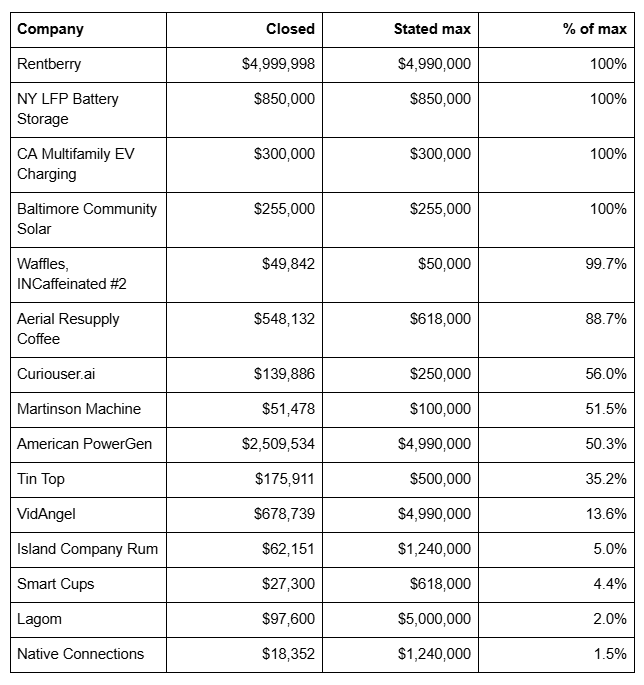
*Total closed is the cumulative amount each campaign had committed at the moment it closed — not the amount raised during the past week. Many of these campaigns were open for months.
A Closing Thought
The most striking thing about this cohort is not the $10.76 million. It is that a single week contained a global rental marketplace, gas-fired power for AI data centers, a grid battery in New York, a content-filtering service, veteran-owned coffee, EV chargers for California renters, community solar in West Baltimore, a Western drama series, a reflective-AI startup, a prefab housing company, a zero-sugar rum, an Energy-as-a-Service solar operator, a waffle restaurant, liquidless beverage technology, and broadband for tribal lands.
No institutional allocator on earth has a mandate broad enough to have funded that list. It exists because Regulation Crowdfunding does not require one. It requires only that enough individual people — sometimes at ten dollars each — agree that a thing should exist.
The ceiling constrains it. Thin disclosure limits it. Illiquidity is a real and permanent cost. But every week it funds a slice of the economy that would otherwise go unfunded, and the range keeps widening.
Two campaigns wrote the headline. The other thirteen wrote the story.
Superpowers for Good should not be considered investment advice. This analysis is educational and reflects the author’s opinions about market structure and trends. All investing carries risk, and early-stage private companies fail at high rates. Seek professional counsel before making investment decisions.
Sources
Featured on SuperCrowd.TV
Solving the Housing Crisis with Sustainable, Attainable Homes — Skip Hulsey, Founder/CEO, Lagom Development · Watch
Companies
Rentberry · American PowerGen · Adaptive Infrastructure Partners · VidAngel Entertainment · Aerial Resupply Coffee · Moon Five Technologies · Solar Development Group · Tin Top · Curiouser.ai · Lagom Development · Island Company Rum · Martinson Machine · Waffles, INCaffeinated · Smart Cups · Native Connections — company websites and platform offering pages linked in the table above.
Regulatory reference

SuperCrowd Investment Directory
Search our Database of 200+ Devin’s Impact Pick of the Week Offerings and Preliminary Diligence Reports on New Offerings

We’ve created a new perk for our Impact Members: a searchable directory of live offerings. To be clear, the database isn’t yet complete, but already includes almost 300 offerings, including a bunch that met the screening requirements to be chosen as one of “Devin’s Impact Pick of the Week” selections.
Each investment offering on the list is open to all investors with no wealth or expertise test. We’ve also prepared a due diligence review—either preliminary or detailed as one of my weekly impact picks. Check it out and let us know what you think.
Support Our Sponsors
Our generous sponsors make our work possible, serving impact investors, social entrepreneurs, community builders and diverse founders. Today’s advertisers include Supercrowd.tv. Learn more about advertising with us here.
Max-Impact Members
(We’re grateful for every one of these community champions who make this work possible.)
Alisa Evans, Mission Enrollment | Brian Christie, Brainsy | Cameron Neil, Lend For Good | Carol Fineagan, Independent Consultant | Eric Coury, Arthia AI | Joey Hayes, thru | John Berlet, CORE Tax Deeds, LLC. | Justin Starbird, The Aebli Group | Ken Steele, Rotarian | Lory Moore, Lory Moore Law | Marcia Brinton, High Desert Gear | Mark Grimes, Networked Enterprise Development | Mike Babbit | Coledger Solutions | Mike Green, Envirosult | Nick Degnan, Unlimit Ventures | Paul Lovejoy, Stakeholder Enterprise | Pearl Wright, Global Changemaker | Scott Thorpe, Philanthropist | Sharon Samjitsingh, Health Care Originals
Upcoming SuperCrowd Event Calendar
If a location is not noted, the events below are virtual.
Join the SuperCrowd Impact League! You can be recognized for making impact investments via Reg CF. See how your activity compares to your peers. It’s free. Win valuable prizes. Start now!
SuperCrowd Impact Member Networking Session: Impact (and, of course, Max-Impact) Members of the SuperCrowd are invited to a private networking session on September 8th at 8:00 PM ET/5:00 PM PT. Mark your calendar. We’ll send private emails to Impact Members with registration details. Upgrade to Impact Membership today!
Join us for SuperCrowdHour on September 16, 2026, as Devin Thorpe, CEO and Founder of The Super Crowd, Inc., leads “Fuel the Fire: Turning Interest into Investment.” Discover practical strategies for turning curiosity into commitment, keeping prospective investors engaged, building trust, and creating momentum for your crowdfunding campaign. Bring your questions for live Q&A and gain actionable insights to help inspire more people to invest in your mission. Register now for FREE!
Visit Our Complete Community Event Calendar
If you would like to submit an event for us to share with the 10,000+ changemakers, investors and entrepreneurs who are members of the SuperCrowd, click here.
We utilized AI to efficiently gather data and analyze key success factors, enabling us to deliver an overview of these successful crowdfunding campaigns.
We share educational information—not investment advice. Some links may generate compensation. See our full disclosure.