


In the spring of 2019, I hosted Bill Gates on my show. For years, I’ve referenced that interview as a high-water mark—because it was. If you run an interview show long enough, there are a few moments that feel like you’ve climbed a mountain and finally gotten to take in the view.
But time has a way of changing what a view looks like.
Over the past few weeks, as new tranches of “Epstein files” have been released and the news cycle has churned through the names inside them, I’ve found myself thinking about what I owe my community in terms of clarity, context, and simple honesty about how my own perspective has shifted.
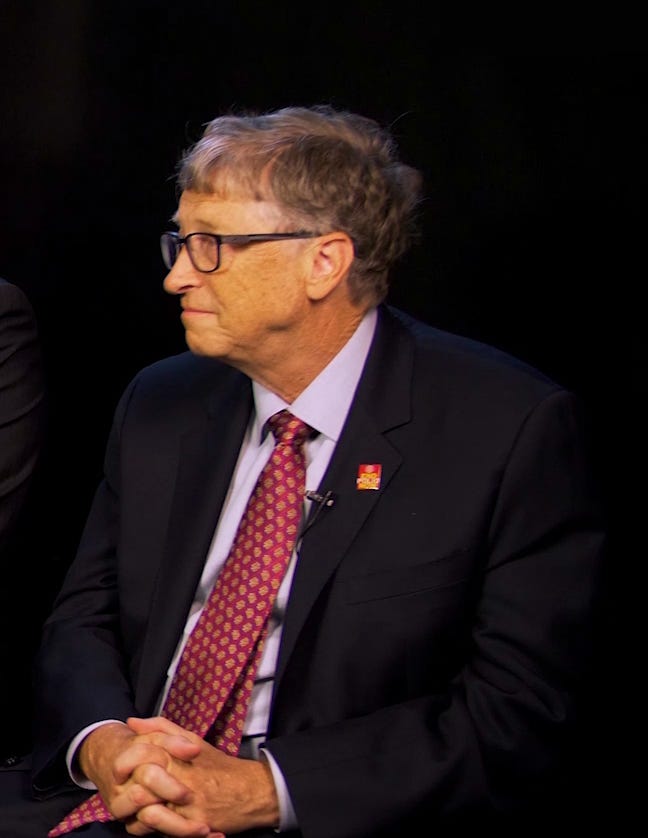
This post is my attempt to “clear the air”—not by relitigating every headline, and not by implying things that haven’t been proven, but by naming what seems true, what seems important, and what I’ve learned.
The factual context
In the newly released Epstein materials, Bill Gates’ name appears frequently—in the thousands. My personal search of the files quickly turned up more than 2,500 files referencing Gates. Note that document counts include duplicates and indirect references and are not a good measure of behavior.
Separately, my quick search for references to President Donald Trump found more than 4,800 documents, sometimes indirectly (for example, conversations where Epstein talks about him to others).
Two things can be true at once:
Being mentioned in files is not, by itself, an allegation of criminal conduct.
The volume of references can still matter reputationally, because it signals a degree of association, interest, contact, or preoccupation—sometimes direct, sometimes indirect.
So, to be precise: I’m not writing this as a claim of guilt. I’m writing it as a sober look at association and judgment—and what it means.
Gates has denied any wrongdoing and says he regrets his association with Epstein.

Timing and transparency: what was and wasn’t known
This part matters to me because it’s the difference between “we missed something obvious” and “the world learned something later.”
When Bill Gates joined me in May of 2019, the early credible public reporting about his meetings with Epstein had not yet landed. Major reporting tying Gates to multiple post-2008 meetings with Epstein—beginning in 2011—came later in October 2019, and that timing is well documented in subsequent coverage.
That means: I wasn’t knowingly ignoring a public red flag at the time of the interview. The information that reframed the story for many people came after.
And yet, something else matters too: “I didn’t know then” doesn’t eliminate the responsibility to respond now—especially when new primary materials and new reporting keep surfacing.
The core lesson: power attracts power—and danger
Epstein’s entire model—at least the part visible from the outside—was built on proximity. Proximity to money. Proximity to prestige. Proximity to the kind of social proof that makes doors open and questions soften.
And it’s hard to overstate how effective that strategy can be.
For me, one of the most sobering takeaways from reading and watching this unfold is that extraordinary accomplishment in one arena doesn’t magically protect someone from poor judgment in another. The same qualities that make people successful—confidence, risk tolerance, an ability to move in elite circles—can also make them vulnerable to the wrong kind of influence.
Even the best-intentioned explanation (“I was trying to fund important work”) doesn’t erase the reputational truth that many people feel in their gut: association with a known bad actor carries a cost.
And in Epstein’s case, that cost isn’t abstract. His crimes were real. The harm was real. The victims are real. When someone is already publicly known to be dangerous, continued engagement isn’t neutral. It’s a decision.
The practical takeaway: better vetting is now essential
I run a show. I curate guests. I introduce people to my audience. That’s not a casual act.
So here’s what has changed for me over time:
I no longer invite someone to be a guest—especially someone with a significant public profile—without doing a basic background search first. Not a deep-dive investigation. Not a moral tribunal. Just the kind of scan that answers a simple question:
Is there anything here that would reasonably make my audience feel blindsided, betrayed, or put in the position of learning painful context after the fact?
This isn’t about assuming guilt. It’s about assuming reality: reputational landmines often appear online long before formal accountability does—and long before a tidy narrative exists.
And if I’m honest, there’s another reason I do it now: because I’ve learned that my audience doesn’t just watch for the guest—they watch for the standards. They’re trusting me with their attention. That means I owe them—I owe you—care.
The broader reflection: values over access
This is the part I’ve wrestled with the most, because it reaches into the ego of anyone who builds something public—my ego.
There’s a temptation—especially when you’re growing a platform—to treat access as the scoreboard. Big name equals big win. A powerful guest equals credibility. A “get” equals success.
And yes: interviewing Bill Gates in 2019 was, professionally, a remarkable moment.
But here’s what these Epstein-file revelations have forced me to admit to myself:
A “high-water-mark” guest isn’t always worth the long-term cost.
Not because association automatically equals guilt, but because credibility is built over years and can be dented in a day—sometimes simply by the perception that you valued proximity to power more than discernment.
This moment has reinforced something I want to be true about me, and about the work I do:
I want values to matter more than access.
I want my platform to be a place where credibility is earned, not borrowed.
I want to be thoughtful about the difference between “impressive” and “worthy of trust.”
And maybe most of all, I want to stay humble enough to say: I can learn. I can tighten my standards. I can own what I didn’t know then, and still respond responsibly now.
That’s what this post is.
If you’re curious to explore the primary materials yourself, I’d encourage you to start with the DOJ’s public Epstein library and read with care, remembering what reputable reporting repeatedly emphasizes: document mentions are not verdicts, and volume is not proof—yet patterns of association can still teach us something about judgment and the seductive pull of influence.
The Super Crowd, Inc., a public benefit corporation, is proud to have been named a finalist in the media category of the impact-focused, global Bold Awards.

Support Our Sponsors
Our generous sponsors make our work possible, serving impact investors, social entrepreneurs, community builders and diverse founders. Today’s advertisers include rHealth, Crowdfunding Made Simple and How to Make Money with Impact Crowdfunding. Learn more about advertising with us here.
Max-Impact Members
(We’re grateful for every one of these community champions who make this work possible.)
Brian Christie, Brainsy | Cameron Neil, Lend For Good | Carol Fineagan, Independent Consultant | Hiten Sonpal, RISE Robotics | John Berlet, CORE Tax Deeds, LLC. | Justin Starbird, The Aebli Group | Lory Moore, Lory Moore Law | Mark Grimes, Networked Enterprise Development | Matthew Mead, Hempitecture | Michael Pratt, Qnetic | Mike Green, Envirosult | Nick Degnan, Unlimit Ventures | Dr. Nicole Paulk, Siren Biotechnology | Paul Lovejoy, Stakeholder Enterprise | Pearl Wright, Global Changemaker | Scott Thorpe, Philanthropist | Sharon Samjitsingh, Health Care Originals | Add Your Name Here
Upcoming SuperCrowd Event Calendar
If a location is not noted, the events below are virtual.
SuperCrowd Impact Member Networking Session: Impact (and, of course, Max-Impact) Members of the SuperCrowd are invited to a private networking session on February 17th at 1:30 PM ET/10:30 AM PT. Mark your calendar. We’ll send private emails to Impact Members with registration details. Upgrade to Impact Membership today!
SuperCrowdHour February: This month, Devin Thorpe will be digging deep into my core finance expertise to share guidance on projections and financial statements. We’re calling it “Show Me the Numbers: Building Trust with Financial Clarity.” Register free to get all the details. February 18th at Noon ET/9:00 PT.
Superpowers for Good Live Pitch: The top-raising Reg CF campaign of 2025 won the June 2025 Superpowers for Good Live Pitch. We’re taking applications for the March 17, 2026, Live Pitch now. There is no fee to apply and no fee to pitch if selected! Apply here now!
Community Event Calendar
Successful Funding with Karl Dakin, Tuesdays at 10:00 AM ET - Click on Events.
10 Years of Reg CF: How It Started vs. How It’s Going: Join the CfPA on Feb 11, 2026, for a special anniversary webinar reflecting on a decade of Regulation Crowdfunding. Hear from Jenny Kassan on Reg CF’s origins and Woodie Neiss on what 10 years of data reveal about what’s worked, what hasn’t, and what’s next—followed by live Q&A. Register here.
If you would like to submit an event for us to share with the 10,000+ changemakers, investors and entrepreneurs who are members of the SuperCrowd, click here.
Manage the volume of emails you receive from us by clicking here.

> document counts include duplicates and indirect references and are not a good measure of behavior.
Yes-- we don't know what Gates did, but Epstein liked to hobnob. If he was a name-dropper and wrote, "...as I was telling my good friend Bill Gates the other day" in thousands of emails, that doesn't mean much.