


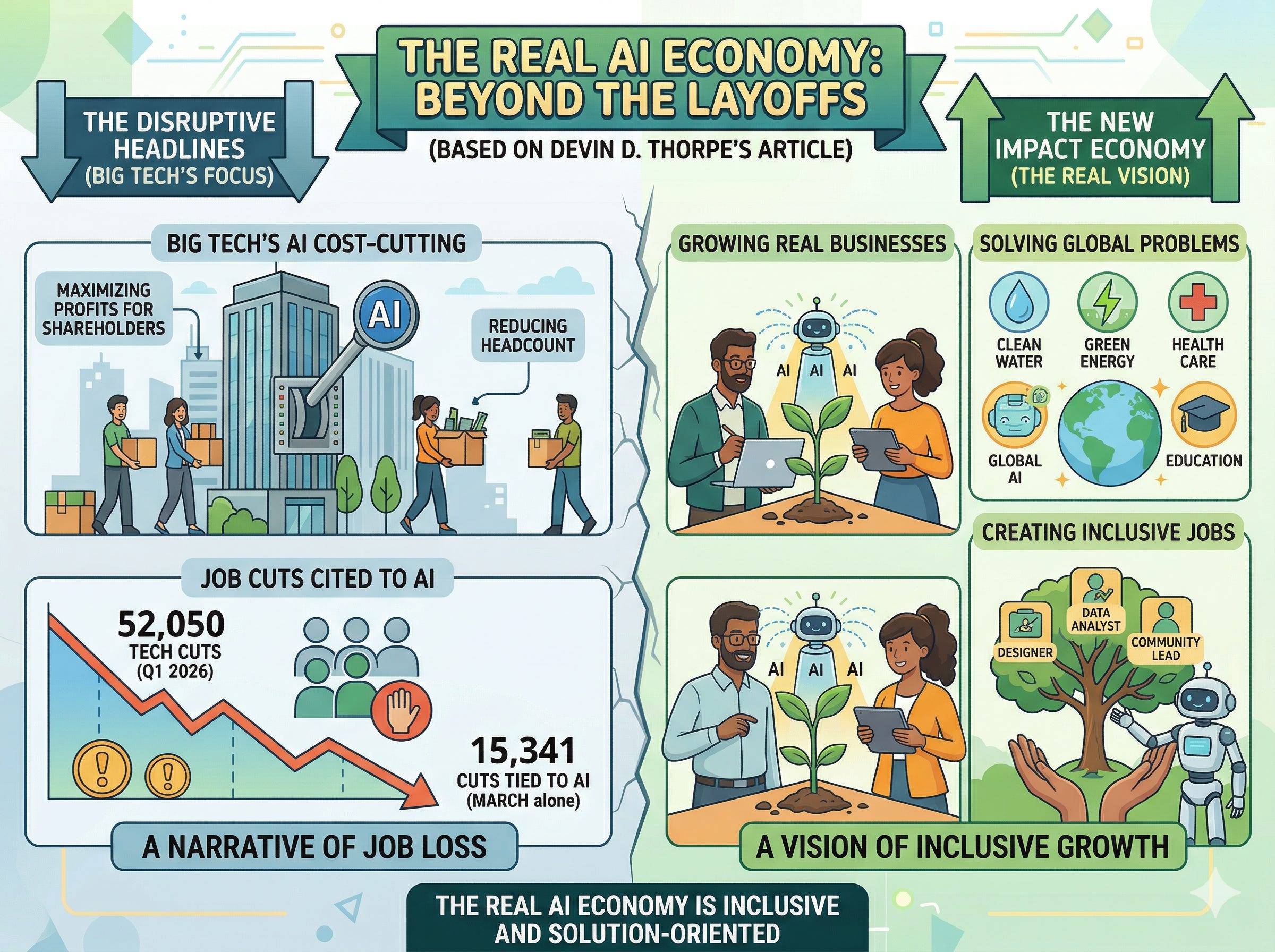
The headlines this week have been hard to miss: layoffs in tech, executives talking about efficiency, and artificial intelligence increasingly cited as a reason jobs are disappearing. Challenger, Gray & Christmas says technology companies announced 52,050 job cuts in the first quarter of 2026, the highest first-quarter total for the sector since 2023. In March alone, AI was the leading reason companies gave for layoffs, with 15,341 announced cuts tied to AI, or 25 percent of all cuts that month.
That is real news. But it is not the whole story.
If you only read the layoff headlines, you might conclude that AI is mainly a machine for replacing people. I think that gets the story backward. At the biggest companies, AI may indeed be used first as a cost-cutting tool. Large organizations under pressure to keep growing profits often reach for the lever they know best: reducing headcount. But outside the bubble of big tech, in the world where most Americans actually live and work, AI is more likely to be an enabling technology than a job-destroying one. The real AI economy will not be built primarily by the companies cutting jobs to fund bigger infrastructure budgets. It will be built by entrepreneurs using AI to make small and midsize businesses more capable, more competitive, and more impactful.
That matters because small businesses are not a sideshow in the American economy. The U.S. Small Business Administration’s Office of Advocacy says the country has 36.2 million small businesses, accounting for almost 46 percent of private-sector employment. From March 2023 to March 2024, small businesses created about nine out of every ten net new jobs. In other words, when we talk about the future of work, we should not be looking only at the biggest firms in Silicon Valley. We should be looking at the smaller companies all over the country that already do most of the job creation.

And those companies are not waiting around. Intuit reports that more than three out of four small and midsize businesses now use AI regularly, and 78 percent of users say it is boosting productivity. ADP reports similar results: most small business leaders say AI helps productivity, cost control, and compliance, while still wanting humans involved in the process. That is exactly what I would expect. Small businesses are not trying to build frontier models. They are trying to write better marketing copy, serve customers faster, manage cash flow more effectively, keep better books, improve training, and free human beings to do the parts of the work that matter most.
This is why I think the phrase “the real AI economy” works. Silicon Valley will do important work. It will build foundational tools. But the real AI economy is what happens when those tools reach farms, factories, clinics, warehouses, studios, schools, restaurants, and Main Street service businesses. It is what happens when a ten-person team can suddenly perform like a twenty-person team, not because they eliminated ten people, but because they eliminated friction.
I also think many workers feel the tension of this moment very personally. Some of the smartest people I know—the kind of people who sit at computers all day, as I do—have started thinking about what they enjoy doing with their hands and feet, and what someone might pay them to do if AI comes for their current job. Some of that is prudence. Some of it is fear. I feel it too. But my own view is that, for the foreseeable future, the people most likely to keep their jobs are the ones who learn how to use AI well. This feels much more like the web in 1998 than some final robotic takeover. The web brought plenty of disruption, plenty of risk, and plenty of nonsense. It also created enormous new opportunity for the people and companies willing to learn it early.

For impact entrepreneurs, the opportunity is especially large. The biggest growth opportunities of the next decade are not trivial conveniences. They are global problems. Climate solutions will keep attracting capital because climate risk is reshaping agriculture, infrastructure, insurance, energy, and everyday life. Health care solutions will keep attracting capital because aging, chronic disease, access, and affordability are not going away. Those are massive, durable markets. And they are not reserved for giant venture-backed startups. Small businesses can lean into them too, sometimes in beautifully local ways: more resilient food systems, healthier restaurants, preventive care, elder care, sustainable manufacturing, cleaner logistics, better diagnostics, community energy solutions.
Purpose matters here, too. A true sense of mission can change a business’s prospects. It can attract customers, talent, partners, and investors. But we should also be honest: capital does not naturally flow fairly. If we want the real AI economy to be better than the old economy, investors need to apply a deliberate gender and racial diversity lens. Otherwise, we will keep backing the same familiar pattern and telling ourselves that habit is merit.
This is one reason I remain so bullish on impact crowdfunding. Venture capital still matters, of course. KPMG reports that U.S. venture investment reached $339.4 billion in 2025, with AI continuing to dominate the largest deals. But the crowd is bigger than Sand Hill Road. Much bigger. Regulation Crowdfunding is still small by comparison, but the rails are real: SEC statistics show 9,461 Reg CF offerings through the end of 2025 and about $1.546 billion in reported proceeds. That is not yet enough. But it is proof of concept. It shows that ordinary investors can participate in private capital formation, and that founders can raise money outside the narrow filters of traditional finance.
Now imagine that model at scale.

Imagine millions of ordinary people treating impact investing not as a niche hobby, but as a normal part of their financial lives. Imagine communities backing businesses they believe in. Imagine customers becoming investors and investors becoming evangelists. Crowdfunding does more than put money on a cap table. At its best, it creates a community of people who want the company to win. That can improve the odds of success in ways institutional capital often cannot.
Imagine when 200 million Americans all invest via regulated investment crowdfunding. If they average $5,000 each, they are collectively investing $10 trillion. That’s more than an order of magnitude more than the VCs, making them look small by comparison.
That is part of why I’m so excited about PurposeBuilt100™. I want it to serve as proof that scale and impact fit together hand in glove. We have spent too many years talking as though there is a tradeoff between doing good and growing fast. There often isn’t. The businesses I most want to celebrate are not those that merely optimized a spreadsheet or engineered short-term financial extraction. They are the ones creating real revenue growth while solving real problems for real people. In a world where we can clearly see scale and impact paired together, we make it easier for everyone—from the smallest retail investor to the largest institution—to see opportunity differently.
That is also why the impact community has a special responsibility in the AI era. We should absolutely encourage entrepreneurs to use AI to empower employees to do more, do it better, and even enjoy the work more. But we should also keep our eyes open to the costs. The International Energy Agency estimates that data centers used about 415 terawatt-hours of electricity in 2024 and projects that figure could rise to around 945 terawatt-hours by 2030. AI may create value, but it will also create environmental and social burdens unless we deliberately back clean energy, efficiency, and human-centered deployment.
So yes, Silicon Valley will keep building AI tools.
But the real AI economy—the one that matters most—will be built by impact entrepreneurs using those tools to grow businesses, create jobs, strengthen communities, and solve problems worth solving.
And I believe the crowd can help fund that future.
What do you think? Share your thoughts in the comments!
Support Our Sponsors
Our generous sponsors make our work possible, serving impact investors, social entrepreneurs, community builders and diverse founders. Today’s advertisers include rHealth, SuperCrowd26, PurposeBuilt100™ and Mission Booster Procurement. Learn more about advertising with us here.
Max-Impact Members
(We’re grateful for every one of these community champions who make this work possible.)
Brian Christie, Brainsy | Cameron Neil, Lend For Good | Carol Fineagan, Independent Consultant | Hiten Sonpal, RISE Robotics | John Berlet, CORE Tax Deeds, LLC. | Justin Starbird, The Aebli Group | Lory Moore, Lory Moore Law | Marcia Brinton, High Desert Gear | Mark Grimes, Networked Enterprise Development | Matthew Mead, Hempitecture | Michael Pratt, Qnetic | Mike Babbit | Coledger Solutions | Mike Green, Envirosult | Nick Degnan, Unlimit Ventures | Dr. Nicole Paulk, Siren Biotechnology | Paul Lovejoy, Stakeholder Enterprise | Pearl Wright, Global Changemaker | Scott Thorpe, Philanthropist | Sharon Samjitsingh, Health Care Originals | Add Your Name Here
Upcoming SuperCrowd Event Calendar
If a location is not noted, the events below are virtual.
SuperCrowd Impact Member Networking Session: Impact (and, of course, Max-Impact) Members of the SuperCrowd are invited to a private networking session on April 14th at 1:30 PM ET/10:30 AM PT. Mark your calendar. We’ll send private emails to Impact Members with registration details. Upgrade to Impact Membership today!
SuperCrowdHour, April 15, 2026, at 12:00 PM Eastern. Devin Thorpe, CEO and Founder of The Super Crowd, Inc., will lead a session on “Compliance Made Easy: Navigating Form C.” Drawing on his extensive experience as an investment banker, impact investor, and crowdfunding expert, Devin will simplify the complexities of Form C filing for regulated investment crowdfunding campaigns. In this session, he’ll walk through the key components of Form C, highlight common compliance pitfalls, and share practical strategies to ensure your offering meets regulatory requirements with confidence. Whether you’re launching your first campaign or refining your compliance process, this SuperCrowdHour will equip you with the knowledge to navigate Form C efficiently—so you can focus on building trust and raising capital successfully.
SuperCrowd26 featuring PurposeBuilt100™: This August 25–27, founders, investors, and ecosystem leaders will gather for a three-day, broadcast-quality global experience focused on disciplined capital formation, regulated investment crowdfunding, and purpose-driven growth. We’re bringing together leading voices in impact investing, compliance, digital marketing, and circular economy innovation to deliver practical frameworks, real-world case studies, and actionable strategies. The event culminates in the PurposeBuilt100™ Showcase, recognizing 100 of the fastest-growing purpose-driven companies in the U.S. Register now to secure your seat and get all the details. August 25–27, streaming worldwide.
Share the application for the PurposeBuilt100™: Purpose-driven founders deserve recognition. The PurposeBuilt100™ application window is now open—celebrating the fastest-growing companies building profit with purpose. If you know a founder creating real impact and real growth, please share this opportunity. Applications are free and confidential. Explore the program and apply today: PurposeBuilt100.com.
Community Event Calendar
Successful Funding with Karl Dakin, Tuesdays at 10:00 AM ET - Click on Events.
Platform Leaders Workshops Program – 5th ICAFR (Málaga, April 8–10, 2026): Join GECA and EDFA for hands-on, interactive workshops for crowdfunding platforms and ecosystem builders—covering investor UX & engagement, secondary markets/technology/tokenisation, and platform data & research—plus dedicated peer exchange with global platform leaders. Register: https://www.crowdfunding-research.org/pago
ICW 2026 Keynote Kickoff - Apr 13 | 10:30–11:00 AM PT - Tim Draper kicks off ICW 2026 with insights on backing transformative startups. Set the stage for three days of pitches, panels, and competition.
Creators as an Asset Class - Apr 13 | 11:00–11:55 AM PT - Scott Kitun and Brian Belley explore creator investing as a new asset class. Learn the opportunities, risks, and emerging playbook.
Group A Pitch Session - Apr 13 | 12:00–12:55 PM PT - Devin Thorpe, Hugh McDermott, and Wendel Afonso present live pitches. Vote for the top startup advancing to the Championship.
Group B Pitch Session - Apr 13 | 2:00–2:55 PM PT - Paul Lovejoy, Sona Shah, Joe Schaeppi, and Hiten Sonpal pitch live. Cast your vote and back the strongest founder.
Capital Dept: Diversifying the Capital Stack - Apr 14 | 11:00–11:55 AM PT - Kelley Frank, Brian Belley, Olowo-n’djo Tchala, Yael Weiss, and Wendel Afonso share proven fundraising strategies. Learn how to plan, launch, and close a successful raise.
Group C Pitch Session - Apr 14 | 12:00–12:55 PM PT - Justin Renfro, Franck Lahaye, and Trevor Legwinski feature in this live pitch round. Watch, evaluate, and vote for the standout startup.
The Listing Playbook - Apr 14 | 1:00–1:55 PM PT - Ajay Tandon, Chris Lustrino, and Gregg Jaclin discuss post-raise pathways. Learn how startups prepare for listings and liquidity.
Group D Pitch Session - Apr 14 | 2:00–2:55 PM PT - Chase Collins, Amanda Benaim, Arthur Erickson, Chad McClennan, and Cole Shepherd pitch live. Vote for who advances to the final round.
Beyond Stocks: Alternative Investing - Apr 15 | 11:00–11:55 AM PT - Scott Kitun and Darren Rovell explore collectibles and alternative assets. Discover trends shaping modern portfolios.
Group E Pitch Session - Apr 15 | 12:00–12:55 PM PT - Eitan Charnoff, Teddy Lyons, Annette Azan, Jaeson Bang, and Jeremy McCool present the final pitches. Last chance to vote before finalists are selected.
Compliance & Regulatory Landscape - Apr 15 | 1:00–1:55 PM PT - Brian Belley, Andrew Stephenson, and Jason Fishman cover key regulations. Understand disclosures, protections, and what’s changing.
Championship Pitch & Closing - Apr 15 | 2:00–3:15 PM PT - Chris Lustrino, Léa Bouhelier-Gautreau, and Teddy Lyons host the final round. Watch the winner crowned and ICW 2026 conclude.
Want to Work to Clean Up Fashion? Career Choices in a Challenging Environment (Washington, DC | Tue, April 21, 2026 | 11:30 AM–1:00 PM EDT): Join Women for Women’s Wear during DC Climate Week for an interactive roundtable + networking on building a career in sustainable fashion—whether you’re exploring a new path, considering a pivot, or looking to drive impact from within your current role. Hear practical insights from professionals across apparel/footwear, government, technology, and finance, and leave with clearer next steps (bring your lunch; refreshments served). Limited space—registration subject to approval (Chatham House Rules apply). Register: https://luma.com/yyz01e4i
Fashion and the Climate Crisis: Policy and Innovation for a Cleaner Industry (Washington, DC | Tue, April 21, 2026 | 3:00–4:30 PM EDT): Join Loop Labs and Women for Women’s Wear during DC Climate Week 2026 for a high-energy session on how policy, innovation, and entrepreneurship are reshaping fashion—featuring a policy panel on sustainability standards and supply-chain transparency, curated networking across government/industry/creatives, and a sustainable fashion showcase spotlighting circular designs from DC-area makers. Limited space—registration subject to approval. Register: https://luma.com/1ns7cqsj
Save the Date! October 20th and 21st will be the Crowdfunding Professional Association Regulated Investment Crowdfunding Summit for 2026. This is the event of the year for everyone in the crowdfunding ecosystem.
If you would like to submit an event for us to share with the 10,000+ changemakers, investors and entrepreneurs who are members of the SuperCrowd, click here.
Manage the volume of emails you receive from us by clicking here.
We share educational information—not investment advice. Some links may generate compensation. See our full disclosure.