


Angel investors have long understood something ordinary investors are now learning: due diligence matters.
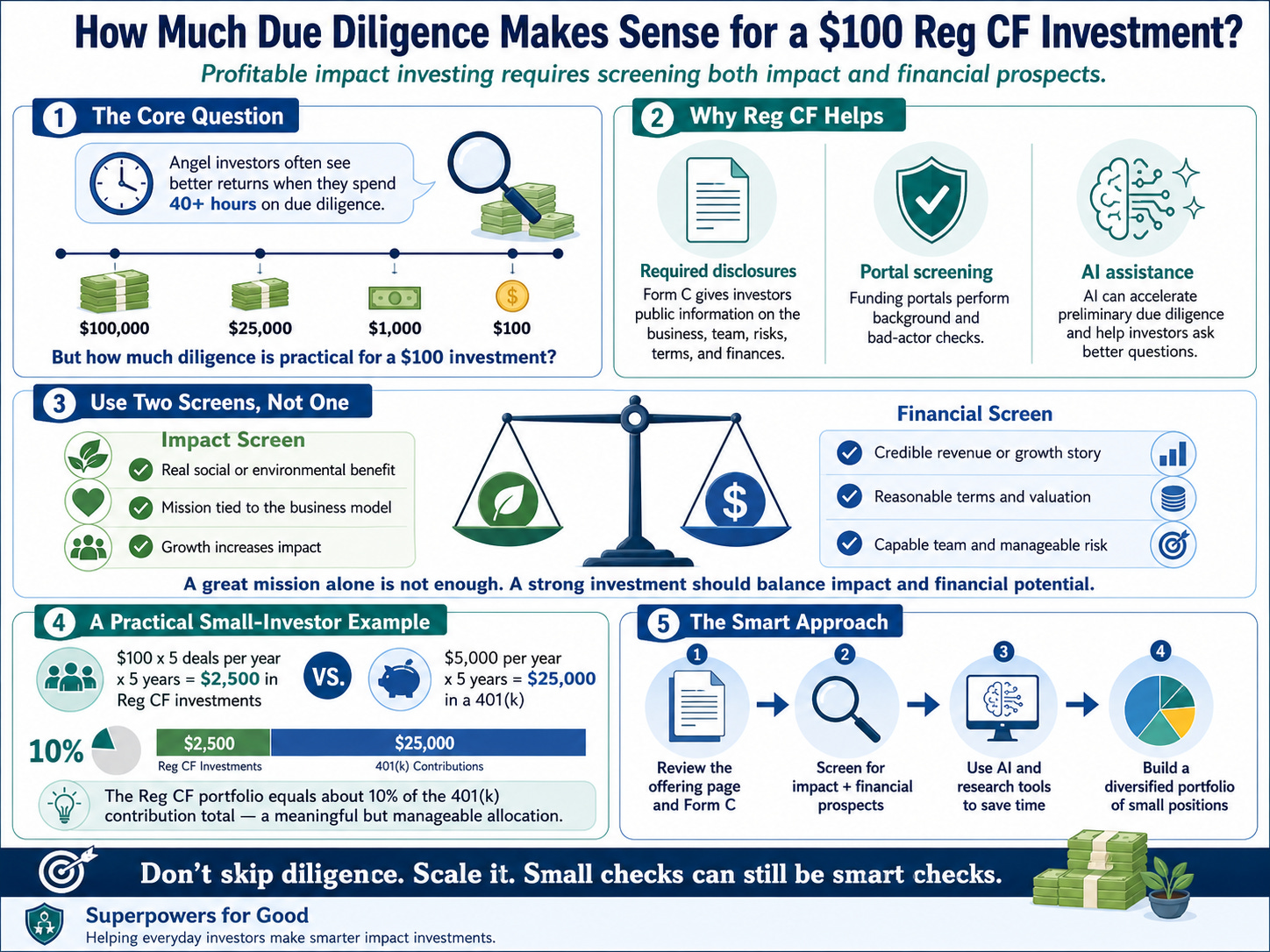
A well-known study of angel investors found that investors who spent more time on due diligence tended to earn better returns. The Angel Capital Education Foundation study, led by Robert Wiltbank and Warren Boeker, reviewed more than 1,100 angel investment exits and found that due diligence time, relevant experience and ongoing participation were all associated with stronger outcomes.
That makes intuitive sense.
If you are investing $100,000 in a startup, spending 40 hours studying the company, the market, the management team, the terms and the risks may not only be reasonable but essential.
If you are investing $25,000, the same may still be true.
But what if you are investing $1,000?
What if you are investing $100?
That is the practical challenge facing everyday investors who want to participate in Regulation Crowdfunding.
We want to invest profitably. We want to support companies creating real social or environmental impact. We want to help founders who may otherwise struggle to access capital. But we also have limited time. Most of us cannot spend a full workweek analyzing every offering before making a modest investment.
So, the question is not whether due diligence matters.
It does.
The real question is this: How much due diligence can we afford to do—and how can we make that diligence smarter, faster and more disciplined?
Reg CF Gives Us a Head Start
The good news is that Regulation Crowdfunding gives ordinary investors a better starting point than most people realize.
Companies raising under Reg CF are required to file Form C with the SEC and provide investors with meaningful disclosures about the business, management, ownership, financial condition, risks, offering terms and intended use of proceeds.
That does not make the investment safe.
It does, however, mean that investors do not have to begin with a blank page. Much of the information an angel investor might request privately is already available publicly.
In addition, Reg CF offerings must be conducted through an SEC-registered intermediary, either a broker-dealer or funding portal, and those intermediaries have gatekeeper responsibilities. FINRA notes that intermediaries must have a reasonable basis for believing an issuer complies with Regulation Crowdfunding and must deny access if the issuer or offering presents potential fraud or investor protection concerns. The SEC also requires intermediaries to conduct background and securities enforcement checks on issuers and key insiders.
Again, that does not eliminate risk.
But it does reduce one category of risk: the chance that an obviously disqualified bad actor can easily use a legitimate portal to raise money from the public.

Small Checks Still Deserve Serious Thinking
Let’s make this practical.
Suppose an investor puts $100 into five Reg CF offerings each year for five years. That is $500 per year and $2,500 over five years.
Now, suppose the same investor puts $5,000 per year into a 401(k). Over the same five years, that is $25,000.
In that example, the Reg CF portfolio represents about 10 percent of the amount invested in the 401(k). That is a healthy, modest allocation for someone who understands the risks and can afford the risk.
But here is the danger: if the Reg CF portfolio is built casually, emotionally or purely around mission, it is likely to disappoint.
If investors repeatedly back companies without understanding the terms, financial prospects, risks or path to repayment or exit, many will lose money. Some may conclude that impact investing does not work. Others may simply quit investing in early-stage impact companies altogether.
That would be a shame.
The problem would not be Reg CF itself. The problem would be undisciplined investing.

Impact-First Should Not Mean Financially Blind
For Superpowers for Good readers, impact matters. It should matter.
Many of us are drawn to companies led by women, founders of color, veterans, immigrants, rural entrepreneurs or community builders. We are inspired by companies addressing climate change, health equity, food access, education, affordable housing, financial inclusion, disability access or other urgent needs.
That instinct is good.
But impact-first investing should not mean financially blind investing.
A company can have a wonderful mission and still be a poor investment. A founder can be inspiring and still offer unfavorable terms. A product can help people and still face brutal competition, weak margins or inadequate capital.
The best Reg CF investing requires two screens, not one.
First, we ask: Does this company create real impact?
Second, we ask: Does this investment have a reasonable chance to produce a financial return appropriate for the risk?
We should be wary of investments that pass only one test.
A company with exciting financial prospects but no meaningful impact may not belong in an impact portfolio.
A company with beautiful impact but weak financial prospects may be better treated as philanthropy than investing.
There is nothing wrong with philanthropy. I make Kiva loans every month knowing I am not earning a financial return. I value the impact.
But when we invest—especially when we are investing money we hope will compound—we owe ourselves a more disciplined approach.
A Practical Due Diligence Framework for $100 Investments
A $100 investment does not justify 40 hours of diligence.
But it does justify a structured review.
For small Reg CF investments, I suggest a simple three-step screen.
1. Confirm the Impact
Ask whether the impact is built into the business model or merely attached to the marketing.
Helpful questions include:
Does the company’s core product or service solve a real social or environmental problem?
Who benefits if the company succeeds?
Is the impact measurable, even if imperfectly?
Is the founder a woman or a member of an underrepresented community?
Would the company create impact in direct proportion to its growth?
The strongest impact investments are often those where revenue and impact grow together. If every new customer, sale or project advances the mission, impact is not a side benefit. It is the business.
2. Screen the Financial Prospects
Then ask whether the company has a credible path to surviving, growing and eventually returning capital.
For debt offerings, that means asking whether the company appears likely to make the required payments. Look at revenue, cash flow, profitability, debt burden, use of proceeds and whether the loan terms seem realistic.
For equity or SAFE offerings, the question is different. You are asking whether the company could plausibly grow enough to create a future exit or meaningful liquidity event. That requires looking at the size of the market, growth rate, valuation, team, competition, business model and capital needs.
Helpful questions include:
Does the company have real revenue?
Are sales growing?
Are margins plausible?
Does the management team appear capable?
Is the valuation reasonable?
Are the terms fair to small investors?
Does the company explain risks candidly?
If the company needs to raise much more money later, what happens to current investors?
None of these questions will produce certainty. They will, however, help avoid the most obvious mistakes.
3. Decide Whether the Investment Fits Your Portfolio
Even a good company may not be a good fit for every investor.
Reg CF investments are risky, illiquid and often long-term. The SEC notes that securities purchased in crowdfunding transactions generally cannot be resold for one year, and in practice, many have no easy resale market even after that period.
So before investing, ask:
Can I afford to lose 100 percent of this investment?
Am I diversified across many offerings?
Am I investing small amounts consistently rather than making one large emotional bet?
Does this investment improve the balance of my portfolio?
Am I confusing admiration for the founder with confidence in the investment?
That last question matters more than we like to admit.
AI Can Help Ordinary Investors Do Better
There is another piece of good news.
AI can dramatically reduce the cost and time required to perform preliminary due diligence.
An investor can share an offering page, Form C or other public disclosures with an AI tool and ask for a structured analysis of both impact and financial prospects. AI can summarize the business, flag risks, compare claims with disclosures, identify missing information and help generate better questions.
AI will not make the investment decision for you.
It can be wrong. It can miss things. It can sound more confident than it should.
But used carefully, AI can help ordinary investors do in minutes what might otherwise take hours.
That matters.
The future of impact crowdfunding depends, in part, on helping small investors make better decisions without requiring them to become full-time analysts.
Free Tools From Superpowers for Good
To help, Superpowers for Good offers free resources for investors.
Our free AI Due Diligence Prompt Builder allows members to generate a customized, roughly 2,000-word due diligence prompt for a specific offering. You can find it here:
AI Due Diligence Prompt Builder
Members who can download or copy a good version of the associated Form C can also upload it to our preliminary due diligence tool here:
These tools are not a substitute for judgment. They are designed to help you ask better questions faster.
We have also launched a gamified investment tracker that allows investors to track their Reg CF investments. Participation is free while we are in beta testing, and everyone is welcome to try it. We will be announcing prizes for top investors each month. You will see me on the leaderboard, but you do not have to beat me to win—I am not eligible.
When Paid Tools Make Sense
For investors routinely investing $5,000 per year or more through crowdfunding, paid research tools may also make sense.
KingsCrowd Edge, for example, is currently listed at $15 per month or $150 per year and includes quantitative investment ratings, analyst reports, deal considerations and other diligence tools for online startup investing.
For investors investing smaller amounts—or investing specifically with an impact lens—becoming an Impact Member of the SuperCrowd may be a better fit.
For just $5.95 per month, Impact Members receive access to our directory of current Reg CF investment offerings, including preliminary diligence reports. Some offerings also feature detailed reports with investment ratings that consider both social impact and financial prospects.
We also publish Devin’s Impact Pick of the Week every Friday for Impact Members.
The goal is not to tell anyone what to do.
The goal is to help ordinary investors build portfolios that are thoughtful, diversified, impact-aligned and financially disciplined.

The Bottom Line
Regulation Crowdfunding has opened a door that was once closed to most Americans.
We can now invest directly in startups, small businesses and community ventures. We can help fund companies that reflect our values. We can support founders who may never get a meeting with a venture capitalist or bank loan officer.
That is powerful.
But access without discipline can be dangerous.
The answer is not to spend 40 hours researching every $100 investment. That would make no economic sense.
The answer is also not to invest casually because the check is small.
The better path is scaled diligence: use the disclosures required by Regulation Crowdfunding, take advantage of portal screening, apply AI carefully, rely on trusted tools where appropriate, and always evaluate both impact and financial prospects.
Small checks can still be smart checks.
And when enough ordinary investors make smart, impact-driven investments, we can help move more capital toward the companies building the future we want.

Support Our Sponsors
Our generous sponsors make our work possible, serving impact investors, social entrepreneurs, community builders and diverse founders. Today’s advertisers include Emission Free Generators, Live Pitch, PurposeBuilt100 and Mission Booster Procurement. Learn more about advertising with us here.
Max-Impact Members
(We’re grateful for every one of these community champions who make this work possible.)
Brian Christie, Brainsy | Cameron Neil, Lend For Good | Carol Fineagan, Independent Consultant | Hiten Sonpal, RISE Robotics | John Berlet, CORE Tax Deeds, LLC. | Justin Starbird, The Aebli Group | Lory Moore, Lory Moore Law | Marcia Brinton, High Desert Gear | Mark Grimes, Networked Enterprise Development | Matthew Mead, Hempitecture | Michael Pratt, Qnetic | Mike Babbit | Coledger Solutions | Mike Green, Envirosult | Nick Degnan, Unlimit Ventures | Dr. Nicole Paulk, Siren Biotechnology | Paul Lovejoy, Stakeholder Enterprise | Pearl Wright, Global Changemaker | Scott Thorpe, Philanthropist | Sharon Samjitsingh, Health Care Originals | Add Your Name Here
Upcoming SuperCrowd Event Calendar
SuperCrowd Impact Member Networking Session: Impact (and, of course, Max-Impact) Members of the SuperCrowd are invited to a private networking session on May 19th at 8:00 PM ET/5:00 PM PT. Mark your calendar. We’ll send private emails to Impact Members with registration details. Upgrade to Impact Membership today!
SuperCrowdHour, May 20, 2026, at 12:00 PM Eastern. Devin Thorpe will lead a session on “How to File Your Form C-AR Yourself for Free!” Designed for founders and issuers navigating regulated investment crowdfunding, this practical session will walk attendees through the annual Form C-AR filing process and show how to complete it independently—without unnecessary legal or filing expenses. Devin will explain what information is required, common mistakes to avoid, important deadlines to remember, and how staying compliant helps build trust with investors while protecting your raise. Whether you’ve recently closed an offering or are preparing for your first annual report, this SuperCrowdHour will provide a clear, cost-effective roadmap to filing your Form C-AR with confidence. Register here: https://thesupercrowd.com/20may26
SuperCrowd26 featuring PurposeBuilt100™: This August 25–27, founders, investors, and ecosystem leaders will gather for a three-day, broadcast-quality global experience focused on disciplined capital formation, regulated investment crowdfunding, and purpose-driven growth. We’re bringing together leading voices in impact investing, compliance, digital marketing, and circular economy innovation to deliver practical frameworks, real-world case studies, and actionable strategies. The event culminates in the PurposeBuilt100™ Showcase, recognizing 100 of the fastest-growing purpose-driven companies in the U.S. Register now to secure your seat and get all the details. August 25–27, streaming worldwide.
Share the application for the PurposeBuilt100™: Purpose-driven founders deserve recognition. The PurposeBuilt100™ application window is now open—celebrating the fastest-growing companies building profit with purpose. If you know a founder creating real impact and real growth, please share this opportunity. Applications are free and confidential. Explore the program and apply today: PurposeBuilt100.com.
Superpowers for Good Live Pitch on e360tv — June 3, 2026. Purpose-driven founders raising capital through Regulation Crowdfunding are invited to apply by May 6, 2026, for a chance to pitch live to a national audience of investors and impact champions.
Community Event Calendar
Successful Funding with Karl Dakin, Tuesdays at 10:00 AM ET - Click on Events.
Earthstock Summit, Ojai, CA, May 29-31: The Earthstock Regenerative Summit in Ojai brings together leaders and community members for panels, workshops, films, music, and hands-on projects focused on regenerative agriculture, ecological design, resilience, health, and sustainable living.
Save the Date! October 20th and 21st will be the Crowdfunding Professional Association Regulated Investment Crowdfunding Summit for 2026. This is the event of the year for everyone in the crowdfunding ecosystem.
If you would like to submit an event for us to share with the 10,000+ changemakers, investors and entrepreneurs who are members of the SuperCrowd, click here.
Manage the volume of emails you receive from us by clicking here.
We share educational information—not investment advice. Some links may generate compensation. See our full disclosure.