


You can advertise in Superpowers for Good. Click to learn more about our affordable options.
Every Regulation Crowdfunding offering files a Form C with the SEC. It is public, it is thorough, and it is largely unread.
Not because investors are lazy. Because of arithmetic. There are 380 live offerings in the SuperCrowd Investment Directory as I write this. A Form C read properly — read the way you would read a term sheet, with the founder bios checked and the market claims tested — is an evening’s work. Read all 380 and you have spent a year doing nothing else.
So what happens instead is what always happens when the work exceeds the hours. You back the two deals somebody you trust mentioned. Or you back nothing, and tell yourself you are being disciplined.
Neither of those is diligence. They are both just triage with better manners.
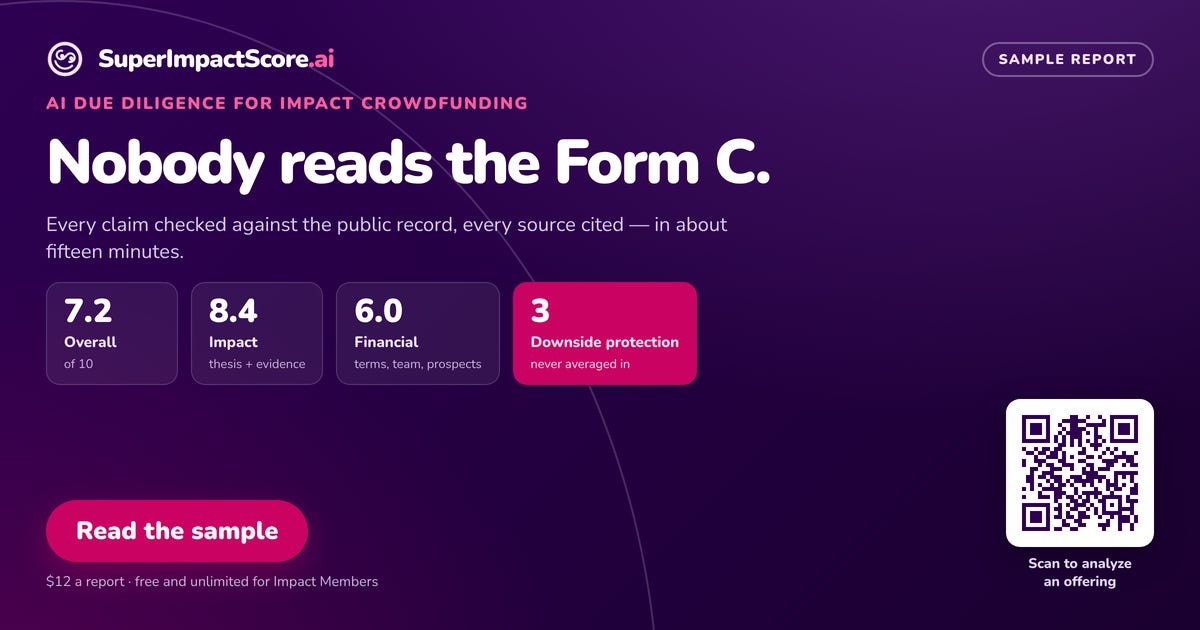
The part most “AI research” skips
There is a lot of AI in finance now, and most of it is a summariser wearing a lab coat. You hand it the document; it hands the document back, shorter. That is not diligence. Diligence is the opposite move: it leaves the document.
SuperImpactScore is built around that distinction. Pick any live offering from the directory and it does three things. It reads the official SEC Form C. Then it goes outside the filing — researching the company, the founders, the market and the competitors across the public web. Then it scores what it found, and shows you the working.
About fifteen minutes, start to finish. The report appears on screen and arrives as a PDF.
Three scores, because these are three different questions
This is the design decision that matters most, and the one I would want to see in any tool before I trusted it.
Most impact scoring collapses everything into one number. That number is useless, because a company can be doing genuinely important work and still be a poor investment, and a company can be a fine investment with an impact story that is mostly adjectives. One number hides exactly the thing you need to see.
So a report carries three:
Impact — the thesis and, separately, the evidence for it. The thesis is weighted more heavily, but a thesis with nothing behind it scores like one.
Financial — management, deal terms and prospects, averaged.
Downside protection — scored on its own, and never averaged into the overall.
That third one is the tell. Averaging downside risk into a composite is how a strong impact story quietly launders a weak balance sheet. Keeping it outside the average means a company can score well overall and still carry a 3 on downside, sitting there next to the headline where you cannot miss it.
Each sub-score comes with a written rationale, a confidence rating, and — the detail I find most useful — a pair of triggers: what would move this score up, and what would move it down. That is a diligence checklist handed to you, free, in the language of the specific company.
The anchor is an index fund
Buried in the rubric is a benchmark I did not expect and now think every scoring system should state out loud: a 5 means this is about as sensible a use of your money as an index fund returning roughly 9% a year.
That is a brutal anchor, and it is the right one. It means a 6 is not “good”. It means “slightly better than doing nothing clever”. For anyone deploying capital professionally, a scoring system that refuses to grade on a curve is worth more than one that flatters the asset class it exists to serve.
The verified claims table
Here is the part I would show a sceptic first.
Every material claim in the filing gets pulled into a table with three columns: what the company claimed, whether it checked out, and what was actually found. The statuses are ✓ Confirmed, ≈ Inconclusive, and ✕ Contradicted.
In the published sample report, the company’s B Corp claim comes back contradicted — not found in the official B Corp directory as of the report date.
That sample company is fictional, built to demonstrate the format, and I want to be straight about that rather than let you assume otherwise. But the mechanism is not a demonstration. Claims get checked, citations get attached, and when something does not hold up the report says so rather than rounding it into prose. In the sample, 11 of 12 material claims carry at least one citation, against an 11-item source list running from the SEC filing through state records, press and court searches.
An investor does not need a tool that agrees with the founder. The founder already agrees with the founder.
For funds, this is a screening layer
If you are writing cheques from a fund rather than a personal account, the honest framing is not “this replaces your process”. It is that the first pass of your process is currently the expensive part and the least differentiated.
At $12 a report, you can screen an entire category — every climate offering open this quarter, every women-led raise, every company on a particular portal — for less than the cost of one associate afternoon. The directory filters are already cut that way: Social Impact, Women in Leadership, Underrepresented Founders.
What comes back is not a decision. It is a sorted pile, with reasons attached, and every claim you would have had to verify by hand already marked ✓, ≈ or ✕. Your analyst starts at the interesting part instead of starting at page one.
That is the trade. The judgement stays yours. The reading does not have to be.
What it is not
The report says this itself, and I would rather repeat it than have you discover it in the small print.
It is prepared by an AI agent working under the direction of an experienced investor, with oversight from our team. Humans and AI both make mistakes. It is informational, it is not investment advice, and Reg CF investments can lose 100% of their value. Read the official filing on EDGAR before you commit money. The report is built to make that reading faster and sharper — not to stand in for it.
How to get one
One report: $12. No membership, no account. Pick an offering, pay through Stripe, and the report arrives in about fifteen minutes.
Unlimited reports: included with Impact Membership — which, if you are reading this, is the paid tier of this newsletter. It is $55 a year, with the first 30 days free, and it also opens the full Investment Directory, Devin’s Impact Pick of the Week, and the rest of the member tools.
The arithmetic there is not subtle. Membership costs less than five reports. If you run more than four in a year — and if you are an active impact investor, you will run four in a month — the membership has already paid for itself and you stop thinking about the price every time you want to check something.
Or see the full sample report first. It costs nothing and it will tell you more about whether this is for you than another paragraph from me will.
The filings were always yours. They were always public, always free, always sitting there on EDGAR. The only thing standing between you and them was the hours. That is the part worth buying back.

Impact jobs this week
Energy Strategy - Carbon Free Energy Procurement — Amazon Web Services (AWS) · Seattle, WA · $155,400–$210,200/yr
Associate Director, Housing Lab — Impact Justice · Remote (United States) · $115,000–$125,000/yr
Senior Officer, Life Sciences, Strategic Investment Fund (SIF) — Gates Foundation · Seattle, WA · $267,000–$413,800/yr
Coming up
Nov 18, 9 AM PT — SuperCrowdHour: The Next Chapter: Accelerating Success After the Raise, with Devin Thorpe. Learn how to keep investors informed after a raise by sharing progress, challenges, milestones and impact — and how to turn early supporters into long-term advocates. Free.
Nov 19, 8 PM ET / 5 PM PT — Superpowers for Good Live Pitch: watch Reg CF founders pitch live to active investors, then meet them in the networking room before, during and after the show. Free for viewers and investors. Register free →
Dec 8, 8 PM ET / 5 PM PT — Impact Member networking session: a private networking session for Impact and Max-Impact Members, who’ll get registration details by email. Upgrade to join →
Feb 4, 2027 — SuperGreen Live: a global virtual gathering connecting climate solutions with the capital and community to scale them. Learn more →
Anytime — Join the SuperCrowd Impact League: get recognized for your Reg CF impact investments, see how you compare with your peers, and win prizes. It’s free. Start now →
Thank you
Our Max-Impact Members: Alisa Evans, Mission Enrollment | Brian Christie, Brainsy | Cameron Neil, Lend For Good | Carol Fineagan, Independent Consultant | Dion Whitman, Call4USA | Eric Coury, Arthia AI | Joey Hayes, thru | John Berlet, CORE Tax Deeds, LLC. | Justin Smith, Contractor+ | Justin Starbird, The Aebli Group | Ken Steele, Rotarian | Lory Moore, Lory Moore Law | Marcia Brinton, High Desert Gear | Mark Grimes, Networked Enterprise Development | Mike Babbit | Coledger Solutions | Mike Green, Envirosult | Nick Degnan, Unlimit Ventures | Paul Lovejoy, Stakeholder Enterprise | Pearl Wright, Global Changemaker | Scott Thorpe, Philanthropist | Sharon Samjitsingh, Health Care Originals | Add Your Name Here
Manage the volume of emails you receive from us by clicking here.
We share educational information—not investment advice. Some links may generate compensation. See our full disclosure.