


Everyday investors who want to invest for impact run a real risk: we may accept more financial risk, or lower potential returns, than we can afford simply because we care about the mission.
There are times when I absolutely support that kind of philanthropic approach.
I make Kiva loans every month. I do that knowing I won’t earn a financial return. In fact, after defaults and currency losses, I expect to get back a little less than I put in. I’m comfortable with that because I value the impact. In my mind, those are philanthropic investments.
But most of our money can’t be treated that way.
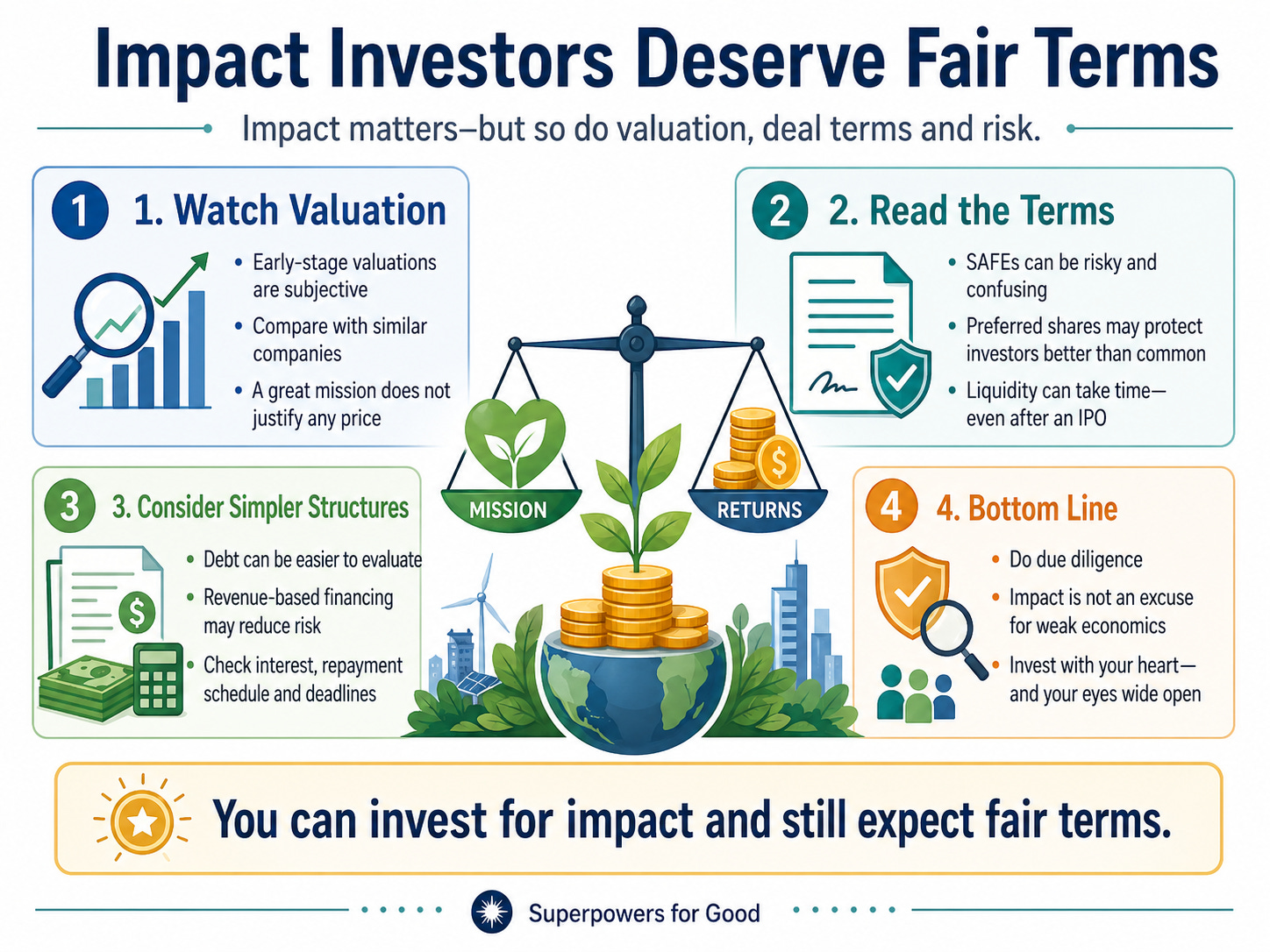
For ordinary investors—people saving for retirement, college, a home purchase, a rainy day or simply a more secure future—most investments need to be priced to produce a reasonable return for the risk involved.
That is especially true in regulated investment crowdfunding.
Reg CF offerings are risky. Startups fail. Small businesses struggle. Even good founders with good intentions can run out of money, miss projections or discover that the market is harder than expected.
Impact matters deeply to me. Every Reg CF investment I make has to pass an impact test. But impact does not eliminate financial risk. It does not make valuation irrelevant. It does not make unfair terms fair.
I was reminded of this recently while reviewing a loan to a pre-revenue company. The impact case was strong. I wanted to like the deal. But the risk was simply too high for the return being offered. Comparing the interest rate to a money market account would have been misleading because the risk was nowhere near comparable.
That is the core issue: risky investments need to offer returns that justify the risk.

Problem One: Valuations Are Often Too High
When investing in equity-type offerings—common stock, preferred stock, SAFEs or convertible notes—I see several common problems in the Reg CF.
The first is valuation.
Valuing early-stage companies is notoriously subjective. People sometimes say, “An asset is worth what someone will pay for it.” That sounds tidy, but it breaks down when the buyer and seller have very different levels of information.
A common definition of fair market value assumes that both buyer and seller are knowledgeable, acting independently, negotiating at arm’s length and under no pressure to complete the transaction.
That is not quite how Reg CF works.
One reason I love Reg CF is that it requires meaningful disclosure. Investors get access to financial statements, risk factors, ownership information, business descriptions and offering terms. That transparency is one of the great strengths of the model.
But disclosure does not put the investor and entrepreneur on equal footing. The founder still knows far more about the business than we do. The founder also usually sets the terms. We do not sit across the table negotiating valuation, liquidation preferences, conversion rights or redemption provisions.
That means we have to scrutinize valuation carefully.
The fact that a company has raised money successfully at a given valuation does not necessarily prove that the valuation is fair. It proves that investors accepted it.
There is a difference.
This is difficult the first time you invest in an equity offering. It gets easier. You learn what similar companies are raising, what stage they are in, how much revenue they have, who invested previously and what terms were used. AI tools can help with some of that research, especially when you are trying to find comparable companies and prior financing rounds.
The key is not to assume that a compelling mission justifies any valuation.
Problem Two: Terms Can Be Skewed Against Investors
The second common problem is deal structure.
As an impact investor, I want to support founders of all sorts. That said, I often find myself reviewing companies where the founders appear to be more affluent than I am. Many founders—certainly not all—have already reached accredited-investor status by virtue of income or net worth.
If you are not an accredited investor, you should be especially careful about subsidizing founders who may be better positioned financially than you are.
The most obvious example is the SAFE.
SAFEs—Simple Agreements for Future Equity—were designed for Silicon Valley-style startups that expect to raise future priced equity rounds from professional venture investors. In that ecosystem, a SAFE is a bridge to a later financing event.
But in Reg CF, SAFEs are often used by companies that have no obvious connection to Silicon Valley, venture capital or the broader tech financing ecosystem. Some of these companies may never raise a priced equity round. If that never happens, investors need to understand exactly what they own and exactly how they get paid.
Imagine investing $100 in a SAFE with a $5 million valuation cap. Three years later, the company is sold for $100 million. You may assume you just made roughly 20 times your money.
Maybe.
But do not assume.
The answer depends on the specific language of the SAFE, especially the provisions governing liquidity events, dissolutions, redemptions and conversions. SAFEs are not all identical, and Reg CF issuers sometimes use modified forms. In some cases, investors may receive a return based on their investment amount rather than the upside they imagined.
I hope founders would not structure or interpret a deal in a way that deprives small investors of a fair return. But hope is not due diligence.
Convertible notes are often better for investors because they at least provide a stated interest rate while investors wait for conversion or repayment. Actual shares—common or preferred—can be clearer still, because investors own equity from the start.
But even shares require scrutiny.
Preferred stock is generally more valuable than common stock because it often gives investors priority in a liquidation. At a minimum, a liquidation preference can mean investors get their money back before founders receive proceeds. If the company sells for a large gain, preferred investors may be able to convert into common shares and share in the upside.
Common shareholders, by contrast, generally share pro rata with founders. If you invest at a $20 million valuation and the company later sells for $2 million, your outcome may be painful. Preferred shareholders in the same company, at the same valuation, might recover far more.
That difference matters.
A valuation that might be reasonable for preferred stock could be far too high for common stock. A $20 million valuation with investor-friendly preferred terms is not the same as a $20 million valuation for common shares.
Terms matter as much as valuation.

Liquidity Can Be Harder Than It Looks
There is another practical hazard in equity crowdfunding: liquidity.
Even when a company eventually goes public through an IPO, SPAC transaction or direct listing, small investors may not be able to sell quickly. In some cases, transferring shares from a transfer agent to a brokerage account can take weeks or months.
That delay can be costly.
Public listings sometimes create an initial burst of enthusiasm followed by a sharp decline. If small investors are stuck waiting for shares to transfer while the market price falls, they may miss the best window for liquidity.
That does not mean these investments are bad. It means the path from “the company went public” to “I sold my shares” may not be simple, quick or painless.
Impact Is Not Scarce
Here’s the good news: there are many impact investments available through Reg CF.
No one should feel forced to accept unfair terms just to make a difference.
I love investing through Reg CF. I have done it about 100 times. I expect to keep doing it. I believe I am helping make the world better while also pursuing financial returns.
But I have also learned to scrutinize the economics.
Impact investors should not be naïve investors. Mission should sharpen our thinking, not dull it.
Revenue-Based Financing Can Help
One increasingly common structure I like is revenue-based financing.
In a revenue-based financing deal, investors are repaid from a share of the company’s revenue until they receive a specified multiple of their investment. I have even seen this concept built into a SAFE-style agreement sometimes called a SAFER, with the “R” standing for redemptions. In that structure, the issuer agrees to redeem portions of the investment out of revenue, potentially providing a stated return such as 2x the original investment.
At first glance, a 2x return may sound modest compared with the dream of a 20x startup outcome.
But remember the other possible scenario: you wait years for an exit and receive far less than expected—or nothing at all. Many small companies never produce a venture-style exit but continue operating for years. In those cases, revenue-based financing may allow investors to receive cash flow much earlier.
That can reduce risk.
Still, investors need to read the details. A promise to repay 1.5x the original investment without a meaningful deadline could take so long that the annualized return becomes unattractive. Given the risk, that may not be fair pricing.
As always, the structure matters.
Debt Can Be a Good Place to Start
For newer investors, simple debt deals can be a great way to learn the ropes and build the skills experienced investors call due diligence.
Debt offerings are usually easier to understand than SAFEs, convertible notes or preferred equity. There is a principal amount. There is an interest rate. There is a maturity date. There is a repayment schedule. You can evaluate whether the business appears likely to make the payments.
That does not make debt safe. Every investment is risky. Small business loans can default.
But the terms are often easier to analyze.
Climatize focuses on climate-related offerings with debt terms. SMBX offers small business loans. Honeycomb Credit also features many small business loans, often with meaningful local or social impact.
For many impact investors, these offerings may be a smart place to begin.

The Bottom Line
Impact investing should not mean accepting bad terms.
It should not mean pretending risk is lower than it is. It should not mean donating money to founders through investment structures that offer too little upside, too little protection or too little clarity.
There is nothing wrong with philanthropy. There is nothing wrong with concessionary capital when you make that choice intentionally.
But if you are investing—not donating—you deserve fair terms.
At The Super Crowd, Inc., a public benefit corporation, we now prepare preliminary due diligence reports on every new regulated investment crowdfunding offering. These reports are designed to give investors a running start by summarizing the company, the impact case, the terms and the risks.
Impact Members can access those reports here.
An Impact Membership costs just $5.95 per month, or $55 per year—about $4.59 per month when paid annually. I also share “Devin’s Impact Pick of the Week” with Impact Members every Friday. Each pick comes with a detailed impact report, a discussion of risks and one small reassurance: I invest my own money before recommending it.
This is not investment advice. Every investor must make their own decisions.
But my hope is simple: that more of us will invest for impact with both our hearts and our eyes wide open.

Support Our Sponsors
Our generous sponsors make our work possible, serving impact investors, social entrepreneurs, community builders and diverse founders. Today’s advertisers include Emission Free Generators, PurposeBuilt100, SuperCrowd26 and CARfiling.com. Learn more about advertising with us here.
Max-Impact Members
(We’re grateful for every one of these community champions who make this work possible.)
Brian Christie, Brainsy | Cameron Neil, Lend For Good | Carol Fineagan, Independent Consultant | Hiten Sonpal, RISE Robotics | John Berlet, CORE Tax Deeds, LLC. | Justin Starbird, The Aebli Group | Lory Moore, Lory Moore Law | Marcia Brinton, High Desert Gear | Mark Grimes, Networked Enterprise Development | Matthew Mead, Hempitecture | Michael Pratt, Qnetic | Mike Babbit | Coledger Solutions | Mike Green, Envirosult | Nick Degnan, Unlimit Ventures | Dr. Nicole Paulk, Siren Biotechnology | Paul Lovejoy, Stakeholder Enterprise | Pearl Wright, Global Changemaker | Scott Thorpe, Philanthropist | Sharon Samjitsingh, Health Care Originals | Add Your Name Here
Upcoming SuperCrowd Event Calendar
If a location is not noted, the events below are virtual.

SOCAP Open: My panel, “Who Decides Where Impact Capital Goes?” with Lyneir Richardson and Jenny Kassan as proposed by Paul Lovejoy at Stakeholder Enterprise is in the public voting round for SOCAP Open in Chicago. Community votes help shape the SOCAP agenda (about 20% of the selection process), so every vote matters. Please take a moment to vote for our session before the deadline. Thank you!
SuperCrowd Impact Member Networking Session: Impact (and, of course, Max-Impact) Members of the SuperCrowd are invited to a private networking session on May 19th at 8:00 PM ET/5:00 PM PT. Mark your calendar. We’ll send private emails to Impact Members with registration details. Upgrade to Impact Membership today!
SuperCrowdHour, May 20, 2026, at 12:00 PM Eastern. Devin Thorpe will lead a session on “How to File Your Form C-AR Yourself for Free!” Designed for founders and issuers navigating regulated investment crowdfunding, this practical session will walk attendees through the annual Form C-AR filing process and show how to complete it independently—without unnecessary legal or filing expenses. Devin will explain what information is required, common mistakes to avoid, important deadlines to remember, and how staying compliant helps build trust with investors while protecting your raise. Whether you’ve recently closed an offering or are preparing for your first annual report, this SuperCrowdHour will provide a clear, cost-effective roadmap to filing your Form C-AR with confidence. Register here: https://thesupercrowd.com/20may26
SuperCrowd26 featuring PurposeBuilt100™: This August 25–27, founders, investors, and ecosystem leaders will gather for a three-day, broadcast-quality global experience focused on disciplined capital formation, regulated investment crowdfunding, and purpose-driven growth. We’re bringing together leading voices in impact investing, compliance, digital marketing, and circular economy innovation to deliver practical frameworks, real-world case studies, and actionable strategies. The event culminates in the PurposeBuilt100™ Showcase, recognizing 100 of the fastest-growing purpose-driven companies in the U.S. Register now to secure your seat and get all the details. August 25–27, streaming worldwide.
Share the application for the PurposeBuilt100™: Purpose-driven founders deserve recognition. The PurposeBuilt100™ application window is now open—celebrating the fastest-growing companies building profit with purpose. If you know a founder creating real impact and real growth, please share this opportunity. Applications are free and confidential. Explore the program and apply today: PurposeBuilt100.com.
Superpowers for Good Live Pitch on e360tv — June 3, 2026. Purpose-driven founders raising capital through Regulation Crowdfunding are invited to apply by May 6, 2026, for a chance to pitch live to a national audience of investors and impact champions.
Community Event Calendar
Successful Funding with Karl Dakin, Tuesdays at 10:00 AM ET - Click on Events.
Earthstock Summit, Ojai, CA, May 29-31: The Earthstock Regenerative Summit in Ojai brings together leaders and community members for panels, workshops, films, music, and hands-on projects focused on regenerative agriculture, ecological design, resilience, health, and sustainable living.
Save the Date! October 20th and 21st will be the Crowdfunding Professional Association Regulated Investment Crowdfunding Summit for 2026. This is the event of the year for everyone in the crowdfunding ecosystem.
If you would like to submit an event for us to share with the 10,000+ changemakers, investors and entrepreneurs who are members of the SuperCrowd, click here.
Manage the volume of emails you receive from us by clicking here.
We share educational information—not investment advice. Some links may generate compensation. See our full disclosure.