


You can advertise in Superpowers for Good. Click to learn more about our affordable options.
A decade ago, the idea that an everyday retail investor could fund the next breakthrough in climate technology or take a meaningful stake in a local sustainable agriculture startup was largely theoretical. The private capital markets were an exclusive club, walled off by strict accreditation rules, high minimum check sizes, and opaque networks. Today, as we navigate the economic landscape of 2026, that paradigm has fundamentally shifted. Regulation Crowdfunding (Reg CF) has matured from a novel experiment born out of the JOBS Act into a formidable, mainstream engine for capital formation. At the heart of this transformation is the explosive growth of impact investing.
Impact investing—the strategy of deploying capital to generate positive, measurable social and environmental impact alongside a financial return—is no longer a niche sub-sector of the financial industry. It has become one of the fastest-growing segments of private market investing. As institutional venture capital experienced periods of contraction, recalibration, and risk aversion over the past few years, retail investors stepped up. Armed with digital platforms, unprecedented access to data, and a deep desire to align their portfolios with their values, the crowd has become a powerhouse of early-stage capital.
The convergence of mission-driven entrepreneurship and community investing is reshaping how startups raise funds. Founders are realizing that their most passionate customers can also be their most valuable shareholders. Meanwhile, everyday people are demanding more from their investments than just a quarterly statement; they want a tangible stake in the solutions to the world’s most pressing challenges, from climate change to wealth inequality.
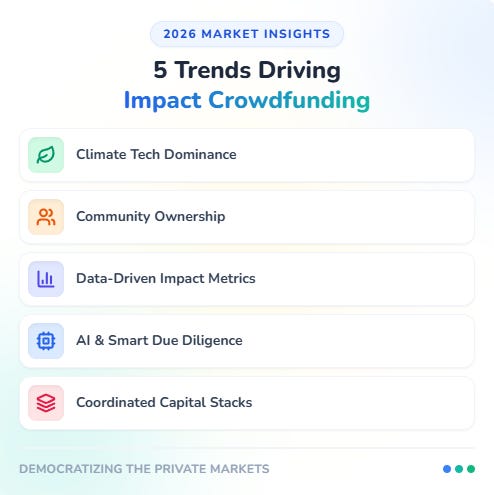
In 2026, the Regulation Crowdfunding ecosystem is characterized by increasing technological sophistication, a more educated investor base, and a regulatory environment that continues to adapt to the realities of democratized finance. This article explores the five defining impact investing trends driving Regulation Crowdfunding today, examining why they matter, how they are influencing the market, and what they signal for the future of startup finance.

The Evolution of Impact Investing and Regulation Crowdfunding
To understand the current state of equity crowdfunding, we must look at how the landscape has evolved since the implementation of Title III of the JOBS Act in 2016. Initially, Regulation Crowdfunding was met with a mix of enthusiasm and skepticism. The original $1.07 million annual funding cap limited its utility for high-growth startups, and early platforms struggled to educate a public accustomed to rewards-based crowdfunding sites like Kickstarter and Indiegogo.
However, the regulatory update in 2021, which raised the Reg CF cap to $5 million, served as a watershed moment. Suddenly, Regulation Crowdfunding became a viable alternative to traditional seed and Series A rounds. It allowed founders to bypass traditional venture capital gatekeepers, who historically directed the vast majority of funding toward a narrow demographic of founders in a few major tech hubs.
In parallel, the past decade has seen a massive wealth transfer and a generational shift in investment philosophy. Millennials and Gen Z, who now make up a significant portion of the retail investor base, have consistently demonstrated a preference for sustainable investing. They do not view financial returns and social good as mutually exclusive; rather, they see them as deeply intertwined.
Founders increasingly choose Reg CF not just out of necessity, but as a strategic maneuver. By opening their cap tables to the public, they are democratizing investment opportunities and building a coalition of stakeholders. This model of community ownership stands in stark contrast to the traditional venture capital model, which often prioritizes hyper-growth and rapid exits over long-term sustainability and community wealth building. Today, Reg CF complements venture capital, angel investing, and Regulation D offerings, serving as a critical layer in the modern capital stack for impact-driven enterprises.
Trend 1: Climate Technology and Sustainability Become Core Investment Themes
If there is one sector that has dominated the intersection of impact investing and Regulation Crowdfunding in 2026, it is climate technology. The urgency of the global climate crisis has catalyzed a wave of innovation, and retail investors are eager to fund the transition to a sustainable economy.
The Broad Spectrum of Climate Tech
Climate investing on crowdfunding platforms has expanded far beyond generic “green” initiatives. Today, retail investors are deploying capital into highly specialized sub-sectors. Renewable energy projects, particularly community solar initiatives, have seen massive success. These projects allow local residents to invest in the solar arrays that power their own neighborhoods, creating a closed-loop system of energy production and wealth generation.
Green infrastructure and the circular economy are also major draws. Startups developing biodegradable materials, advanced recycling robotics, and sustainable supply chain software are finding receptive audiences on platforms like Climatize and Wefunder. Climatize, in particular, has emerged as a vital conduit for climate-conscious investors, making it easier for everyday people to directly fund renewable energy projects and climate-tech startups without needing institutional capital.
Water technologies—addressing scarcity, purification, and agricultural efficiency—have surged in popularity as climate resilience becomes a global priority. Furthermore, carbon reduction and capture technologies, once the exclusive domain of deep-tech venture capital, are now raising millions through Reg CF, allowing everyday citizens to directly fund the fight against atmospheric carbon.
Why Retail Investors Care
The appeal of climate investing in the retail space is twofold. First, the existential threat of climate change has created a highly motivated investor base. People want to feel that their money is actively working to secure a livable future. Second, the financial upside is increasingly clear. As governments worldwide implement stricter environmental regulations and offer massive subsidies for green tech, the market for sustainable solutions is expanding exponentially. Retail investors recognize that the next generation of unicorn companies will likely be those that solve the world’s biggest environmental problems. Regulation Crowdfunding enables participation in this environmental innovation, ensuring that the financial rewards of the green transition are not hoarded by institutional elites.
Trend 2: Community Ownership Becomes a Strategic Competitive Advantage
In 2026, the concept of the “customer-investor” has moved from a marketing buzzword to a fundamental business strategy. Community ownership is no longer just a nice-to-have; it is a strategic competitive advantage that can dictate a startup’s long-term success.
The Customer-Investor Flywheel
When a customer becomes an investor, their relationship with the brand fundamentally changes. They transition from a passive consumer to an active stakeholder. This dynamic creates a powerful flywheel effect. Customer-investors are more likely to buy the company’s products, defend the brand on social media, provide valuable product feedback, and recruit new customers. Brand loyalty is cemented by literal equity.
For mission-driven businesses, community-driven fundraising aligns perfectly with their ethos. Main Street businesses and local enterprises are leveraging platforms like Honeycomb Credit to issue community-funded loans and revenue-sharing notes. Honeycomb Credit has proven that local economic development can be a shared enterprise, allowing a neighborhood bakery or a regional organic farm to raise capital directly from the people who buy their products. By internalizing their community’s support, these businesses turn their most loyal patrons into financial backers.
Engagement and Retention
Successful crowdfunding campaigns transform investors into advocates and ambassadors. Founders in 2026 are leveraging sophisticated investor relations tools to keep their retail backers engaged. They host exclusive town halls, offer beta testing opportunities, and create private community forums. This ongoing investor engagement leads to unprecedented long-term customer retention. When a competitor enters the market, a customer might switch brands; an investor will not. By distributing ownership, founders are building a moat around their business that traditional marketing dollars simply cannot buy.
Trend 3: Measuring Impact Becomes as Important as Measuring Returns
As impact investing has grown, so too has the scrutiny surrounding it. The era of vague promises and “greenwashing” is over. In 2026, retail investors demand transparency, and measuring impact has become just as critical as measuring financial returns.
The Rise of Standardized Metrics
In the early days of impact crowdfunding, founders could often win over investors with a compelling narrative and a mission statement. Today, investor expectations have matured. They want hard data. This shift has driven the adoption of standardized reporting frameworks within the Reg CF ecosystem. While public companies grapple with complex ESG (Environmental, Social, and Governance) regulations, private startups raising capital from the crowd are voluntarily adopting streamlined impact reporting standards such as the IRIS+ system or B Corp certification metrics.
Founders are increasingly publishing measurable impact outcomes alongside their financial performance. A clean water startup doesn’t just report its monthly recurring revenue; it reports the exact number of gallons purified. A fair-trade coffee company reports on the specific wage increases of its partner farmers.
Transparency and Trust
This commitment to data-driven decision making and transparency builds immense trust with the retail investor base. Platforms are integrating impact metrics directly into the deal pages, allowing investors to filter and evaluate companies based on their specific ESG criteria. For founders, rigorous impact reporting is no longer a burden; it is a vital marketing tool and a prerequisite for attracting the modern impact investor.
Trend 4: AI, Data Analytics, and Technology Improve Crowdfunding
The technological infrastructure supporting Regulation Crowdfunding has taken a quantum leap forward by 2026. Artificial intelligence and advanced data analytics are fundamentally improving accessibility, trust, and investment quality across the ecosystem.
Deal Discovery and Due Diligence
With thousands of active Reg CF campaigns at any given time, deal discovery was historically a major pain point for retail investors. Today, AI-driven recommendation engines analyze an investor’s past behavior, stated values, and risk tolerance to surface highly relevant impact investments. Emerging platforms like Aequitas Invest are pioneering new models of equitable deal discovery, utilizing technology to highlight underrepresented founders and impact-driven startups that might otherwise be overlooked by traditional algorithms. By focusing on democratized access and rigorous, tech-enabled vetting, platforms like Aequitas Invest ensure that a user passionate about social equity or inclusive entrepreneurship is immediately connected with aligned opportunities.
Furthermore, technology is democratizing due diligence. Third-party aggregators and analytics firms utilize predictive analytics and machine learning to evaluate startup health, analyzing everything from web traffic and social sentiment to founder track records and market size. This empowers retail investors with institutional-grade insights.
Fraud Detection and Education
Crucially, AI is playing a massive role in fraud detection and regulatory compliance. Automated systems scan offering documents, financial statements, and marketing materials to flag inconsistencies or unrealistic claims, protecting the crowd from bad actors. Additionally, AI-powered investor education tools, such as interactive chatbots and dynamic risk-assessment quizzes, are helping novice investors understand the complexities and risks of startup investing, ensuring a more informed and resilient market.
Trend 5: Coordinated Capital Replaces Single-Source Financing
One of the most sophisticated trends to emerge in 2026 is the strategic use of coordinated capital. Founders are no longer viewing Regulation Crowdfunding in isolation. Instead, they are building diversified funding strategies, combining multiple capital sources to optimize their balance sheets and maintain control.
The Modern Capital Stack
A typical funding round for a high-growth impact startup today might involve a concurrent Regulation Crowdfunding and Regulation D offering. This allows the company to accept small checks from their community (Reg CF) while simultaneously taking in larger investments from accredited angel investors and family offices (Reg D).
Furthermore, founders are layering non-dilutive capital into the mix. Government grants, particularly those focused on climate tech and local economic development, are being used to derisk the company for early investors. Revenue-based financing and community lending—facilitated by platforms like Honeycomb Credit—are utilized for inventory and operational expenses, preserving equity for strategic growth.
Even traditional venture capital is participating in this coordinated approach. VC firms are increasingly acting as lead investors in rounds that are then opened up to the crowd. This symbiotic relationship provides the startup with institutional validation and mentorship, while still allowing the community to share in the upside. By moving away from single-source financing, founders are building more resilient companies and dictating their own terms.

Emerging Trends Beyond 2026
As we look toward the end of the decade, several nascent trends are poised to further disrupt the impact crowdfunding space.
Tokenization and Blockchain
While the speculative crypto frenzy of the early 2020s has faded, the underlying technology has found practical application in private market investing. Tokenization of equity—representing shares as digital assets on a blockchain—is beginning to streamline cap table management and facilitate easier dividend distributions. Importantly, this is happening without the speculative volatility of cryptocurrencies, focusing purely on operational efficiency and eventual secondary market liquidity.
Institutional Participation and Inclusive Entrepreneurship
We are also seeing the early stages of institutional participation in Reg CF. Impact-focused donor-advised funds (DAFs) and progressive community foundations are exploring ways to deploy capital through crowdfunding platforms to support local economic development. This aligns with a broader push toward inclusive entrepreneurship, ensuring that capital flows to female founders, founders of color, and entrepreneurs outside of traditional tech hubs. Platforms like Aequitas Invest are leading the charge in this arena, proving that the democratization of private markets must expand from the investor side to the founder side to create a truly equitable financial ecosystem.
Challenges Facing Impact Crowdfunding
Despite the immense progress, the Regulation Crowdfunding ecosystem in 2026 is not without its challenges. A balanced analysis requires acknowledging the hurdles that founders, investors, and platforms must navigate.
Liquidity and Risk
The most persistent challenge remains liquidity limitations. Startup investments are inherently illiquid, and while secondary markets are slowly developing, retail investors must still be prepared to hold their equity for five to ten years, with a high probability of total loss. Managing investor expectations regarding timelines and risk is a constant battle.
Regulatory Compliance and Fraud
Regulatory compliance is another significant burden. The costs associated with financial reviews, legal structuring, and ongoing reporting can be prohibitive for very early-stage companies. Furthermore, while AI has improved fraud prevention, the open nature of the internet means that platforms must remain hyper-vigilant against sophisticated scams and misleading marketing.
Measuring Real Impact
Finally, measuring real impact remains complex. While standardized reporting is improving, there is still a risk of “impact washing”—where companies exaggerate their social or environmental benefits to attract capital. Ensuring that impact metrics are audited and verified is the next major hurdle for the industry to overcome to maintain long-term trust.
Practical Advice for Founders
For entrepreneurs looking to leverage Regulation Crowdfunding in 2026, success requires more than just a good product; it requires a masterful execution of community building and storytelling.
Build an Engaged Investor Community Early: Do not wait until your campaign launches to start building your audience. Cultivate a community of passionate followers, customers, and newsletter subscribers months in advance. The most successful campaigns are funded by a startup’s existing network in the first 48 hours, which then triggers the platform’s algorithms to attract outside investors.
Create Transparent Campaigns: Honesty is your best marketing tool. Clearly articulate your risks, your challenges, and your financial realities. Retail investors are surprisingly forgiving of setbacks if they feel they are being treated as true partners.
Demonstrate Measurable Impact: Go beyond vague mission statements. Define your Key Performance Indicators (KPIs) for both financial growth and social impact. Show potential investors exactly how their capital will move the needle on the issues they care about.
Leverage Crowdfunding as Marketing: Treat your Reg CF campaign as a massive public relations and customer acquisition event. The marketing dollars spent promoting your raise will often yield new customers, strategic partnerships, and media coverage, providing ROI even beyond the capital raised.
Practical Advice for Investors
For retail investors navigating the private markets, enthusiasm for impact must be balanced with disciplined financial strategy.
Evaluate Impact Companies Rigorously: Do not invest solely based on an emotional connection to a cause. Dig into the business model. A company cannot deliver sustainable impact if it goes bankrupt. Evaluate the team, the market size, and the unit economics just as you would a traditional tech startup.
Portfolio Diversification: Startup investing is a numbers game. Do not put all your allocated capital into a single company. Build a diversified portfolio of 15 to 20 startups across different sectors and stages to mitigate risk.
Maintain a Long-Term Mindset: Understand that this capital is locked up. Do not invest money you will need for a down payment or an emergency fund in the next five years. Treat startup investing as a long-term wealth-building strategy, not a get-rich-quick scheme.
Future Outlook
Looking ahead to the next five years, Regulation Crowdfunding is positioned to become a dominant force in early-stage capital formation. We can anticipate further regulatory refinements, perhaps increasing the funding caps again to keep pace with inflation and market demand. Technological innovation will continue to reduce friction, making investing in a private startup as seamless as buying a share of a public stock on a brokerage app.
Most importantly, the demographic shifts driving impact investing will only accelerate. As Gen Z enters their prime earning years, their insistence on aligning capital with values will force the entire financial industry to adapt. Impact investing will cease to be a distinct category; it will simply become the standard way that business is done.
The landscape of startup finance in 2026 is fundamentally different from the one that existed a decade ago. The five trends driving Regulation Crowdfunding—the dominance of climate tech, the strategic advantage of community ownership, the demand for measurable impact, the integration of AI, and the rise of coordinated capital—are all pointing toward a more democratic, transparent, and purpose-driven financial system.
Regulation Crowdfunding is no longer just an alternative funding mechanism; it is a powerful tool for empowering entrepreneurs who are solving real-world problems. By enabling everyday investors to participate in the private markets, we are not just democratizing capital; we are collectively funding the future we want to see. As the ecosystem continues to mature, the synergy between impact investing and equity crowdfunding will undoubtedly play a pivotal role in building a more sustainable, resilient, and inclusive global economy.
References
U.S. Securities and Exchange Commission (SEC). (2025). Annual Report on Regulation Crowdfunding Capital Formation.
Global Impact Investing Network (GIIN). (2026). Sizing the Impact Investing Market: Retail Capital Trends.
Crowdfunding Professional Association (CfPA). (2025). State of the Industry: The Rise of the Customer-Investor.
KingsCrowd. (2026). Private Market Data and Analytics: Q1 2026 Market Report.
Climatize & Honeycomb Credit. (2025). Community Capital for Climate Resilience and Main Street Growth.
Aequitas Invest. (2026). Democratizing Access: The State of Inclusive Entrepreneurship in Reg CF.
World Economic Forum. (2026). The Future of Democratized Finance and ESG Integration.
OECD. (2025). Financing SMEs and Entrepreneurs: An OECD Scoreboard.
Bring Impact Stories to Your Big Screen with SuperCrowd.tv

Transform your living room into a hub for positive change with SuperCrowd.tv! Dive into the heart of the impact crowdfunding community through exclusive founder interviews, engaging monthly webinars, and thrilling live pitch events—all perfectly tailored for your television. Backed by The Super Crowd Inc., a public benefit corporation dedicated to growing community participation in impact investing, this platform makes it easier than ever to get inspired. It is completely free to watch, with absolutely no subscriptions or sign-ins required. Download the app today on Amazon Fire TV or Roku and start experiencing the future of impact investing right from the comfort of your couch!
Disclaimer:
This article is for informational and educational purposes only. It does not constitute financial advice, investment advice, or a recommendation to buy or sell any securities. Crowdfunding investments are speculative, illiquid, and carry a high degree of risk, including the total loss of principal. Past performance is not indicative of future results. Investors should conduct their own due diligence and consult with financial advisors before making investment decisions.
Support Our Sponsors
Our generous sponsors make our work possible, serving impact investors, social entrepreneurs, community builders and diverse founders. Today’s advertisers include Fureelz and Mission Booster Procurement. Learn more about advertising with us here.
Max-Impact Members
(We’re grateful for every one of these community champions who make this work possible.)
Brian Christie, Brainsy | Cameron Neil, Lend For Good | Carol Fineagan, Independent Consultant | Hiten Sonpal, RISE Robotics | John Berlet, CORE Tax Deeds, LLC. | Justin Starbird, The Aebli Group | Lory Moore, Lory Moore Law | Marcia Brinton, High Desert Gear | Mark Grimes, Networked Enterprise Development | Matthew Mead, Hempitecture | Michael Pratt, Qnetic | Mike Babbit | Coledger Solutions | Mike Green, Envirosult | Nick Degnan, Unlimit Ventures | Dr. Nicole Paulk, Siren Biotechnology | Paul Lovejoy, Stakeholder Enterprise | Pearl Wright, Global Changemaker | Scott Thorpe, Philanthropist | Sharon Samjitsingh, Health Care Originals
Upcoming SuperCrowd Event Calendar
If a location is not noted, the events below are virtual.
Join the SuperCrowd Impact League! You can be recognized for making impact investments via Reg CF. See how your activity compares to your peers. It’s free. Win valuable prizes. Start now!
SuperCrowd Impact Member Networking Session: Impact (and, of course, Max-Impact) Members of the SuperCrowd are invited to a private networking session on July 14th at 8:00 PM ET/5:00 PM PT. Mark your calendar. We’ll send private emails to Impact Members with registration details. Upgrade to Impact Membership today!
SuperCrowdHour, July 15, 2026, at 12:00 PM Eastern. Devin Thorpe, CEO and Founder of The Super Crowd, Inc., will lead a session on “How to Make a Splash With Your Campaign Launch.” Drawing on his extensive experience helping entrepreneurs and impact-driven founders succeed in investment crowdfunding, Devin will share proven strategies for creating momentum and attracting attention when launching a crowdfunding campaign. In this session, he’ll explore how founders can prepare for a successful launch, build excitement before going live, engage their networks effectively, and generate the early traction that often determines long-term campaign success. Attendees will learn practical tactics for storytelling, outreach, media engagement, and community building, along with common mistakes that can limit visibility and investor interest. Whether you’re preparing for your first crowdfunding raise or looking to improve the performance of a future campaign, this SuperCrowdHour will provide actionable insights to help you launch with confidence and maximize your campaign’s impact from day one. Register now!
SuperCrowd26 featuring PurposeBuilt100™️: This August 25–27, founders, investors, and ecosystem leaders will gather for a three-day, broadcast-quality global experience focused on disciplined capital formation, regulated investment crowdfunding, and purpose-driven growth. We’re bringing together leading voices in impact investing, compliance, digital marketing, and circular economy innovation to deliver practical frameworks, real-world case studies, and actionable strategies. The event culminates in the PurposeBuilt100™️ Showcase, recognizing 100 of the fastest-growing purpose-driven companies in the U.S. Register now to secure your seat and get all the details. August 25–27, streaming worldwide.
Share the application for the PurposeBuilt100™: Purpose-driven founders deserve recognition. The PurposeBuilt100™ application window is now open—celebrating the fastest-growing companies building profit with purpose. If you know a founder creating real impact and real growth, please share this opportunity. Applications are free and confidential. Explore the program and apply today: PurposeBuilt100.com.
Community Event Calendar
Successful Funding with Karl Dakin, Tuesdays at 10:00 AM ET - Click on Events.
Register Now! October 20th and 21st will be the Crowdfunding Professional Association Regulated Investment Crowdfunding Summit for 2026. This is the event of the year for everyone in the crowdfunding ecosystem.
If you would like to submit an event for us to share with the 10,000+ changemakers, investors and entrepreneurs who are members of the SuperCrowd, click here.
We utilized AI to efficiently gather data and analyze key success factors, enabling us to deliver an overview of these successful crowdfunding campaigns.
We share educational information—not investment advice. Some links may generate compensation. See our full disclosure.