


You can advertise in Superpowers for Good. Click to learn more about our affordable options.
For a decade, Regulation Crowdfunding has let ordinary people invest in the startups and small businesses they believe in. Since the rules took effect in 2016, about 9,850 crowdfunding offerings have been completed, according to Investing.com. This week, the Securities and Exchange Commission signaled it is ready to make the system work better.
At the SEC’s Small Business Capital Formation Advisory Committee meeting on October 27, Chairman Paul Atkins said he has asked Commission staff to evaluate which parts of Regulation Crowdfunding can be amended to lower compliance costs and make the rules more attractive to companies and investors.
That is welcome news. The SuperCrowd supports modernizing Regulation Crowdfunding — and we believe the reforms should help both ends of the market: companies ready to raise millions, and the much larger number of founders raising their first few hundred thousand dollars.
What happened at the SEC
Regulation Crowdfunding shared the agenda with IPO modernization at the October 27 meeting of the SEC’s Small Business Capital Formation Advisory Committee. The session looked back on roughly ten years of Reg CF and at ways to widen access to early-stage capital.
Chairman Paul Atkins said he has directed staff to identify which aspects of Reg CF can be amended to reduce compliance burdens. The move fits a broader SEC push to expand retail investors’ access to private markets, following September’s proposal to revise the definition of an accredited investor.
Commissioner Mark Uyeda said the rules should be reviewed regularly and noted that “the anti-fraud provisions already apply to any statement made with respect to crowdfunded offerings.” His central question: how prescriptive should the rules be, given the relatively small amounts raised?
Industry voices presenting included Brian Belley, President of the Crowdfunding Professional Association (CfPA); Sherwood Neiss, Principal of Crowdfund Capital Advisors; and Nick Tommarello, Founder and CEO of Wefunder.
Nothing has changed yet. Any amendment would go through the SEC’s normal rulemaking process, including a public comment period.
What reformers are asking for
The industry’s proposals share one theme: rules that fit the size of the raise.
The Crowdfunding Professional Association’s four priorities, presented by Brian Belley:
A streamlined tier for small offerings up to $350,000, with self-certified financial statements and simpler forms, while keeping executive accountability and material disclosures.
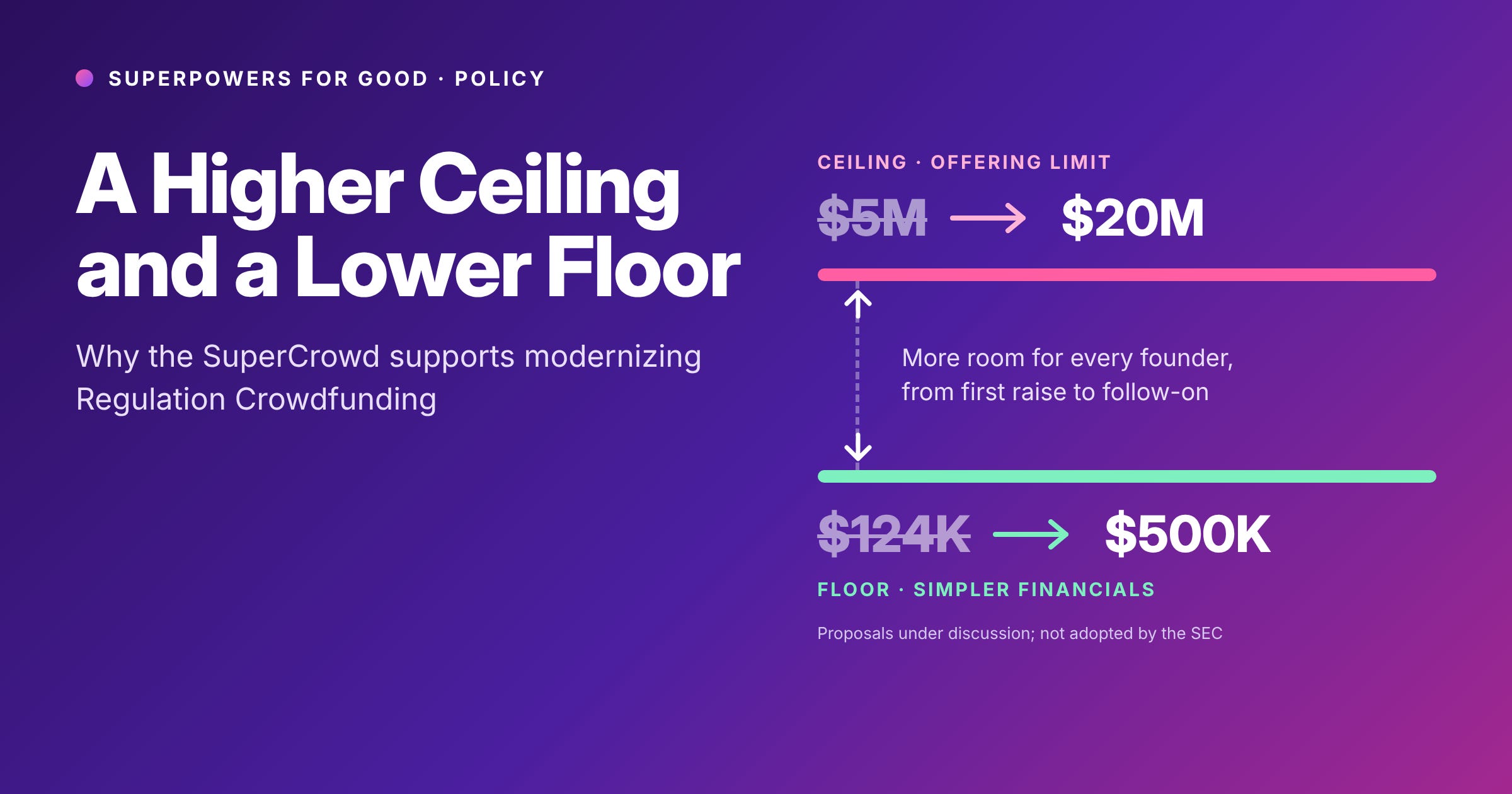
A higher offering limit: from $5 million to $20 million in a 12-month period, with compatible treatment under Section 12(g) of the Exchange Act.
Simpler investor limits and issuer communications: investor limits modeled on Regulation A, guidance on sharing factual business information, and targeted changes to Rule 204, which governs how offerings can be advertised.
Clearer information for investors: better disclosure of ownership rights, structures, fees and tax obligations before investing, plus simpler annual reporting.
“Regulation Crowdfunding has demonstrated its value as a capital formation tool over the past decade.” — Brian Belley, CfPA President
Two rulemaking petitions filed earlier this year make similar requests:
File No. 4-889 from BLPN (Building Legendary Professional Networks), filed March 4, seeks a $20 million cap and simpler advertising and communications rules.
File No. 4-914 from Crowdfund Capital Advisors, signed by Sherwood Neiss and filed July 13, proposes a $20 million cap with inflation adjustments and new transaction-level market data. The firm argues the current cap forces larger raises into multiple rounds.
Why the SuperCrowd supports modernization
The SuperCrowd exists to help everyday investors back founders who make a difference. Modernizing Regulation Crowdfunding serves that mission directly — and our founder has put his view on the public record.
On October 26, Devin Thorpe, founder and CEO of The Super Crowd, Inc., submitted a comment letter to the SEC in his individual capacity. He supports the petition to raise the Reg CF limit to $20 million — and argues the reforms shouldn’t stop there.
“Raising the limit to $20 million is a great step for companies ready to raise millions. But most of the entrepreneurs I work with are trying to raise their first few hundred thousand dollars.” — Devin D. Thorpe
For those founders, Devin argues, the biggest obstacle isn’t the cap. It’s the up-front cost of GAAP financial statements and an accountant’s review. His letter asks for two changes at the small end of the market:
Raise the threshold for officer-certified financial statements from $124,000 to $500,000, with future inflation adjustments.
Let companies in that tier use a clearly disclosed cash or simplified accrual basis instead of full GAAP.
There’s precedent. In 2020, the SEC temporarily allowed officer-certified statements for raises up to $250,000. Devin points to that as a model for a permanent $500,000 threshold.
His proposal keeps safeguards in place. The company’s principal executive officer would still certify the statements. The accounting basis would be disclosed and applied consistently. And prior crowdfunding sales would count toward the threshold, so no one can sidestep it by setting a low target.
“A higher ceiling and a lower floor together would grow the whole market.” — Devin D. Thorpe
Larger companies would get room to raise more; first-time founders, many of them women and underrepresented entrepreneurs building impact businesses, would get a lower-cost way in.

Members of our community are part of this conversation too.
What it could mean for you
If you’re a founder: a streamlined small-offering tier could cut the cost of a first raise by thousands of dollars in accounting fees. A $20 million ceiling could let growing companies stay with their community investors instead of turning elsewhere for later rounds.
If you’re an investor: clearer disclosure of ownership rights, fees and tax obligations would make it easier to compare offerings. Simpler investor limits could give you more flexibility. Reformers have paired each proposal with safeguards — executive accountability, disclosure and intermediary oversight stay in place.
What doesn’t change: investing in startups is risky and illiquid. Better rules can lower costs and improve information; they can’t remove risk. Due diligence still matters.
How to weigh in
The SEC takes public comments seriously, and comments from founders and investors who use crowdfunding carry weight.
Read the petitions: File No. 4-914 (Crowdfund Capital Advisors) and File No. 4-889 (BLPN) on SEC.gov.
Submit a comment: share your experience — what a raise cost you, what information you wished you’d had as an investor.
Tell us what you think: reply in the comments. What one change would make crowdfunding work better for you?
References
Impact Crowdfunding Leader Backs $20 Million Reg CF Limit — Yahoo Finance via ACCESS Newswire, October 29, 2026
SEC’s Atkins Seeks Changes to Crowdfunding Regulations — Investing.com, October 27, 2026
SEC Weighing Overhaul to Crowdfunding Rules, Atkins Says — Bloomberg, October 27, 2026
CfPA Calls for Modernization of Regulation Crowdfunding at SEC Advisory Committee Meeting — Business Insider via ACCESS Newswire, October 28, 2026
SEC Small Business Capital Formation Advisory Committee Considers Capital Raising Reforms — TheCorporateCounsel.net
Sponsored by:

Join us Monday, November 9th, at 7 PM Eastern/4 PM Pacific for the SuperCrowd.tv pregame Tailgate Party with Farm to Pet, factory tour and webinar. This event will be unlike anything you’ve experienced before. Scheduled right before the Monday evening game, you’ll enjoy getting into the mood for some football as you learn more about investing in Farm to Pet. Register for free now.
Impact jobs this week
Real Estate Attorney — Gordon Feinblatt LLC · Baltimore, MD · Hybrid · $150,000–$180,000/yr
Director of Growth & Giving — Elemental Impact · New York, NY · Hybrid · $138,100–$207,200/yr
Acquisitions Specialist & Housing Cooperative Coach — New Hampshire Community Loan Fund · Concord, NH · Hybrid · $57,000–$66,000/yr
Coming up
Nov 9, 7 PM ET / 4 PM PT — Pregame Tailgating with Farm to Pet: a special Superpowers for Good episode with a one-hour virtual site visit and barbecue before the game. #ad
Nov 10, 8 PM ET / 5 PM PT — Impact Member networking session: a private networking session for Impact and Max-Impact Members, who’ll get registration details by email. Upgrade to join →
Nov 18, 9 AM PT — SuperCrowdHour: The Next Chapter: Accelerating Success After the Raise, with Devin Thorpe. Learn how to keep investors informed after a raise by sharing progress, challenges, milestones and impact — and how to turn early supporters into long-term advocates. Free.
Nov 19, 8 PM ET / 5 PM PT — Superpowers for Good Live Pitch: watch Reg CF founders pitch live to active investors, then meet them in the networking room before, during and after the show. Free for viewers and investors. Register free →
Feb 4, 2027 — SuperGreen Live: a global virtual gathering connecting climate solutions with the capital and community to scale them. Learn more →
Anytime — Join the SuperCrowd Impact League: get recognized for your Reg CF impact investments, see how you compare with your peers, and win prizes. It’s free. Start now →
Thank you
Our Max-Impact Members: Alisa Evans, Mission Enrollment | Brian Christie, Brainsy | Cameron Neil, Lend For Good | Carol Fineagan, Independent Consultant | Dion Whitman, Call4USA | Eric Coury, Arthia AI | Joey Hayes, thru | John Berlet, CORE Tax Deeds, LLC. | Justin Smith, Contractor+ | Justin Starbird, The Aebli Group | Ken Steele, Rotarian | Lory Moore, Lory Moore Law | Marcia Brinton, High Desert Gear | Mark Grimes, Networked Enterprise Development | Mike Babbit | Coledger Solutions | Mike Green, Envirosult | Nick Degnan, Unlimit Ventures | Paul Lovejoy, Stakeholder Enterprise | Pearl Wright, Global Changemaker | Scott Thorpe, Philanthropist | Sharon Samjitsingh, Health Care Originals | Add Your Name Here
Manage the volume of emails you receive from us by clicking here.
We share educational information—not investment advice. Some links may generate compensation. See our full disclosure.