


You can advertise in Superpowers for Good. Click to learn more about our affordable options.
The Shape of the Week
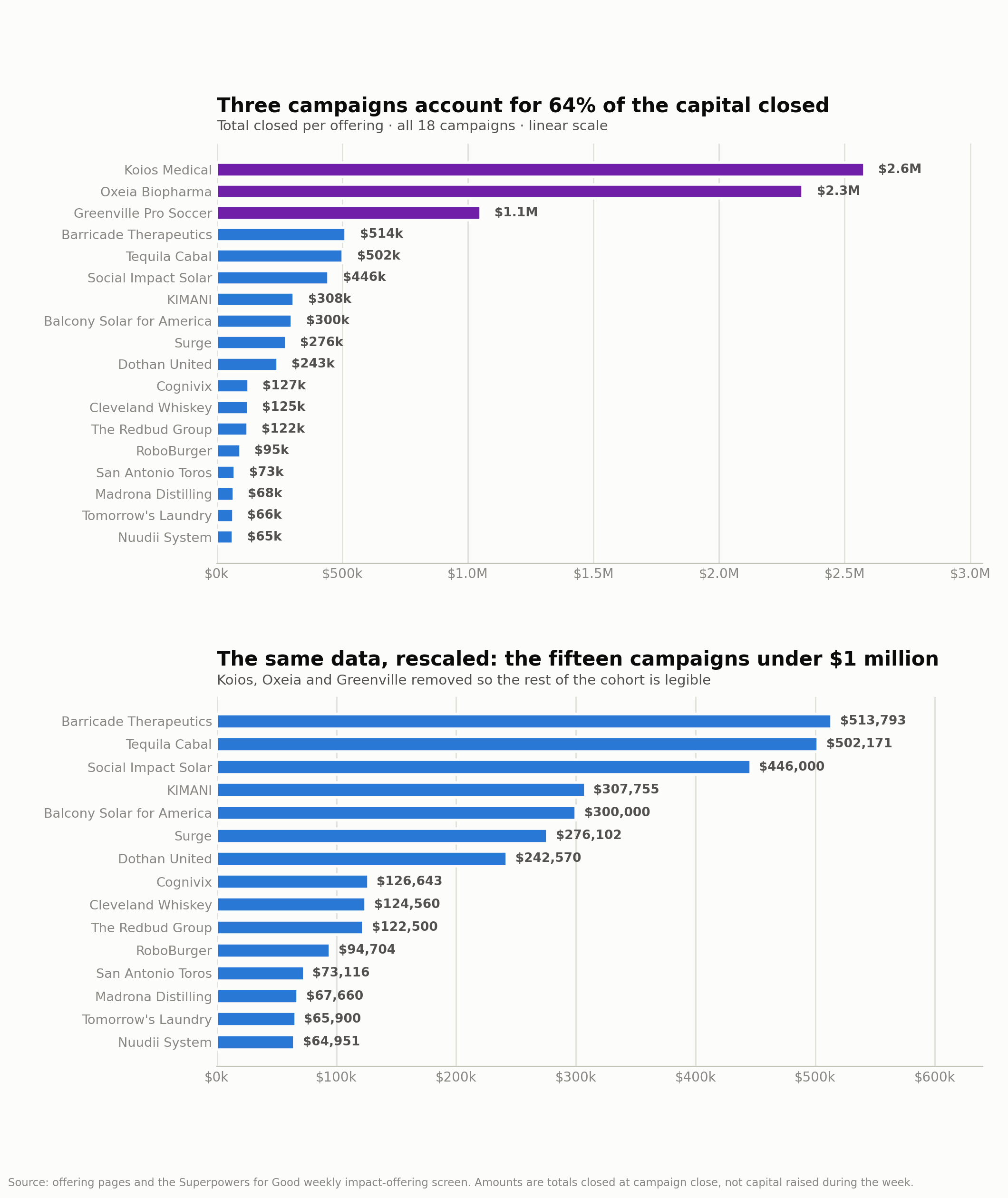
Koios Medical closed at $2,577,724. Oxeia Biopharma closed at $2,333,154. Greenville Pro Soccer closed at $1,050,802. Together: $5,961,680, or 64.2% of everything that closed.
Below those three, the distribution flattens fast. The mean campaign closed at $516,117. The median closed at $259,336 — a ratio of roughly two to one, which is actually the tightest mean-to-median spread this series has recorded. Previous weeks have run four- and eight-to-one. This was a more evenly distributed week than the headline suggests.
Remove the top three and the remaining fifteen closed $3,328,425 combined, with a top performer at $513,793 and a floor at $64,951. That middle band — roughly $65,000 to $515,000 — is where the texture of impact Reg CF actually lives. Fifteen of eighteen campaigns landed inside it.
Founders benchmarking themselves against the headline will conclude they are failing when they are performing at or above the median. Benchmark against the median.

Platform Analysis: Six Portals, Two Clear Winners
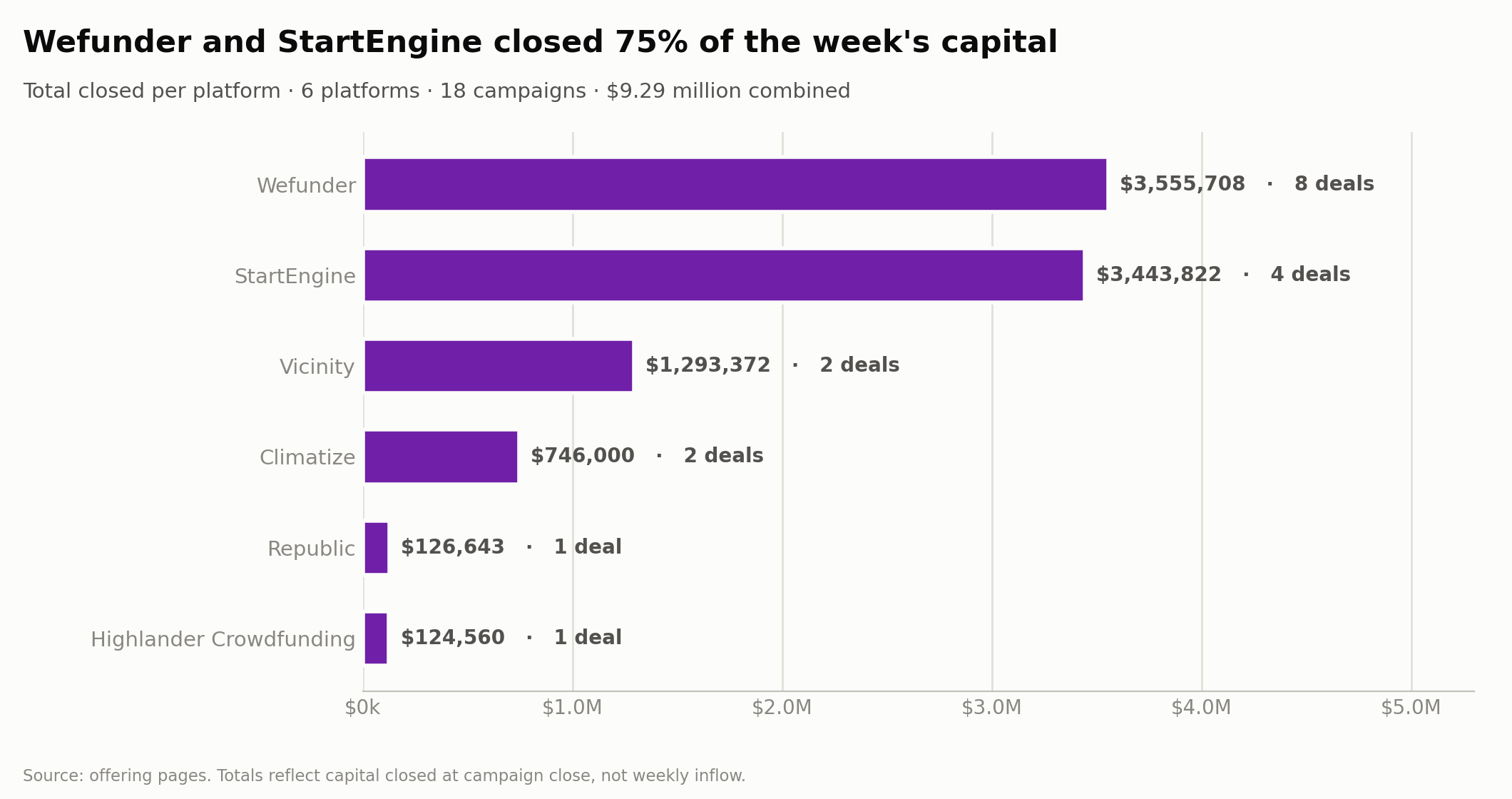
Wefunder and StartEngine closed 75.3% of the week’s capital between them — but they got there by completely different routes, and the contrast is the most useful thing in this table.
Wefunder: breadth, and one outlier carrying the total
Wefunder closed eight deals, the most of any platform, for $3,555,708. But look at the median: $99,808. Seven of its eight deals closed under $310,000. The platform’s total is carried almost entirely by Koios Medical’s $2.58 million — strip that out and Wefunder’s remaining seven deals total $977,984, at an average of $139,712.
That is Wefunder’s model working exactly as designed. It is a volume business with an enormous standing retail audience, and it hosts an extraordinarily wide range: an AI radiology company at a $90 million valuation alongside a gin distillery in Redmond, Washington, a boobwear brand, a men’s t-shirt company, a semi-pro football franchise, a real estate developer and a luxury travel club. Two SAFEs, two preferred equity rounds, one convertible note, one revenue share.
No other platform in this cohort hosted more than two security types. Wefunder hosted four.
The trade-off is attention. A founder gets the largest retail pool in the category and maximum instrument flexibility, but competes against hundreds of live campaigns. Wefunder amplifies a crowd you bring; it rarely manufactures one from nothing.
Best fit: consumer-facing and community-anchored companies, founders arriving with an audience, and anyone who needs structural flexibility.
StartEngine: fewer deals, much larger ones
StartEngine closed four deals for $3,443,822 — a median of $507,982, more than five times Wefunder’s. Three of its four cleared half a million dollars.
StartEngine’s advantage is a very large, habituated retail investor base that has invested before and will invest again, plus brand recognition that lowers friction for first-time investors. Its deals this week — a concussion therapy in Phase 2b, a preclinical oncology company with state cancer-institute backing, a tequila brand, a burger-making robot — share a quality worth naming: each is instantly legible. You can explain any of them in one sentence to someone with no technical background.
That is not an accident. On a platform with a large catalog and a transactional audience, category legibility is the differentiator.
Best fit: companies with a graspable consumer or clinical hook and a credential that fits on one line.
Vicinity: the community-ownership specialist
Vicinity closed two deals for $1,293,372 — both professional soccer clubs, and the second-highest median in the cohort at $646,686.
This is the week’s most distinctive platform story. Vicinity hosted Greenville Pro Soccer ($2,500 minimum, closed $1,050,802) and Dothan United ($1,000 minimum, closed $242,570). Those are the two highest minimum investments in the entire cohort, by a wide margin, and both campaigns closed successfully.
Community sports ownership is a genuinely different investment product. The buyer is not primarily underwriting a financial return; they are buying a stake in a civic institution they will attend, wear, argue about and bring their children to. That buyer tolerates a $2,500 entry price in a way a generic retail investor would not.
Best fit: place-based institutions with an existing fan or member base — teams, venues, clubs, local infrastructure with identity attached.
Climatize: the project-finance machine, again
Climatize closed two deals for $746,000, both debt, both specific infrastructure projects rather than operating companies, and both with a $10 minimum — the lowest in the market.
Balcony Solar for America closed $300,000 of a $300,000 maximum: exactly 100%. Social Impact Solar closed $446,000 of $500,000, or 89.2%.
This is a pattern that has now repeated across multiple weeks of this series, and it is structural rather than lucky. Climatize is not selling shares in a company whose future is unknowable; it is syndicating a defined capital requirement for a defined asset. Bright Saver needs a specific sum for inventory, supplier deposits, freight and warehousing on balcony solar kits. Social Impact Solar needs development and safe-harbor capital for a 45 MWac project on a closed landfill in Lexington, Kentucky. When the sum is raised, the raise is done.
The $10 minimum is the other half of the design: at ten dollars, the platform is optimizing for the number of people connected to the energy transition rather than the size of any individual check.
Best fit: shovel-ready infrastructure with grant backing, utility awards or offtake contracts — where the capital need is a number, not a range.
Republic and Highlander: the single-deal platforms
Republic closed Cognivix at $126,643; Highlander closed Cleveland Whiskey at $124,560. Both are one-deal weeks, so neither total says much about platform quality.
The Cleveland Whiskey result does say something about ask-sizing, and we’ll return to it — a company with a $43.2 million valuation, more than a million bottles sold across 3,100 retail outlets, and sixteen years of operating history closed 2.7% of its stated maximum.
What founders should take from the platform data
Start with the security. Project debt → Climatize. Community equity in a local institution → Vicinity. SAFE or revenue share → Wefunder. That decision eliminates most of the field before you compare brands.
Then match legibility to audience. StartEngine rewards one-sentence clarity. Wefunder rewards an audience you already have. Vicinity rewards civic identity.
Then be honest about who brings the traffic. Every campaign in this cohort that closed near its ceiling brought something with it — a patient community, a fan base, a utility award, a customer list.
Tap below to add Superpowers For Good as a trusted source.

Security Type Analysis: All Six, In One Week
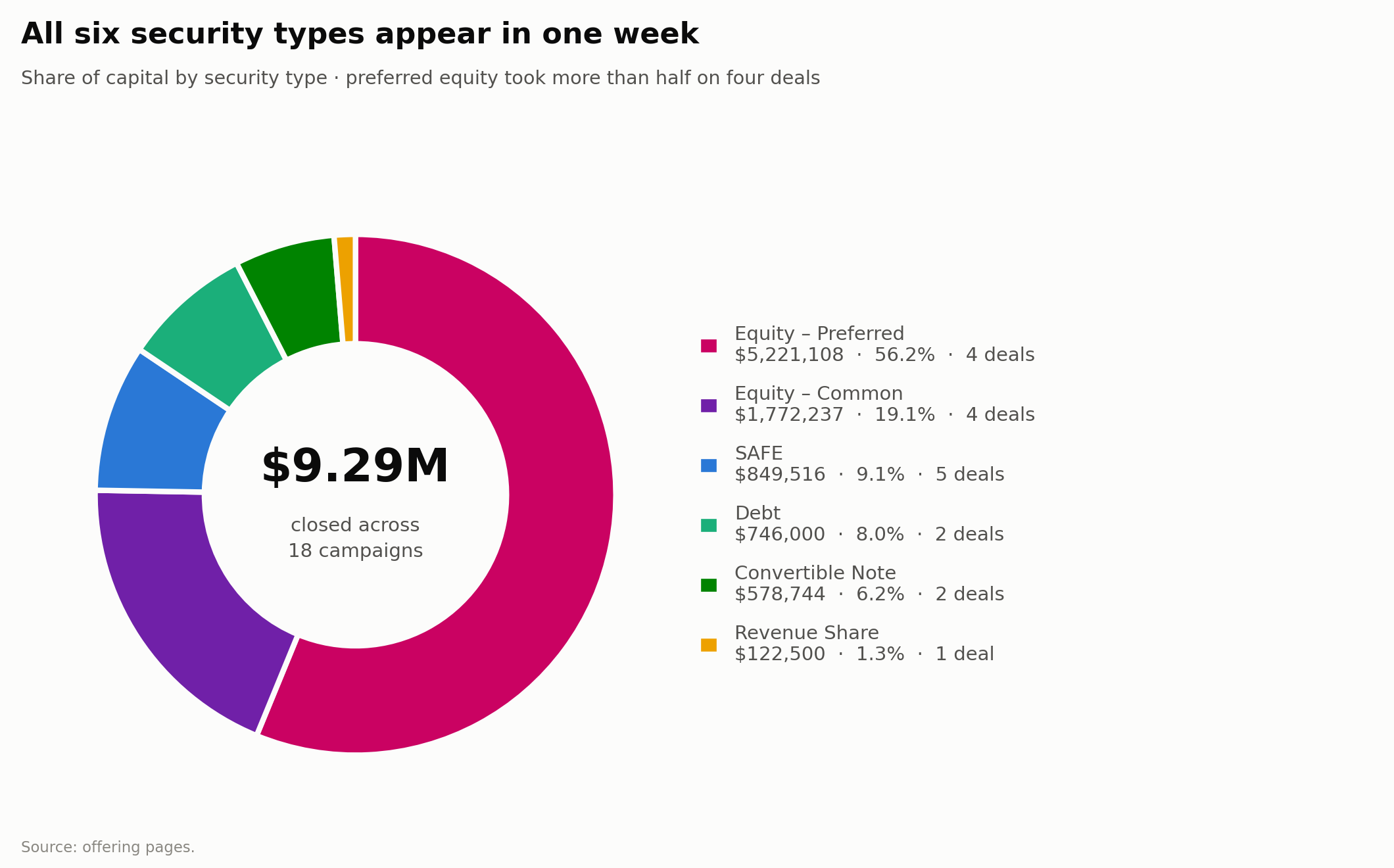
By dollars, preferred equity dominates. By deal count, SAFEs lead with five. And for the first time in this series, every structure the market offers appeared in the same seven days.
Preferred equity: this week’s story
Four preferred deals took 56.2% of the capital, and two of them — Koios and Oxeia — are the largest raises of the week. That is not coincidence. Preferred equity typically carries a liquidation preference, placing retail investors ahead of common holders in a downside scenario, and sometimes anti-dilution protection.
For a company facing a long, binary, capital-intensive road — FDA pathways, Phase 2b enrollment, clinical validation — that protection is not decorative. It is a direct response to the shape of the risk. An investor in a preclinical or clinical-stage company is accepting a genuinely wide distribution of outcomes. Preferred narrows the downside tail.
The costs are cognitive load and founder flexibility. Preferred requires explaining a capital stack to people who have never seen one, and it constrains what a founder can later offer an institutional lead who wants the senior position. Both Koios and Oxeia appear to have judged that trade worth making — and the market agreed, emphatically.
Best suited to: capital-intensive, regulated, long-horizon businesses where downside protection is a substantive part of the pitch.
Common equity: simple, and structurally the weakest seat
Four common-equity deals took 19.1%. Common stock gives retail investors the same class the founders hold. Its virtue is that it needs no explanation — no valuation cap, no conversion mechanics, no liquidation waterfall. For a campaign converting a first-time investor in a single reading, that clarity is a conversion asset.
Its cost is position. Common sits behind every preference in a liquidation and absorbs dilution from every subsequent priced round. Greenville Pro Soccer’s investors are buying common at a $45 million valuation; Cleveland Whiskey’s at $43.2 million. Those may prove justified. They should be examined rather than assumed.
Common works best when the crowd is genuinely a stakeholder crowd and when a complex preferred stack is unlikely — which describes a soccer club far better than it describes a biotech.
SAFEs: most-used by count, smallest by dollars
Five SAFEs closed $849,516 between them — an average of $169,903. The SAFE remains founder-beloved for good reason: no interest, no maturity, no immediate valuation negotiation, minimal legal cost, no governance transferred.
It also remains, in my view, the instrument most likely to disappoint retail investors over the next five years — not because it is unfair, but because it is misunderstood. A SAFE is not equity. It is a contractual right to equity upon a triggering event. If no qualifying priced round or liquidity event ever occurs, a SAFE can sit indefinitely: converting nothing, owing nothing, worth nothing. Many retail investors believe they have bought shares.
For Surge, deploying infrastructure with a projected path to $70 million in annual revenue at full deployment, a SAFE is well-matched to a company likely to raise institutionally. For a semi-professional football franchise, the triggering event is harder to picture. Both used one.
Best suited to: early-stage companies with a credible line of sight to a priced round. Poorly suited to: businesses that will grow profitably without ever raising institutional capital.
Debt: the instrument that finishes
Two debt deals, both on Climatize, both effectively at target. Debt makes a dated, arithmetic promise: principal plus interest, on a schedule. The investor knows what success looks like and when it arrives — no decade-long wait for an exit that statistically may not come.
The point founders routinely miss: debt does not dilute you at all. A business or project with predictable cash flow that sells equity has permanently given away a share of something that may outlive the founder. One that borrows pays a defined price and keeps everything.
Convertible notes: back, after a long absence
Two convertible notes closed $578,744 — Barricade Therapeutics at $513,793 and Nuudii System at $64,951. This instrument had been essentially absent from impact Reg CF for a long stretch, and its return in two very different companies is worth noting.
A note differs from a SAFE in two ways that matter: it accrues interest, and it has a maturity date. Those features are precisely what make it awkward with a retail crowd — at maturity the issuer must convert, repay, or renegotiate with thousands of small holders who cannot practically be convened. But for an issuer that wants to compensate investors for time rather than leaving them in open-ended limbo, the note is the more honest instrument. Interest accrual is, functionally, an acknowledgment that the investor’s money has a cost.
I would not be surprised to see notes continue recovering share, particularly among issuers whose investors have grown skeptical of SAFEs that never convert.
Revenue share: one deal, and the right one
The Redbud Group’s $122,500 was the week’s only revenue share — and it closed at 98.8% of its stated maximum, the second-highest completion ratio in the cohort.
Revenue share pays investors a percentage of top-line revenue until a defined multiple is returned. For a residential developer that has already built and sold five homes for profit with two more under contract, this is structurally correct in a way equity is not. There are real cash flows, on a real schedule, with no acquirer required. The investor gets paid as homes sell.
Best suited to: project-based ventures, margin-carrying consumer brands, and mission-driven companies that intend to stay independent.
The alignment question
Your instrument is a statement about the relationship you want for the next decade.
Debt: I will pay you back on a schedule, and then we are square.
Revenue share: We share upside as it arrives, and you don’t need me to sell.
Convertible note: Trust me through an event that hasn’t happened — but the clock is running and interest accrues.
SAFE: Trust me through an event that hasn’t happened yet.
Common equity: Same boat, including the part where the boat takes fifteen years.
Preferred: You are ahead of me if this goes badly.
The most common founder error in Reg CF is choosing the instrument that is cheapest to issue rather than the one that matches the company’s actual cash-flow shape.
The Completion Ratio: Two Campaigns Broke the Ceiling
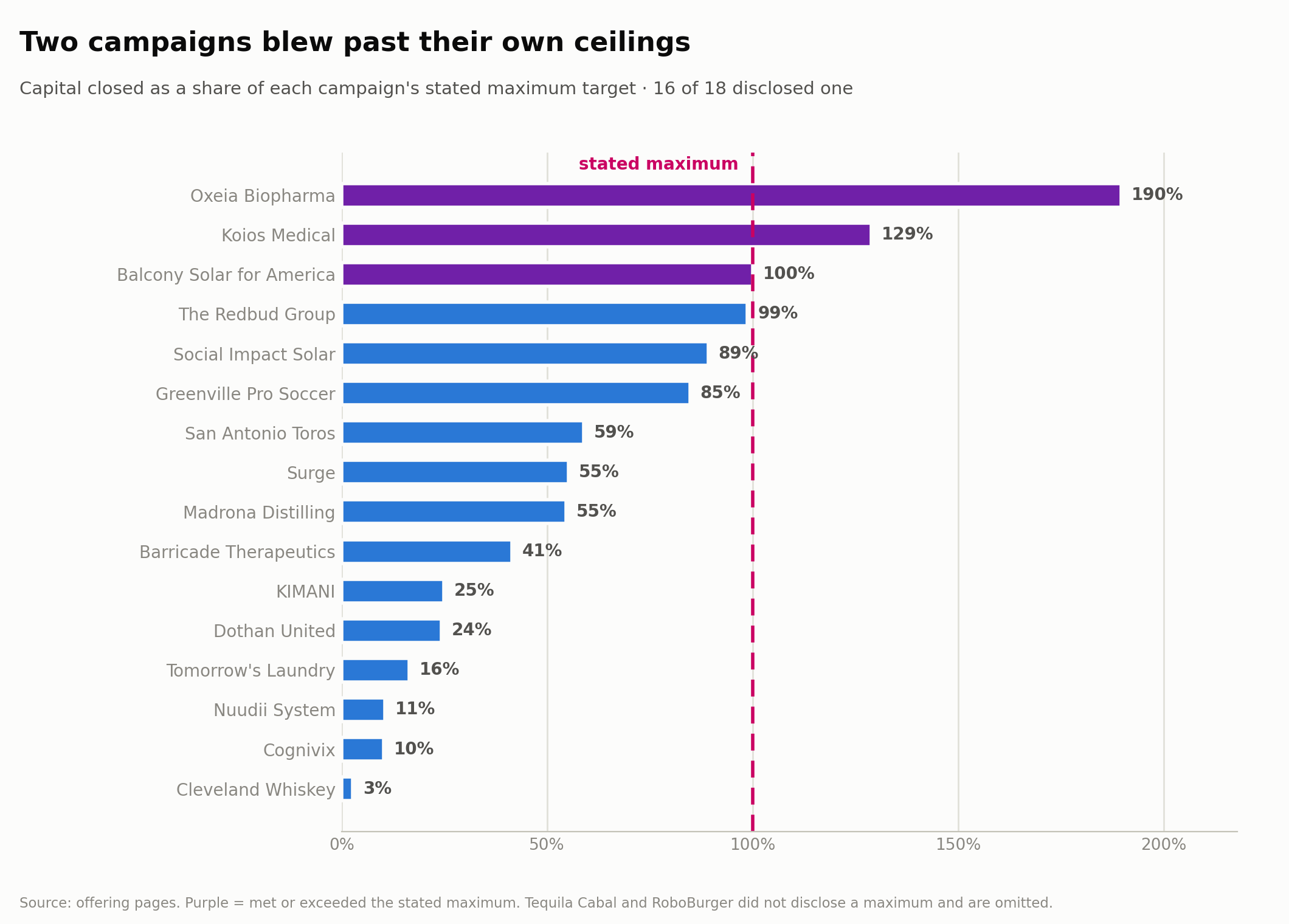
Tequila Cabal and RoboBurger did not disclose maximum targets and are omitted.
Every Reg CF campaign publishes two numbers most readers skip: a minimum target and a maximum target. Measuring what closed against the issuer's own stated maximum is more diagnostic than any raw dollar figure, because it judges a campaign against its own stated ambition rather than against unrelated companies.
Two campaigns exceeded their own stated maximums — the first time this has happened in the series. Oxeia Biopharma closed at 190% of a $1.23 million maximum; Koios Medical at 129% of a $2 million maximum.
This is worth explaining, because it looks like an error and isn’t. Under Reg CF an issuer may accept oversubscription above its stated maximum, provided the offering materials disclose that possibility and the total stays within the $5 million twelve-month statutory cap. Both companies did exactly that. Oxeia accepted roughly $1.1 million more than it said it would seek; Koios roughly $578,000 more.
What that tells you is demand exceeded expectation by a wide margin — which, for a retail investor, is a genuinely positive signal about how the campaign was received. It is also a reminder that a stated maximum is a planning number, not a legal ceiling.
And at the other end
Cleveland Whiskey closed 2.7% of its stated maximum. The company is not weak: sixteen years old, more than a million bottles sold, 3,100 retail outlets in twenty states, a 512% valuation increase since 2016. But it set a $4.6 million maximum — nearly the full statutory ceiling — and displayed a progress bar sitting near zero for the campaign’s entire life.
Crowdfunding conversion is powerfully social. A page showing 90% funded creates urgency and validation. A page showing 3% creates hesitation, regardless of the company behind it. Had Cleveland Whiskey stated a $250,000 maximum, the identical $124,560 would have displayed as 50% funded, and social proof would have worked for the campaign rather than against it. In my estimation the capital raised would have been higher, not lower.
The same arithmetic applies to Cognivix (10%), Nuudii System (11%) and Tomorrow’s Laundry (16%) — all companies with real traction and maximums far above what their campaigns could realistically deliver.
Practical guidance
Set the minimum where failure is near-impossible. It is a failure threshold, not a goal. Oxeia’s $19,999.64 minimum meant the raise could not fail; its $1.23 million maximum turned out to be conservative. That is exactly the right asymmetry.
Set the maximum at roughly 1.5x what you honestly expect — enough headroom for a strong finish, close enough that the progress bar works for you. And disclose the oversubscription provision so you can accept more if demand surprises you, as Oxeia and Koios did.
Copy the project-finance discipline. Climatize’s deals succeed partly because the maximum is the capital requirement. When your ask equals a real number tied to a real use, investors can tell.
Minimum Investment Analysis: From $10 to $2,500
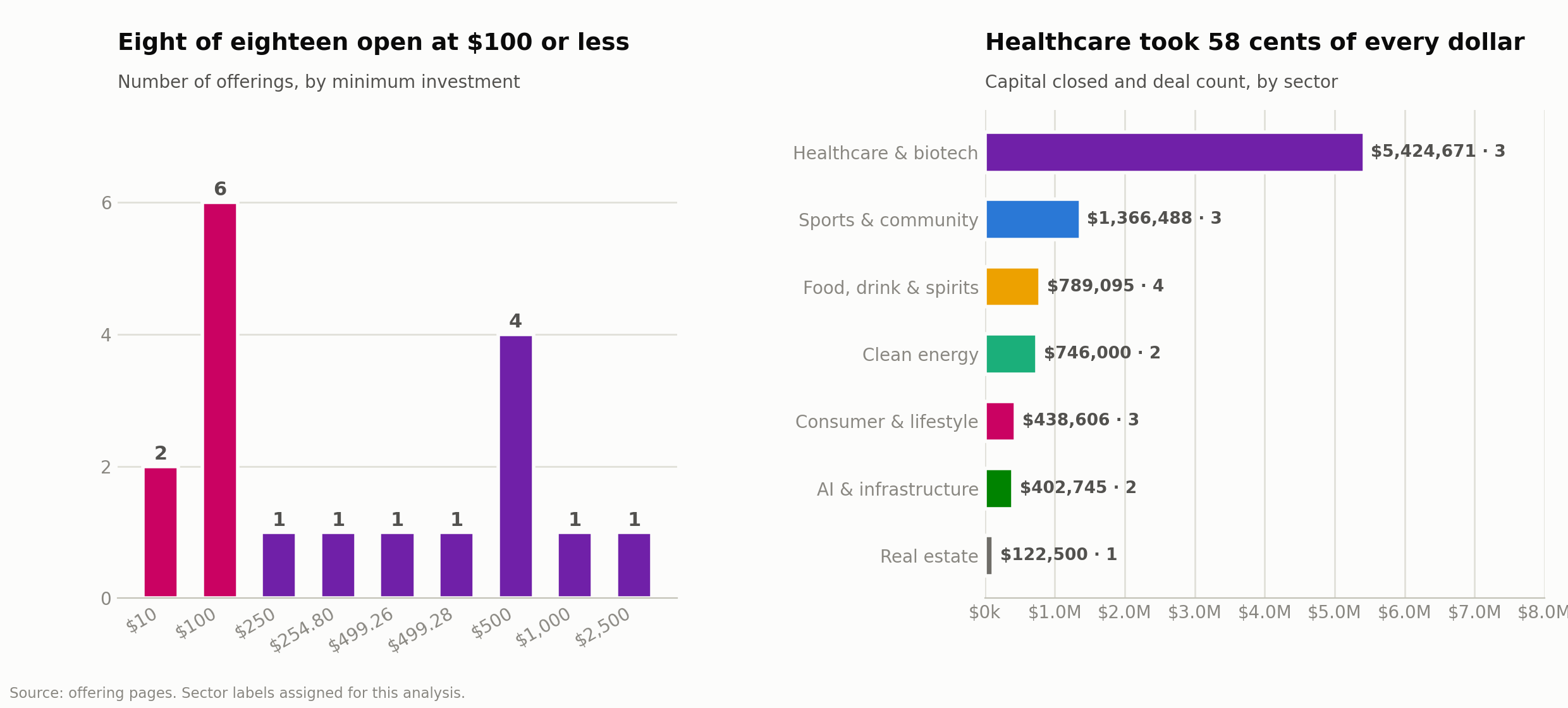
Eight of eighteen opened at $100 or less. The median minimum was $252.40. And the range — $10 to $2,500, a 250x spread — is the widest this series has recorded.
The odd-looking figures ($254.80, $499.26, $499.28) are share-price arithmetic: a round share count at a specific per-share price produces an unround dollar minimum. It is a small tell that the issuer priced shares first and derived the minimum second.
The Greenville counter-example
Here is where this week complicates the conventional wisdom. The standard argument for low minimums is strong and I have made it repeatedly: in Reg CF your investors are frequently your customers, your advocates or your neighbours, so optimize for count rather than check size. Every barrier subtracts advocates.
Greenville Pro Soccer set a $2,500 minimum and closed $1,050,802 — 85% of its maximum, the third-largest raise of the week.
That should not work under the low-minimum thesis, and it worked anyway. Why?
Because the thesis is really about matching the entry price to the motivation. A $100 minimum converts a mildly interested browser. A $2,500 minimum converts someone who already owns a scarf. Greenville Pro Soccer is the parent of the Greenville Triumph and the Greenville Liberty, building its own stadium, with Ronaldinho in the ownership group and a youth-to-professional pathway embedded in the community. Its buyers are not browsers. They are people for whom the club is already part of their identity.
Dothan United tells the same story at smaller scale: a $1,000 minimum, a USL League Two club known locally as The Dragons, $242,570 closed.
The lesson is not “high minimums work.” It is that minimum investment should be set from audience motivation, not from a benchmark. If your investors need persuading, go low. If they are already committed, a higher minimum concentrates your cap table without costing you conversions — and saves you the administrative burden of thousands of small holders.
What thresholds actually work
$10 for community infrastructure, where broad participation is itself an objective. Climatize’s results keep validating the choice.
$100 for consumer-facing and community-anchored companies whose investors are their customers. Six campaigns used it this week, including Madrona Distilling, Nuudii System and Tomorrow’s Laundry — all brands with existing customer bases.
$250–$500 for technical and capital-intensive companies — high enough to filter for deliberateness, low enough to stay genuinely open. Nine of eighteen campaigns landed in this band.
$1,000+ only when identity does the converting — civic institutions, fan-owned ventures, or raises complementing an institutional round.
For investors: a low minimum is a feature of the offering, not a measure of the opportunity. Accessibility and quality are independent variables.
Founder and Investor Psychology: Why Some Campaigns Compound
Strip these eighteen campaigns down and the ones that performed above the cohort median share five ingredients.
1. A one-sentence problem. Concussions have no approved treatment. Radiologists need faster, more accurate ultrasound reads. Renters can’t install rooftop solar. If the problem takes a paragraph, it will not travel.
2. Transferred credibility. Retail investors cannot perform technical diligence, so they perform institutional diligence by proxy. Oxeia’s Phase 2a trial at the University of Kansas Medical Center with an 85% responder rate. Barricade’s funding from the Cancer Prevention & Research Institute of Texas and support from the American Cancer Society. Koios’s FDA clearance, CE mark, reimbursement eligibility and Newsweek “World’s Best Digital Health Company” designation. These are not decorations — they are the mechanism by which a non-expert reaches a decision.
3. Traction in units, not adjectives. Nuudii System: 100,000 customers in 40 countries, $14 million lifetime sales, 75% gross margins. Tomorrow’s Laundry: 11,500 customers, 50% repeat purchase rate, 4.9 stars, $4 million lifetime revenue, profitable in 2025. Cleveland Whiskey: a million bottles, 3,100 outlets, 20 states. Numbers do work adjectives cannot.
4. A founder whose biography explains the company. Tom Lix has run Cleveland Whiskey since 2009. Chad McClennan founded Koios in 2011 — fifteen years of work behind an overnight-looking result. Annette Azan built Nuudii from a problem she experienced personally. Biography is the cheapest durable credibility a founder has.
5. A pre-existing community. The least glamorous finding and the most important. Every campaign that closed near or above its ceiling brought its own crowd.
Why retail investors behave differently from institutions
Institutions are compensated for returns. Retail impact investors are buying a bundle: a financial position, an identity statement, a membership, and a piece of a future they want to exist. That bundle explains behavior that looks irrational under a pure-returns model — paying $2,500 to own a sliver of a soccer club, lending $10 to a balcony solar program, backing a preclinical oncology company with a single asset.
None of it is naive. It is a different objective function. It also means narrative quality is not marketing overhead in Reg CF — it is a substantial component of the product. A founder who treats the campaign page as a compliance document has misunderstood the instrument.
Featured on Superpowers for Good: Surge and the Privacy-First City
Surge closed $276,102 against a $500,000 maximum — 55% of its ceiling, placing it in the upper-middle of this cohort's completion ratios and comfortably above the median. For a pre-revenue infrastructure company at an $8.5 million valuation using a SAFE with a $250 minimum, that is a solid, unglamorous result: proportionate ask, proportionate outcome.
Deeper Looks: Four Campaigns Worth Studying
Koios Medical — fifteen years, then the largest raise of the week
Koios closed $2,577,724, 129% of its stated maximum. The pitch is AI-powered ultrasound analysis for thyroid and breast imaging, with auto-generated reports — and the credentials are unusually complete for a Reg CF issuer: FDA clearance, CE mark, reimbursement eligibility, and Newsweek’s “World’s Best Digital Health Company” designation.
Chad McClennan founded the company in April 2011. That is fifteen years of work behind a result that reads like a sudden success. The $90 million valuation is the highest in the cohort, and it will invite scrutiny — but the regulatory clearances are the kind of validation retail investors can evaluate without a biology degree, and the oversubscription suggests they did.
The lesson: clear your regulatory hurdles before you ask the crowd. The cost of explaining a pre-clearance company to retail is enormous; the cost of explaining a cleared one is almost nil.
Oxeia Biopharma — the week’s biggest surprise
Oxeia closed $2,333,154, or 190% of its stated maximum — the largest overshoot in this series. OXE103 is a first-in-class ghrelin therapy aimed at delivering therapeutic doses immediately post-concussion, with an 85% responder rate reported from a Phase 2a trial at the University of Kansas Medical Center and Phase 2b enrollment of 160 patients planned for 2026.
Why did this resonate so far beyond expectation? Three reasons, I think. Concussion is a problem nearly every American family has encountered through sport. There is no approved pharmacological treatment, so the white space is obvious to a non-expert. And the Phase 2a data point is a single, memorable, verifiable number.
The $50 million valuation on a clinical-stage asset is aggressive, and investors should underwrite it rather than assume it. But the campaign’s reception was unambiguous.
The lesson: a problem your audience has personally experienced converts at a rate that no amount of market-size analysis can replicate.
Greenville Pro Soccer — the $2,500 door that opened
Already discussed, but worth isolating: a $2,500 minimum — 25x the cohort’s most common threshold — producing $1,050,802 at 85% of maximum.
Greenville Pro Soccer connects youth participation, community engagement and professional play across South Carolina’s Upstate, is building its own stadium, and counts Ronaldinho among its owners. Joe Erwin founded it in 2018.
The lesson: when identity does the converting, price the entry for the people who already belong — not for the people you hope to recruit.
The Redbud Group — the quiet near-perfect close
$122,500 against a $124,000 maximum: 98.8%. A Charlotte, North Carolina residential developer building through Broadtail Homes, with five homes already built and sold for profit and two more under contract.
This raise will generate no headlines and it is, on a risk-adjusted basis, among the most sensible outcomes in the cohort. Revenue share matched to a business with real, dated cash flows. A maximum sized to what the campaign could actually deliver. A founder operating since 2013 with a demonstrated track record of completed transactions.
The lesson: right-sized asks finish. This is the single most repeatable finding across every week of this analysis.
Impact Investing Through Reg CF: Where the Money Went
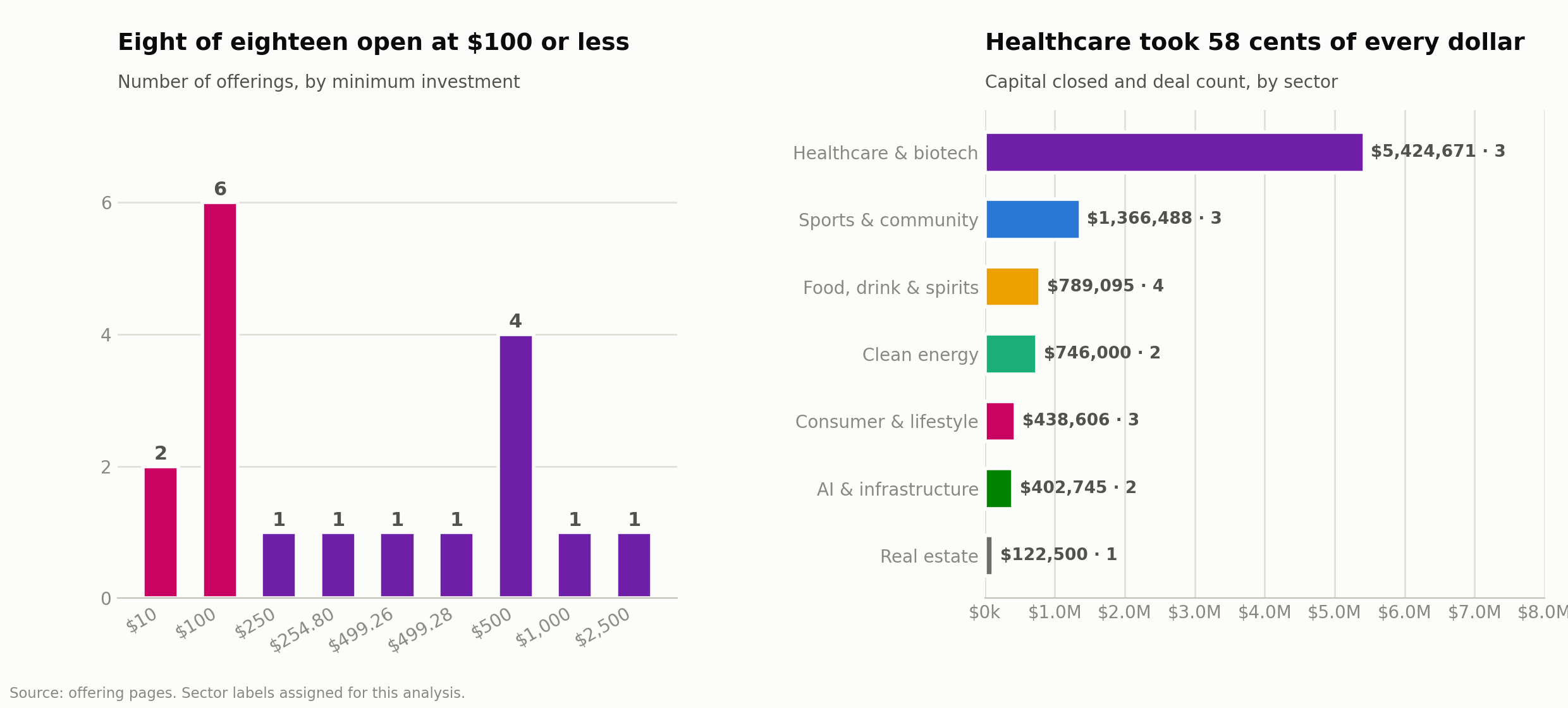
Healthcare took 58 cents of every dollar on three deals. That concentration is the headline, but three other movements matter more for where this market is going.
Healthcare is Reg CF’s highest-conviction category
Three healthcare deals averaged $1,808,224 — more than seven times the cohort median. No other sector came close.
Retail investors fund healthcare with a conviction they bring to almost nothing else, and the reason is structural: health problems are universally legible. You do not need to understand ghrelin pharmacology to understand that concussions have no treatment. You do not need to read a radiology journal to understand that faster, more accurate cancer detection is valuable. The impact case and the commercial case are the same sentence.
Sports is emerging as a serious impact category
Three sports deals closed $1,366,488 — second only to healthcare. Greenville, Dothan United and the San Antonio Toros are all community-ownership plays in professional or semi-professional soccer and football.
I think this is the most underrated trend in this dataset. A community-owned sports club is a near-perfect Reg CF product: the audience is pre-assembled, geographically concentrated, emotionally invested and already accustomed to paying for membership. The impact claims — youth pathways, local hotel and restaurant spending, civic identity — are real, local and verifiable by the investors themselves.
Expect platforms to build for this. Vicinity already has.
Climate has become project finance
Both clean-energy deals were project debt rather than company equity: a balcony solar inventory program and a 45 MWac landfill solar project. Neither is a technology bet; both are financing bets on assets with defined economics.
This is a maturation signal. Early climate crowdfunding sold technology futures. This sells kilowatt-hours with contracts behind them.
AI shows up as infrastructure, not applications
Surge and Cognivix closed $402,745 between them — both building physical or industrial infrastructure rather than consumer AI applications. Cognivix turns industrial robot arms into no-code automation cells that learn from a single demonstration; Surge deploys privacy-first urban sensing.
The pattern across recent weeks is consistent: retail capital is flowing to AI’s physical layer, not its software layer. That may reflect differentiation — there are too many AI applications to choose between, and comparatively few companies building the sensing, robotics and compute substrate underneath.
Five predictions
These are analytical views, not forecasts to trade on.
1. Community sports ownership becomes a named category. Three deals in one week is not noise. The product-market fit between civic identity and retail securities is unusually clean, and the higher minimums these raises support make them economically attractive for platforms.
2. Preferred equity gains share in clinical and regulated sectors. This week demonstrated that retail investors will fund preferred structures at scale when the risk profile justifies them. Expect more biotech and medtech issuers to offer downside protection rather than common.
3. Convertible notes continue recovering. As early SAFEs age without converting, the note’s interest accrual and maturity date start looking like features rather than friction.
4. Project finance remains the highest-completion segment. Climatize’s consistency across weeks is structural, not lucky. More platforms will move toward project-level rather than company-level offerings.
5. Ask-sizing becomes a taught discipline. Cleveland Whiskey at 3% and Oxeia at 190% are the same lesson from opposite directions. The completion-ratio data is too consistent for platforms to keep ignoring it.

Broader Market Trends for 2026
Retail investors are maturing, unevenly
The 2026 retail investor is different from the 2021 version. Many have now held a Reg CF position for four or five years and learned experientially that liquidity is scarce, updates go quiet, and a SAFE can sit indefinitely. That produces more discriminating behavior at the top of the market — more attention to instruments, more questions about exit paths, more scrutiny of valuation.
The preferred-equity dominance in this week’s data is, I suspect, partly a reflection of that maturity. Investors who have been burned by unconverted SAFEs read a liquidation preference differently than they did five years ago.
But maturity is unevenly distributed, and a $10 minimum guarantees a permanent inflow of first-time investors who have never read a cap table. Both things are true at once, and platforms remain under-invested in the education layer that would reconcile them.
AI is quietly changing due diligence on both sides
Retail investors now have analytical capability that was recently institutional-only. An individual can pull an issuer’s Form C from SEC EDGAR, extract the financials, benchmark a valuation against comparables, summarize risk factors and check founders’ claimed history — in minutes, at effectively zero cost.
Three consequences seem likely.
Valuation discipline tightens. When anyone can benchmark a $90 million or $50 million pre-money in seconds, aggressive valuations get harder to sustain. Several in this cohort will invite that scrutiny.
Disclosure quality becomes competitive advantage. Issuers whose Form C is thorough and whose numbers reconcile will benefit. Issuers relying on enthusiasm to outrun scrutiny will find it harder.
Founders get better prepared. The same tools help founders model dilution, stress-test claims and anticipate objections — narrowing the gap between well-advised and unadvised issuers.
The caution: AI analysis is only as good as the disclosure it consumes, and Reg CF disclosure is thin by design. A confident machine summary of a sparse Form C is still a summary of a sparse Form C.
Community-driven finance keeps becoming infrastructure
The most durable trend here is neither a sector nor an instrument. It is the steady normalization of the idea that an enterprise can be financed by the people it serves.
A soccer club in Greenville is part-owned by the people in its stands. A landfill in Lexington becomes a solar farm financed partly by people who will live near it. Balcony solar kits reach renters through capital provided in $10 increments. A gin distillery in Redmond is backed by people who drink its gin.
None of these required a venture capitalist, a bank committee or an exit. That is a parallel financing system for the enormous category of enterprises that are economically viable, socially valuable and permanently uninteresting to institutional capital. Reg CF’s most important long-run contribution may have very little to do with startups.
Actionable Takeaways
For founders
Match the instrument to your cash-flow shape, not to what’s cheapest to issue. If you’ll never raise a priced round, don’t issue a SAFE. If you have revenue on a schedule, price revenue share or debt before selling equity you can never buy back.
Right-size your maximum, and disclose oversubscription. Oxeia’s conservative maximum plus an oversubscription provision let it accept 190%. Cleveland Whiskey’s $4.6M maximum guaranteed a discouraging progress bar. The first design has no downside; the second has no upside.
Set the minimum where failure is impossible. It is a threshold, not an aspiration.
Price the entry door for your actual audience. $100 if they need persuading. $2,500 if they already own the scarf.
Clear your credentials before you ask the crowd. FDA clearance, a state cancer-institute grant, a utility award. Retail investors evaluate your validators when they cannot evaluate your technology.
Bring your own crowd. Every near-ceiling close in this cohort did.
Plan campaign one as the list-building exercise for campaign two. The compounding is the clearest path to a larger raise.
For investors
Read “closed” correctly. A campaign that closed at $2.6 million last week did not raise $2.6 million last week. Check the open date before inferring momentum.
Know what you are buying. A SAFE is not stock. A note accrues interest and matures. Common sits behind preferred. These determine whether and when you are paid.
Compute the completion ratio yourself — closed versus stated maximum, straight from the offering page. It tells you how the market received the deal.
Treat oversubscription as a signal, not a guarantee. Oxeia’s 190% says demand was strong. It says nothing about whether OXE103 clears Phase 2b.
Underwrite the valuation, not the story. This cohort includes $90 million, $50 million, $45 million and $43.2 million valuations at pre-revenue or early-revenue stages. Those may prove justified. They should be examined.
Ask what “impact” means in each specific deal. A concussion therapy, a soccer club and a tequila brand are all in this week’s impact screen. Decide your own definition rather than accepting a label.
Size positions to the risk. A $10 minimum makes participation possible, not concentration wise. Early-stage private companies fail at high rates and Reg CF positions are generally illiquid.
The Full Cohort
*Total closed is the cumulative amount each campaign had committed at the moment it closed — not the amount raised during the past week. Many of these campaigns were open for months.
A Closing Thought
The most striking thing about this cohort is not the $9.29 million. It is that a single week contained an FDA-cleared AI radiology platform, a concussion therapy heading into Phase 2b, a preclinical colorectal cancer drug, two professional soccer clubs, a semi-pro football franchise, a 45-megawatt solar project on a closed landfill, balcony solar kits for renters, privacy-first urban sensors, no-code industrial robotics, a tequila brand, a whiskey distillery, a craft gin maker, a burger robot, a men’s t-shirt company, a boobwear brand, a luxury travel club and a Charlotte homebuilder.
No institutional allocator on earth has a mandate broad enough to have funded that list. It exists because Regulation Crowdfunding does not require one. It requires only that enough individual people — sometimes at ten dollars, sometimes at twenty-five hundred — agree that a thing should exist.
Three campaigns wrote the headline. The other fifteen wrote the story.
Superpowers for Good should not be considered investment advice. This analysis is educational and reflects the author’s opinions about market structure and trends. All investing carries risk, and early-stage private companies fail at high rates. Seek professional counsel before making investment decisions.
SuperCrowd Career Path Job Postings
Environmental Initiatives Lead, Sustainability — Google · Chicago, IL · $188,000–$274,000/yr
Senior Associate/Manager, Sustainability and Impact — Bain Capital · Boston, MA · Remote OK · $130,000–$160,000/yr
Associate, Investment Operations — ImpactAssets · United States · Remote OK · $75,000–$83,000/yr
WM Global Investment Office - Institutional Innovation Lead, Investing with Impact / Impact Private Markets, Executive Director — Morgan Stanley · New York, NY · $175,000–$265,000/yr
Managing Director, WWF Impact — World Wildlife Fund · Washington, DC · $181,000–$260,200/yr
Certified Diabetes Care and Education Specialist (CDCES), Registered Dietitian — My Diabetes Tutor - Diabetes Education Telehealth · United States · Remote OK · $45.00–$48.00/hr
Operations & Impact Analyst (AI-Native) — Hedge Impact headhunting · Palo Alto, CA · $140–$160/yr
Affordable Housing Finance Product Manager - Executive Director — Morgan Stanley · New York, NY · $150,000–$250,000/yr
Community Development Investment Director — Fifth Third Bank · Dallas, TX · $96,500–$207,500/yr
Director of Grants & Impact Investments JN -082026-180502 — Goodwin Recruiting · St Louis, MO · $165,000–$190,000/yr
Principal, Social Impact Funds — American Heart Association · Dallas, TX · Remote OK · $86,900–$115,000/yr
Investment Associate - Technology & Media — Cerity Partners · San Francisco, CA · Remote OK · $100,000–$115,000/yr
Support Our Sponsors
Our generous sponsors make our work possible, serving impact investors, social entrepreneurs, community builders and diverse founders. Today’s advertisers include SuperGreen Live and Membership. Learn more about advertising with us here.
Max-Impact Members
(We’re grateful for every one of these community champions who make this work possible.)
Alisa Evans, Mission Enrollment | Brian Christie, Brainsy | Cameron Neil, Lend For Good | Carol Fineagan, Independent Consultant | Eric Coury, Arthia AI | Joey Hayes, thru | John Berlet, CORE Tax Deeds, LLC. | Justin Starbird, The Aebli Group | Ken Steele, Rotarian | Lory Moore, Lory Moore Law | Marcia Brinton, High Desert Gear | Mark Grimes, Networked Enterprise Development | Mike Babbit | Coledger Solutions | Mike Green, Envirosult | Nick Degnan, Unlimit Ventures | Paul Lovejoy, Stakeholder Enterprise | Pearl Wright, Global Changemaker | Scott Thorpe, Philanthropist | Sharon Samjitsingh, Health Care Originals
Upcoming SuperCrowd Event Calendar
If a location is not noted, the events below are virtual.
Join the SuperCrowd Impact League! You can be recognized for making impact investments via Reg CF. See how your activity compares to your peers. It’s free. Win valuable prizes. Start now!
SuperCrowd Impact Member Networking Session: Impact (and, of course, Max-Impact) Members of the SuperCrowd are invited to a private networking session on October 13th at 8:00 PM ET/5:00 PM PT. Mark your calendar. We’ll send private emails to Impact Members with registration details. Upgrade to Impact Membership today!
SuperCrowdHour, October 21, 2026, at 9:00 AM Pacific. Devin Thorpe, CEO and Founder of The Super Crowd, Inc., will lead a session on “Before You Click ‘Invest’: Due Diligence for Crowdfunding Investors.” Drawing on his experience as a former investment banker, impact investor, and crowdfunding expert, Devin will explore the key questions investors should ask before putting money into a crowdfunding offering. The session will break down practical due diligence steps, including how to review a company’s financial information, understand its business model, assess risks, evaluate the offering terms, and identify important questions that may not be obvious at first glance. Attendees will learn how to distinguish promising opportunities from potential red flags and develop a more disciplined approach to evaluating impact crowdfunding investments. Whether you’re considering your first crowdfunding investment or already building a portfolio, this SuperCrowdHour will provide practical insights to help you make more informed investment decisions.
SuperGreen Live is where climate solutions meet the capital and community needed to scale them. This global virtual gathering brings together entrepreneurs, investors, sustainability leaders and changemakers to explore practical solutions for building a greener future. Expect inspiring conversations, innovative companies, investment opportunities and actionable ideas—all designed to help turn climate ambition into meaningful progress. Join the growing community working to accelerate solutions for people and the planet on February 4, 2027. Learn more at SuperGreenLive.org.
Visit Our Complete Community Event Calendar
If you would like to submit an event for us to share with the 10,000+ changemakers, investors and entrepreneurs who are members of the SuperCrowd, click here.
We utilized AI to efficiently gather data and analyze key success factors, enabling us to deliver an overview of these successful crowdfunding campaigns.
We share educational information—not investment advice. Some links may generate compensation. See our full disclosure.